
A receding hairline is not always hair loss, and when it is, the earlier you act the more there is to work with. Most men see their hairline settle a little higher after their teens, and that is normal. A receding hairline caused by male pattern hair loss is different: it keeps moving, usually from the temples, and the hairs at the edge grow finer as it goes. This guide explains how to tell the two apart, what the Norwood stages mean in plain English, why a receding hairline in women usually points somewhere else, and what the evidence says about treatment.
The short version
- A hairline that moves once and then stays put is usually maturing. One that keeps moving, or that looks thinner at the edges, deserves attention.4,2
- Male pattern hair loss is the commonest cause and can begin at any time after puberty; an earlier start may mean quicker progression.4
- In women, a receding hairline is not typical of female pattern hair loss. Traction alopecia and frontal fibrosing alopecia need to be ruled out, and both need a doctor.8,11,14
- Nothing restores a hairline where follicles have gone. Medicines slow loss and can thicken what remains, but they only work while you keep using them.6
- PRP is an add-on, not a first-line treatment, and early stages respond best.20,21

Mature hairline vs receding hairline: how to tell the difference
A mature hairline is a small, even rise in the hairline that settles and stays; a receding hairline keeps moving. The difference is mostly one of direction over time. The standard Hamilton-Norwood scale even allows for this: its first type is described as a “normal to slightly recessed” hairline.2 Genuine early male pattern hair loss, by contrast, is a progressive process, and the British Association of Dermatologists (BAD) notes that it can start any time after puberty.4
There is no validated checklist for separating the two on a single look, so what follows are practical rules of thumb rather than trial results. They are the reason we ask for dated photographs.
| What you notice | More likely a mature hairline | More likely a receding hairline |
|---|---|---|
| Movement over time | Rose a little, then stayed put for years | Still moving back; photos from 1 to 2 years ago look different |
| Hairs at the edge | Same thickness as the rest of the scalp | Finer, shorter, paler hairs along the corners |
| Shape | Even and fairly straight across | Deepening at the temples, often one side faster |
| Rest of the scalp | Crown and parting unchanged | Crown thinning or a widening parting as well |
| Family history | None obvious | Close relatives with thinning |
A practical way to find out is to photograph your hairline in the same light, with the hair dry and combed back, every three months. If it has not changed after a year, a mature hairline is the likelier explanation. If it has, or if you are unsure, a doctor can examine the hairs at the edge under magnification.
What causes a receding hairline?
In most men the cause is male pattern hair loss, an inherited sensitivity of hair follicles to the hormone DHT. Follicles in the frontal and crown areas gradually shrink (“miniaturise”), spend less time growing and produce shorter, finer hairs, while follicles at the sides and back are largely spared.4,7 BAD describes the usual pattern as a receding frontal hairline and loss from the top of the head, with the sides and back spared.4
This is the same biology as in our guide to whether PRP works for hair loss. Other things can make a hairline look worse without being pattern loss, including traction from tight hairstyles, scarring conditions and, less often, thyroid problems or low iron. The NHS advises seeing a GP if you are worried about hair loss, ideally before going to a commercial hair clinic, so that the cause is understood first.5 We agree with that advice.
Receding hairline stages: the Norwood scale in plain English
The Norwood-Hamilton scale grades male pattern hair loss from type I (minimal) to type VII (a narrow horseshoe of hair at the sides and back). Norwood published the classification in 1975 using 1,000 white adult men, and noted that hair loss keeps advancing with time even in later years.1 For the hairline, the first four stages matter most.
| Stage | What it looks like | Why it matters |
|---|---|---|
| Type I | Normal to slightly recessed hairline2 | Often a mature hairline; monitor with photos |
| Type II | Slight recession at the front corners (frontotemporal), under about 2 cm2,3 | Could be maturing or the start of loss; the stage where acting early gives most options |
| Type III | Deeper recession at the corners, over about 2 cm, crown unaffected2 | Clearly male pattern hair loss; treatment usually worthwhile |
| Type IV | Recession plus a thinning crown, with a band of hair between them2,3 | More follicles already lost; expectations need to be realistic |
| Types V to VII | The band narrows, then the front and crown merge, leaving a horseshoe of hair2,3 | Medicines may hold what remains; PRP is unlikely to change much |
Stage matters because follicles that have not yet shrunk much are the ones that respond. In the research, men with milder loss (Norwood II to III) did better than those with advanced loss,20 and in a 2025 retrospective cohort of 46 people, photographic improvement was reported in 52%, 46% and 16% of mild, moderate and severe cases respectively.21 That cohort was small and uncontrolled, so treat the percentages as a pattern, not a promise.
Receding hairline in women: what it usually means
A receding hairline in women is less often female pattern hair loss than other conditions, so it deserves a proper diagnosis. BAD says that in female pattern hair loss the hairline at the front of the scalp often remains normal, with thinning over the top and a widened parting instead.8 Reviews agree that the frontal hairline is often spared, although one described pattern involves widening thinning that opens up at the front hairline, and another involves bitemporal recession as seen in men.9 If you are searching “women receding hairline”, the causes below are the ones to separate.
| Cause | Typical clues | Reversible? |
|---|---|---|
| Female pattern hair loss | Widening parting, diffuse thinning on top; front hairline often normal8 | Treatable; minoxidil is first line10 |
| Traction alopecia | Thinning at the margins after tight ponytails, braids, weaves or extensions; a “fringe sign” of short hairs left at the edge14 | Reversible if caught early; scarring if pulling continues14,15 |
| Frontal fibrosing alopecia | Hairline slowly moves back, often with eyebrow loss; fringe sign lost11,14 | Scarring: hair that has gone does not return11 |
Traction alopecia
Traction alopecia comes from sustained pulling. Risk rises with the amount of tension and how long it lasts, and with chemical relaxers; tight buns and ponytails, extensions and tight braids are considered highest risk.14 It is common: one review reports it in about a third of women of African descent who wear such styles for long periods.14 The encouraging part is that it is preventable and, if diagnosed early, can be reversed, but if the styling continues it can progress to irreversible scarring.14,15 The first step is to ease the tension, and a doctor can check whether any scarring has begun.
Frontal fibrosing alopecia
Frontal fibrosing alopecia (FFA) is a scarring condition in which the frontal hairline progressively recedes, often with loss of the eyebrows.11 BAD says it occurs mostly in white postmenopausal women, and that “once a hair has fallen out, it will not re-grow in this area”.11 In a multicentre review of 355 patients (343 women, mean age 61), 37% had severe disease; among 111 treated with finasteride or dutasteride, about half improved and half stabilised, though this was a retrospective review.12 A 2025 update notes that treatment still rests largely on case series, that the aim is to prevent progression, and that early diagnosis is a key target.13
FFA is a dermatology diagnosis, not a PRP indication. We are not aware of controlled evidence that PRP regrows hair in scarring alopecias; published work consists of narrative reviews describing early insights.24 If your hairline is moving back and the skin looks smooth, shiny or inflamed, or your eyebrows are thinning, please see your GP or a dermatologist first. Our menopause hair loss guide covers the diffuse thinning that is more typical at that stage of life.
How to stop a receding hairline: what the evidence supports
No treatment is 100% effective, and none stops a receding hairline for good; the aim is to slow it and keep or thicken the hair you have. The NHS names finasteride and minoxidil as the main treatments for male pattern baldness, says they do not work for everyone and that they only work for as long as they are used.6 BAD says minoxidil needs at least 6 months and possibly up to 12 before any benefit may be noted, and finasteride may need up to 14 months of continuous use.4 Both are prescriber decisions, so speak to your GP or prescriber.
- Finasteride (men only). In two one-year trials of 1,553 men aged 18 to 41, finasteride 1 mg a day gave an average of 107 more hairs than placebo at one year and 138 more at two years, counted in a patch on the crown, while the placebo group kept losing hair.16 Two things to know. Response is better at the crown than at the front hairline,7 and a meta-analysis of 15 placebo-controlled trials found a 1.57-fold higher risk of sexual side effects with the 5-alpha-reductase inhibitors (95% CI 1.19 to 2.08).17 Women should not use it.6
- Minoxidil. The only medicine with a high level of evidence for female pattern hair loss, though about 40% of women do not improve on it.10 BAD advises avoiding it when planning a pregnancy or breastfeeding.8
- Microneedling. In a 100-man pilot, adding weekly microneedling to minoxidil gave a mean change of 91.4 hairs against 22.2 for minoxidil alone at 12 weeks, though the men had loss at the crown rather than the hairline.19 A network meta-analysis of 27 trials ranked minoxidil plus microneedling first.18
- PRP. See the next section.
Where does PRP fit for a receding hairline?
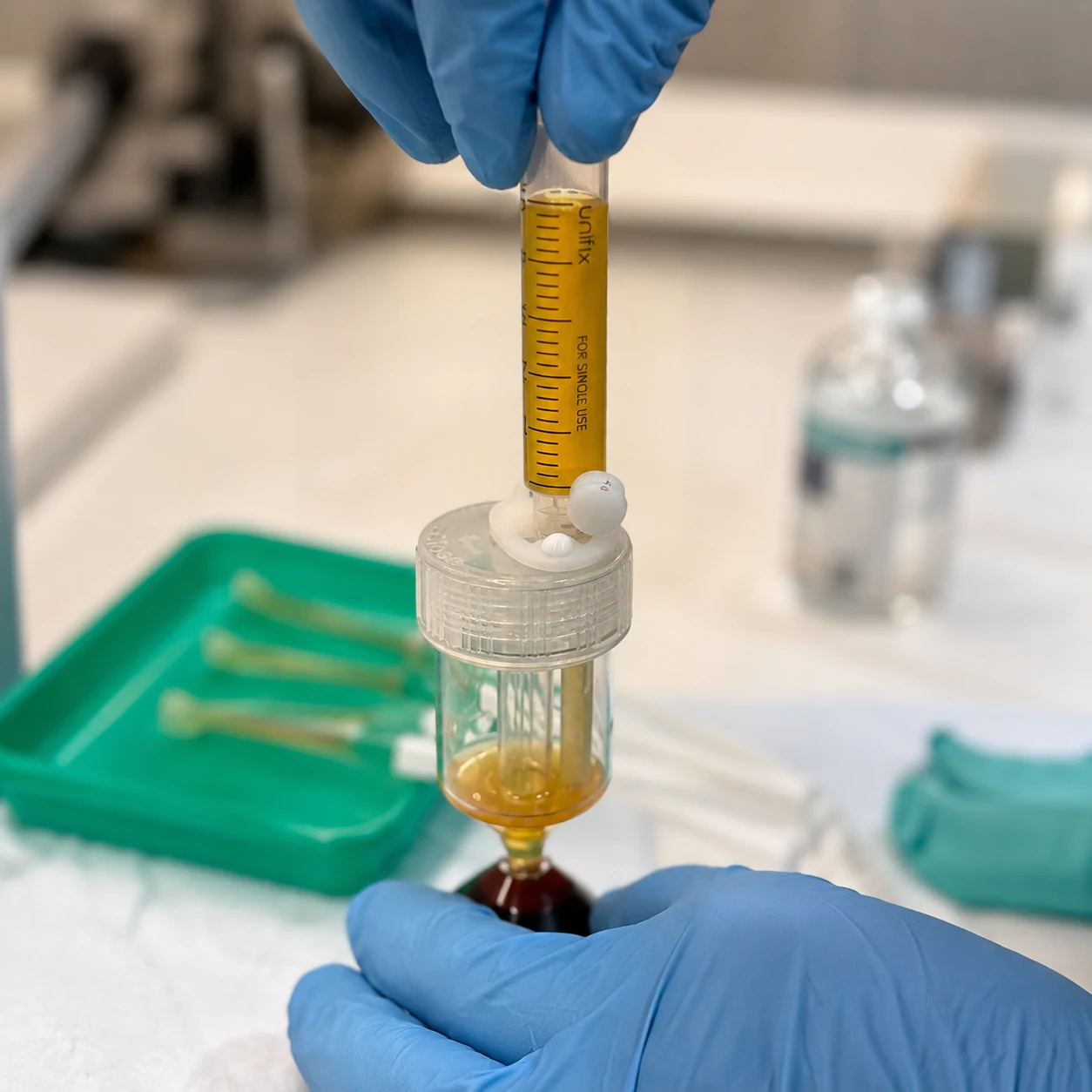
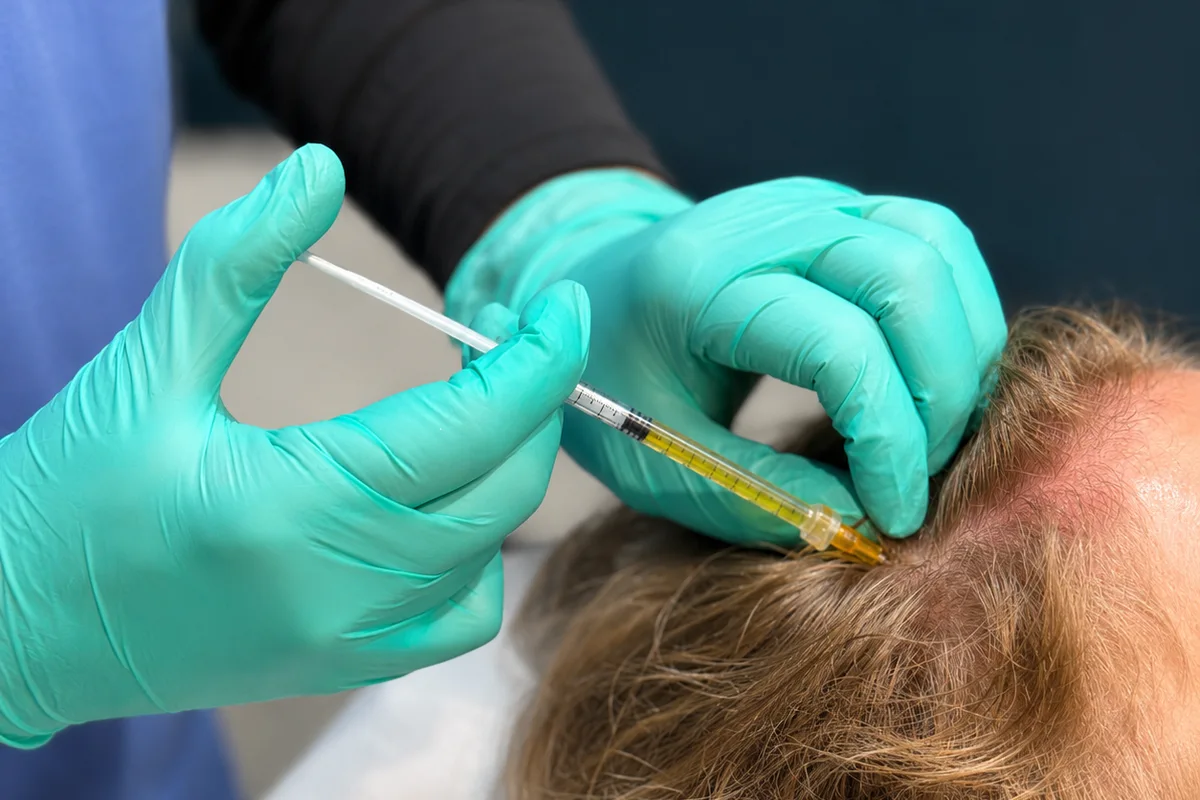
PRP is best seen as an add-on for early to moderate recession, not a replacement for medicines. Our post on PRP for hair loss covers the evidence in detail. In brief: pooled trial data show an average gain in hair density of roughly 20 to 28 hairs per cm² compared with control, rated low certainty, with no clear change in hair thickness.22,23 In the network meta-analysis, PRP alone ranked below minoxidil alone, and minoxidil plus PRP ranked above minoxidil alone.18 One review proposed PRP as a co-adjuvant to medicines because it does not suppress the hormonal component of pattern loss.20
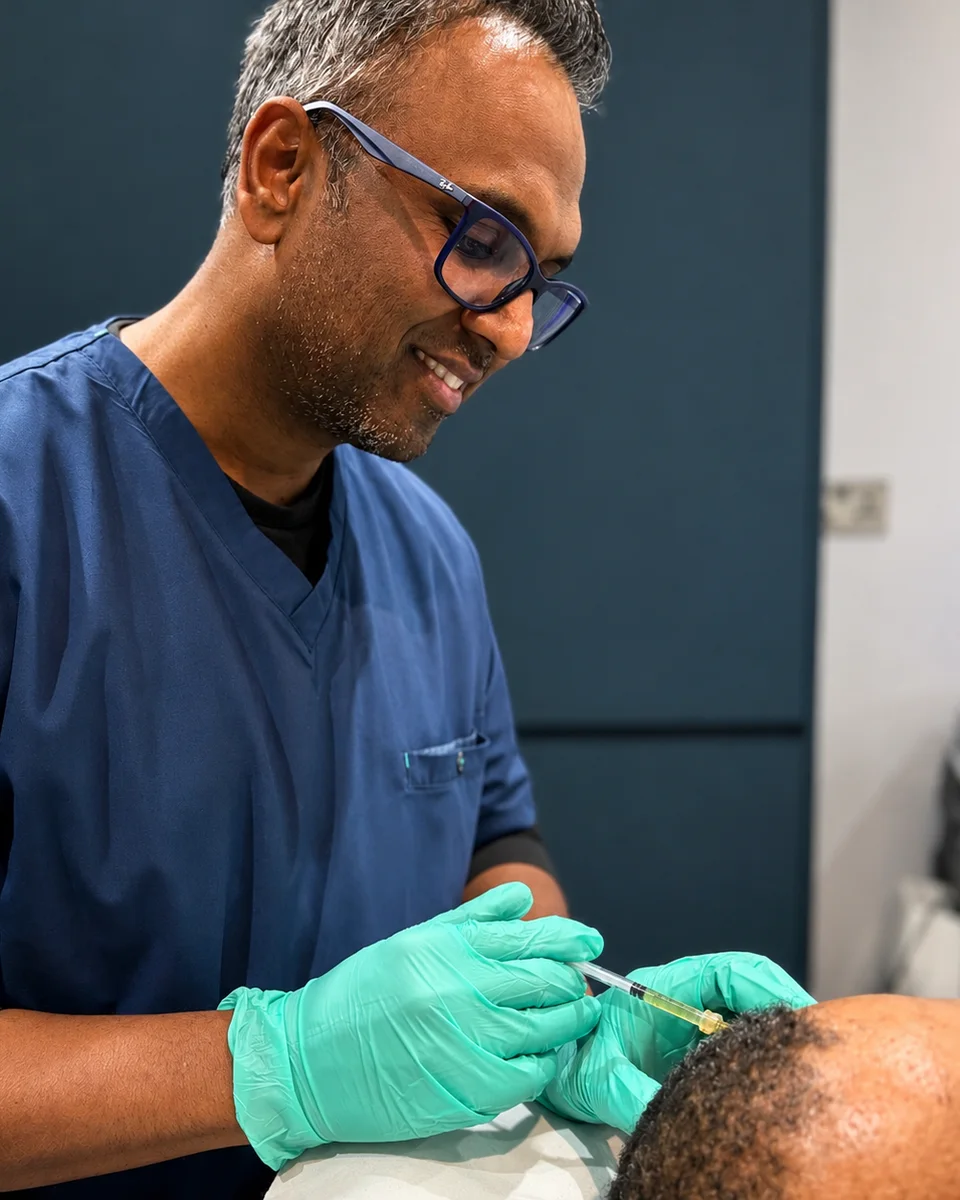
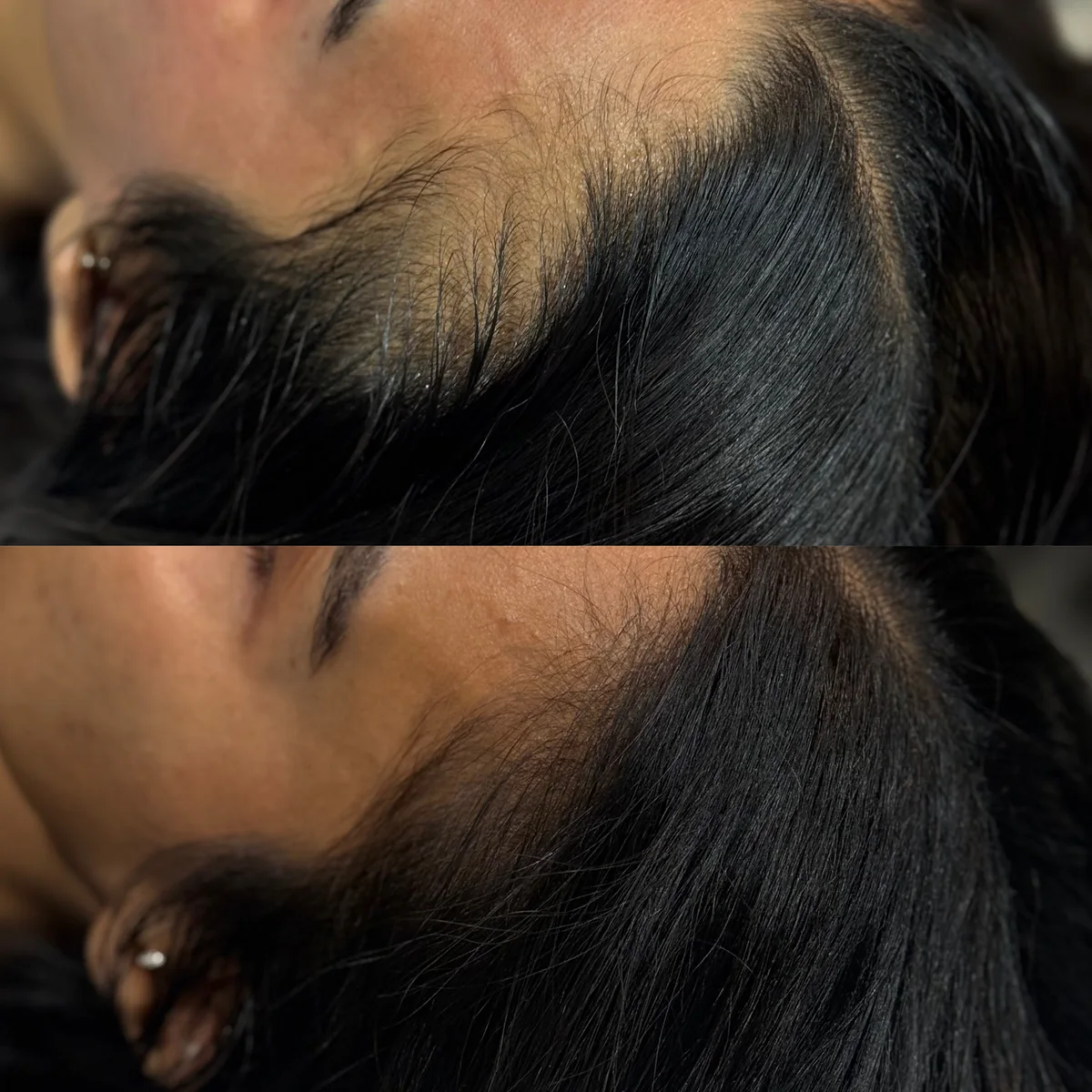
Most of those trials measured the crown or the scalp overall, not the hairline specifically, so we cannot promise the same effect at the temples. What we can say is that PRP acts on follicles that still exist. That is why we treat early recession differently from an established bald temple. At Rejuvena, our PRP hair treatment in Bedford is planned by Dr Nick, sometimes combining PRP with PRF or microneedling depending on the pattern; exosomes are early-evidence only. Results build over several months, gains fade without maintenance, and in the best-known trial some men began losing their gains again 12 to 16 months later.20 Prices are on our pricing page; PRP is not available on the NHS.
PRP may suit you if
- Recession is early (roughly Norwood II to III) and still changing
- Hairs in the thinning area are finer but still present
- You are using, or are willing to use, a prescribed medicine too
- You want to start before more follicles are lost
- You can commit to a course and maintenance
See a doctor first if
- The skin at the hairline is smooth, shiny, red or scaly
- Your eyebrows are thinning as well
- The hairline recedes after years of tight styles
- Hair is falling out suddenly or in round patches
- You have a blood disorder, take anticoagulants, or are pregnant
What can’t be reversed, and where does hair transplant fit?
Temples that have been smooth and bald for years have usually lost their follicles, and no injection or lotion brings them back. At that point the options are camouflage (including wigs, some of which are available on the NHS6) or a hair transplant. A transplant moves hair from the back and sides of the head, which BAD describes as typically more resistant to DHT, to thinning areas; it is not offered on the NHS.4,6 It does not create new hair, so the donor supply sets the limit, and Norwood noted that the success of transplant surgery depends largely on proper patient selection.1
In scarring conditions such as FFA, a 2026 systematic review found only case series and reports (113 patients), with transplants considered in people whose disease was quiet, and a clear fall in graft survival after the second year.25 That is specialist territory. We compare the two routes honestly in PRP vs hair transplant, and the right answer is often medicine and PRP first, surgery later or not at all.
Receding hairline myths: what holds up?
Many popular beliefs about hairlines have little evidence behind them. A review that looked for evidence on 12 common hair loss myths found little to support many of them.26 Taking the ones we hear most:
- “Hats cause a receding hairline.” We searched for evidence and found none showing that ordinary hat-wearing causes pattern hair loss, which is driven by inherited sensitivity to DHT.4,7 Headwear or hairstyles that pull tightly on the hairline are a different matter; that is traction.14
- “Only men get a receding hairline.” Women do too, usually for the reasons in the table above.9,11
- “Once it is working I can stop treatment.” NHS guidance says these treatments only work for as long as they are used.6
- “A transplant gives you new hair.” It relocates existing hair from the donor area.4
How our Hair Growth Potential quiz uses stage
Our Hair Growth Potential check asks you to pick the picture that looks most like your hair. For men the options run from temples starting to recede, through temples clearly receding and temples plus a thinning crown, to front and crown joining; women choose between three parting-width pictures. The quiz weighs stage and how long the change has been going on, because the trials favour early, recent loss. Patchy loss, sudden all-over shedding and smooth shiny skin do not get a score at all; they route you to a doctor, because they are different conditions. It is a guide, not a diagnosis; our hair loss guide covers the options in more depth.
Free 2-minute check
Which stage is your hairline at?
Pick the picture closest to your hair, answer six short questions, and see what the clinical evidence suggests for someone with a similar profile. If your hair loss needs a doctor’s assessment first, we will say so.
Check your hair growth potential →Frequently asked questions
At what age does a hairline normally start to recede?
Male pattern hair loss can begin at any time after puberty, and an earlier start may mean quicker progression.4 A small settling of the hairline in early adulthood is common and is not necessarily hair loss.
Does a receding hairline always lead to baldness?
Not necessarily, and we cannot predict an individual course from one photo. What is known is that male pattern hair loss tends to keep advancing with time,1 which is why dated photographs and an early assessment are more useful than guessing.
Can a receding hairline grow back?
Where follicles are still alive but miniaturised, medicines can thicken the hair and sometimes recover some density. Where follicles have gone, as in scarring alopecias or long-bald temples, no treatment brings them back.11
Should I see my GP or a clinic first?
The NHS suggests seeing a GP if you are worried, before a commercial clinic.5 At Rejuvena, Dr Nick leads every hair consultation and will tell you if your hairline needs a dermatology referral or is better managed with medicine alone.
References
- Norwood OT. Male pattern baldness: classification and incidence. South Med J. 1975;68(11):1359–1365. doi:10.1097/00007611-197511000-00009
- Xi H, Yuan X, Yuan H, Lin K, Wang C, Wang Z, Zhang J. Enhanced stratification of male pattern hair loss using AI through novel loss region ratio analysis. Sci Rep. 2025;15:38280. doi:10.1038/s41598-025-23561-3
- Salman KE, Altunay IK, Kucukunal NA, Cerman AA. Frequency, severity and related factors of androgenetic alopecia in dermatology outpatient clinic: hospital-based cross-sectional study in Turkey. An Bras Dermatol. 2017;92(1):35–40. doi:10.1590/abd1806-4841.20175241
- British Association of Dermatologists. Male pattern hair loss (patient information). skinhealthinfo.org.uk
- NHS. Hair loss. nhs.uk/conditions/hair-loss
- NHS. Hair loss: treatments. nhs.uk/conditions/hair-loss/treatments
- Devjani S, Ezemma O, Kelley KJ, Stratton E, Senna M. Androgenetic alopecia: therapy update. Drugs. 2023;83(8):701–715. doi:10.1007/s40265-023-01880-x
- British Association of Dermatologists. Female pattern hair loss (patient information). skinhealthinfo.org.uk
- Bhat YJ, Saqib NU, Latif I, Hassan I. Female pattern hair loss: an update. Indian Dermatol Online J. 2020;11(4):493–501. doi:10.4103/idoj.idoj_334_19
- Müller Ramos P, Melo DF, Radwanski H, de Almeida RFC, Miot HA. Female-pattern hair loss: therapeutic update. An Bras Dermatol. 2023;98(4):506–519. doi:10.1016/j.abd.2022.09.006
- British Association of Dermatologists. Frontal fibrosing alopecia (patient information). skinhealthinfo.org.uk
- Vañó-Galván S, Molina-Ruiz AM, Serrano-Falcón C, et al. Frontal fibrosing alopecia: a multicenter review of 355 patients. J Am Acad Dermatol. 2014;70(4):670–678. doi:10.1016/j.jaad.2013.12.003
- Messenger AG, Asfour L, Harries M. Frontal fibrosing alopecia: an update. Am J Clin Dermatol. 2025;26(2):155–174. doi:10.1007/s40257-024-00912-w
- Billero V, Miteva M. Traction alopecia: the root of the problem. Clin Cosmet Investig Dermatol. 2018;11:149–159. doi:10.2147/ccid.s137296
- Sharquie KE, Schwartz RA, Aljanabi WK, Janniger CK. Traction alopecia: clinical and cultural patterns. Indian J Dermatol. 2021;66(4):445. doi:10.4103/ijd.ijd_648_20
- Kaufman KD, Olsen EA, Whiting D, et al. Finasteride in the treatment of men with androgenetic alopecia. J Am Acad Dermatol. 1998;39(4):578–589. doi:10.1016/s0190-9622(98)70007-6
- Lee S, Lee YB, Choe SJ, Lee WS. Adverse sexual effects of treatment with finasteride or dutasteride for male androgenetic alopecia: a systematic review and meta-analysis. Acta Derm Venereol. 2019;99(1):12–17. doi:10.2340/00015555-3035
- Gupta AK, Wang T, Bamimore MA, Polla Ravi S, Talukder M. Relative effects of minoxidil 5%, platelet-rich plasma, and microneedling in pattern hair loss: a systematic review and network meta-analysis. Skin Appendage Disord. 2023;9(6):397–406. doi:10.1159/000534196
- Dhurat R, Sukesh M, Avhad G, Dandale A, Pal A, Pund P. A randomized evaluator blinded study of effect of microneedling in androgenetic alopecia: a pilot study. Int J Trichology. 2013;5(1):6–11. doi:10.4103/0974-7753.114700
- Stevens J, Khetarpal S. Platelet-rich plasma for androgenetic alopecia: a review of the literature and proposed treatment protocol. Int J Womens Dermatol. 2019;5(1):46–51. doi:10.1016/j.ijwd.2018.08.004. The 12 to 16 month relapse observation is from Gentile P, et al. Stem Cells Transl Med. 2015;4(11):1317–1323, doi:10.5966/sctm.2015-0107.
- Batni K, Khetan D, Bhatnagar A, Chaudhary RK, Verma A. Novel method for preparation of autologous leucocyte rich platelet-rich plasma (L-PRP) under closed system and assessment of its clinical efficacy in androgenetic alopecia: a retrospective cohort study. J Plast Reconstr Aesthet Surg. 2025;103:128–139. doi:10.1016/j.bjps.2025.01.043
- Kieling L, Konzen AT, Zanella RK, Valente DS. Is autologous platelet-rich plasma capable of increasing hair density in patients with androgenic alopecia? A systematic review and meta-analysis of randomized clinical trials. An Bras Dermatol. 2024;99(6):847–862. doi:10.1016/j.abd.2024.01.002
- Anitua E, Tierno R, Alkhraisat MH. Platelet-rich plasma in the management of alopecia: a systematic review and meta-analysis of clinical evidence. Dermatol Ther (Heidelb). 2025;15(11):3213–3252. doi:10.1007/s13555-025-01542-8
- Alves R, Grimalt R. Platelet-rich plasma and its use for cicatricial and non-cicatricial alopecias: a narrative review. Dermatol Ther (Heidelb). 2020;10(4):623–633. doi:10.1007/s13555-020-00408-5
- Palacios-Diaz RD, Lasheras-Pérez MA. Systematic review of efficacy of hair transplantation in patients with classic lichen planopilaris and frontal fibrosing alopecia: revisiting the current evidence. An Bras Dermatol. 2026;101:501426. doi:10.1016/j.abd.2026.501426
- DiMarco G, McMichael A. Hair loss myths. J Drugs Dermatol. 2017;16(7):690–694. PMID 28697221.
This article is for general information and does not replace a personal consultation. A receding hairline can have several causes, some of which need a doctor’s diagnosis before any treatment. PRP results vary with the type and stage of hair loss, general health and how many viable follicles remain.