
How much hair shedding is normal? Between 50 and 100 hairs a day, according to the American Academy of Dermatology. That sounds like a lot, and on a wash day it can look like far more. The useful question is usually not the number but the change: shedding that is clearly heavier than your own normal, that comes out in clumps, or that leaves your parting or ponytail visibly thinner. This guide explains what normal shedding looks like, how it differs from true hair loss, what typically sets off a heavy spell, what a doctor checks, and the signs that mean you should not wait.
The short version
- Normal is 50 to 100 hairs a day. You rarely see them all, which is why a wash-day tangle can look alarming.1,2
- Shedding is not the same as hair loss. Most sudden heavy shedding is telogen effluvium, a temporary reaction to a trigger from around two to three months earlier.6,7
- It usually recovers. The British Association of Dermatologists says telogen effluvium “usually gets completely better without any treatment”, although regrowth to full thickness takes many months.6
- Some signs need a doctor promptly: bald patches, a red, scaly or sore scalp, smooth shiny areas, or shedding that does not settle.8,10
- PRP is for persistent pattern thinning, not acute shedding. If you are shedding suddenly, finding the cause comes first.
How much hair shedding is normal each day?
It is normal to shed between 50 and 100 hairs a day. The NHS gives the same range and adds that we often lose them “without noticing”.1,2 Each hair has a life cycle: a long growing phase, a brief transition, then a resting phase of roughly two to three months before it falls and a new hair begins. At any moment around 5 to 10% of scalp hairs are resting, and those are the ones that shed.3,8
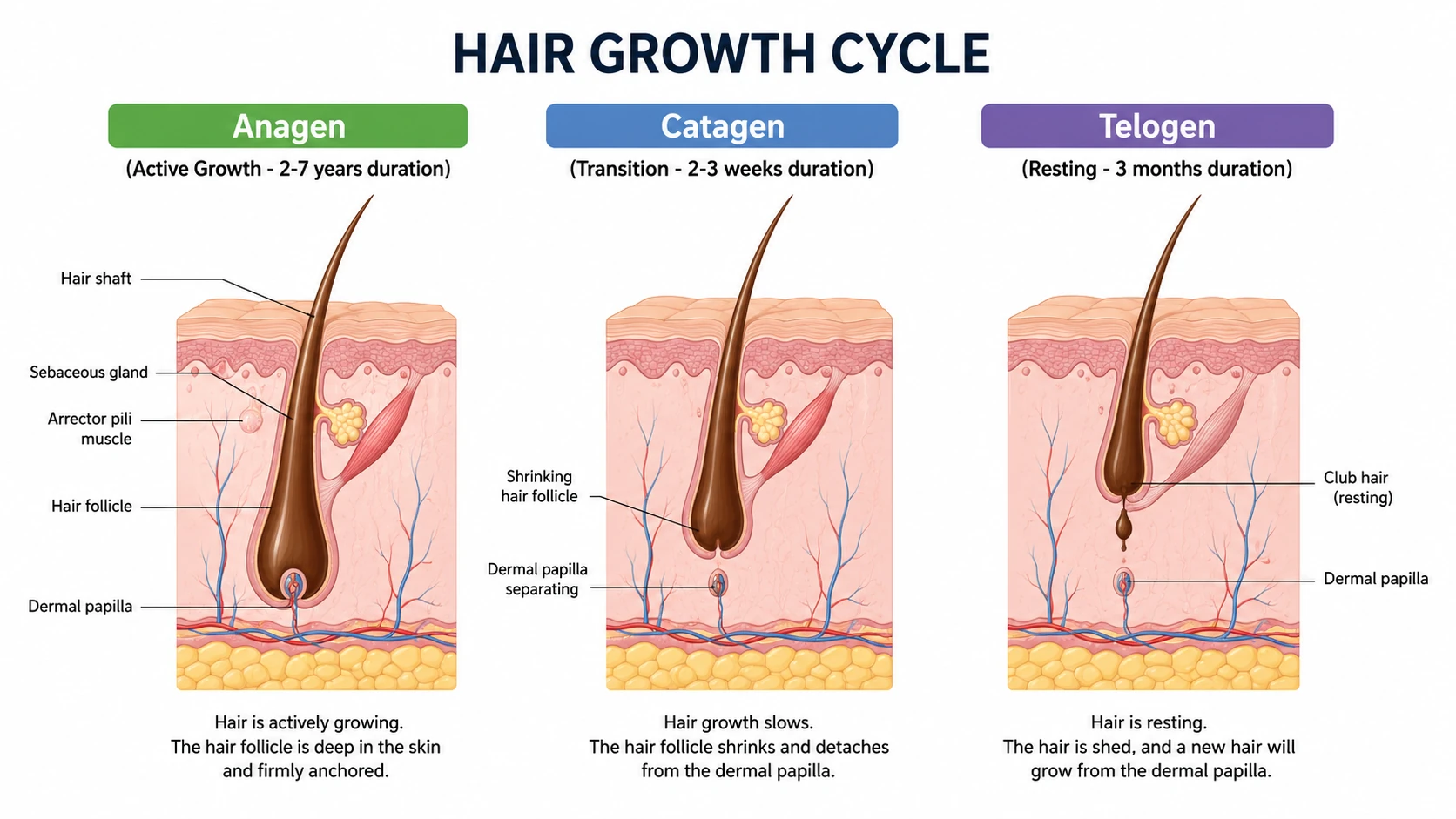
So a steady trickle of fallen hairs is the cycle working as designed. How much hair shedding is normal for you also depends on hair length, how often you wash and brush, and the time of year, so the useful comparison is with your own usual, not a number on a page.
Why does shedding look worse on wash days?
Wash days can make perfectly normal shedding look far heavier. Hairs that have finished their cycle often stay loosely in the scalp until brushing, styling or washing moves them, so a wash day can release a few days’ worth at once. That is our explanation rather than a measured finding, but it fits the “modified wash test” clinicians use, which is done after a set number of days without shampooing.7
One reassuring piece of evidence: in a study of 181 people, the number of hairs removed by a standard pull test did not differ significantly according to when the person had last washed or brushed their hair.5 Washing does not appear to loosen hairs that were not already ready to go. If you only wash twice a week, expect a bigger clump each time.
Does hair shed more in autumn?
Possibly, yes. In a classic study of 14 healthy men in Sheffield, the proportion of scalp follicles in the growing phase peaked in March and fell to a low in September. Shed hairs peaked around August and September, at about 60 a day, more than double the winter rate.4 That is one small study of men with indoor jobs, so it suggests a seasonal rise is plausible rather than proving it for everyone. A late-summer or autumn increase that settles by itself is not a reason for alarm.
Hair shedding vs hair loss: what is the difference?
Shedding means more hairs than usual are falling out, but they are still being replaced. Hair loss means something has stopped hair growing back. The American Academy of Dermatology draws the same line: with hair loss, hair will not grow back until the cause stops, whereas you may simply be shedding more than normal.1 The two can look identical in the shower, so the pattern and timing matter.
| Pattern | What you notice | Typical timing | Usual outlook |
|---|---|---|---|
| Telogen effluvium | More hair in the brush, shower and plughole; thinner ponytail; no bald patches | Starts around 2 to 3 months after a trigger6,7 | Shedding phase lasts 3 to 6 months; usually recovers without treatment6 |
| Anagen effluvium | Rapid, widespread loss of growing hairs | Days to weeks after chemotherapy or radiation8,9 | Regrowth usually 1 to 3 months after the cause stops8 |
| Pattern thinning | Widening parting, thinner crown or receding temples; hairs get finer | Gradual, over months and years13 | Tends to progress gradually; follicles shrink over time13 |
| Alopecia areata | Smooth, bald patches that are not red or scaly | Can appear at any time10 | Unpredictable; regrowth often starts in the centre of a patch10 |
The distinction in hair shedding vs hair loss is not always clean: telogen effluvium and pattern thinning can occur together, so a heavy shedding spell sometimes reveals thinning that was already under way.7
What is telogen effluvium, and how long does it last?
Telogen effluvium is a temporary increase in shedding that happens when a trigger pushes more hairs than usual into the resting phase at the same time. They are then shed together, typically two to three months later.7 The British Association of Dermatologists puts the shedding phase at 3 to 6 months, and describes it as “considered chronic” only if it lasts more than 6 months.6
The delay is what makes it confusing, and why “how much hair shedding is normal?” is the wrong question in isolation. The better one is what changed a few months ago. By the time the hair is coming out, the illness, operation or stressful event is long forgotten. Doctors ask about triggers from roughly two to five months before the shedding began.8
- Recovery. Most acute episodes settle. One review puts remission at around 95% of acute cases; another source says it typically resolves within two to six months, but can last longer if the trigger continues.7,8
- Regrowth takes time. New hair grows from the follicle at its own pace, so thickness can take many months to return. Medication does not speed this up, and it can recur if an underlying cause such as iron deficiency is not addressed.6
- Chronic telogen effluvium is debated. A systematic review of 18 studies found that many cases with this label probably represent early female pattern hair loss or an unidentified trigger.16
Why is my hair falling out? Common triggers
The usual causes of a sudden increase in shedding are childbirth, a high fever or serious illness, surgery, major stress, rapid weight loss or crash dieting, new medicines and stopping hormonal contraception. The British Association of Dermatologists and the American Academy of Dermatology list these, along with severe scalp skin problems.1,6 Thyroid disease, in either direction, can also cause it, and it reverses once thyroid levels are normal again.7
Around one in three people diagnosed with telogen effluvium never find a cause.6,7 If you are asking why is my hair falling out and no trigger comes to mind, that is common, and it is a reason to check what can be checked.
Some triggers have their own detailed guides:
- Shedding two to five months after a baby is so common that it has a name, telogen gravidarum.7 Our guide to postpartum hair loss covers what to expect.
- Marked weight loss and extreme dieting are recognised triggers.6 If you are losing weight quickly, including with weight-loss injections, see our article on weight-loss injections and hair loss.
- If you have started a supplement and are wondering whether it is to blame, we look at the evidence on creatine and hair loss separately.
Excessive hair shedding: three simple self-checks
Three low-effort checks help you judge how much hair shedding is normal for you, and whether excessive hair shedding is real: a pull test, a counted routine, and regular photos. None of them is a diagnosis, but together they turn a vague worry into something a GP or dermatologist can work with.
1. The pull test, as a doctor does it
In clinic, the examiner grasps about 40 to 60 hairs close to the scalp and applies gentle traction. One textbook-style threshold calls the test positive if more than 10% of the hairs, roughly four to six, come away. A positive result points to active shedding, but a negative one does not rule it out, and the test is hard to standardise.8 In the 181-person study mentioned earlier, the average pull removed fewer than one hair, and the authors suggested that two hairs or fewer should be considered normal.5
Sources disagree on washing: the British Association of Dermatologists warns of a false negative if hair was washed within 48 hours,6 while the larger study found no significant difference.5 A pull test on yourself is a rough guide at best.
2. The hair-count idea
Clinicians use a standardised wash test, collecting and counting hairs after a set period without shampooing, and it has its limits: in a study of 41 people, agreement with the clinical diagnosis was only fair.7,11 At home, a count will never match the 50 to 100 figure neatly, because hairs also fall on pillows, clothes and brushes. Its value is the trend. Pick one routine, such as wash day, gather the hairs the same way for a few weeks, and note whether the amount is steady, rising or falling.
3. Photos
Gradual thinning is almost invisible day to day. Once a month, in the same light, photograph your parting, the crown from above and each temple. A few months of photos tell a doctor far more than a description.
When should shedding or hair loss be seen by a GP or doctor?
See a GP if you are worried, and see a doctor promptly if you notice patches, a red, scaly or painful scalp, smooth shiny skin, or shedding that is not settling. The NHS says hair loss is not usually anything to worry about, but can occasionally be a sign of a medical condition, and it invites you to book if it is affecting you.2
Usually reasonable to watch and record
- Evenly heavier shedding after a clear trigger such as a baby, illness or diet
- A late-summer or autumn rise that settles
- No bald patches and a normal-looking scalp
- Photos and counts staying roughly steady or improving
See a GP or doctor promptly if
- You have round or smooth bald patches
- The scalp is red, scaly, itchy, sore, crusted or weeping
- There are smooth, shiny areas with no visible hair openings
- The loss is sudden and heavy, or still not settling
- You are on new medicines or having cancer treatment
- It is distressing you, whatever the cause
Smooth patches that are not red or scaly are the typical picture of alopecia areata, an immune condition.10 Patchy loss with scaling, itching or a painful, boggy swelling can be a fungal infection (tinea capitis), which needs oral treatment because creams do not reach the follicle.8 If the hair openings in a bare area have vanished, the alopecia is probably scarring. That is permanent, and best evaluated by a dermatologist, which is why early assessment matters.8
One nuance: telogen effluvium itself can cause scalp tenderness, burning or itching (trichodynia).7 A sore scalp does not prove something sinister, but it is a reason to have it looked at. Persistence counts too: the British Association of Dermatologists advises seeing your doctor if shedding does not get better.6
What tests might a doctor consider for excessive hair shedding?
There is no routine test for hair loss; tests are chosen according to your history and what the scalp shows. A review for family doctors says testing is indicated when the history or examination suggests a cause.8 For suspected telogen effluvium, doctors typically look for thyroid disease and iron deficiency.6,8
| Test | Why it may be done | Worth knowing |
|---|---|---|
| Ferritin (iron stores) | Iron deficiency is the most common nutritional deficiency worldwide and is linked to telogen effluvium12 | Cut-offs for “low” vary between studies, from 15 to 70 µg/L, and the link to hair loss is still debated. Inflammation can raise ferritin.12 |
| Thyroid function (TSH) | Overactive and underactive thyroid can both increase shedding7,8 | Hair shedding settles once thyroid levels are corrected7 |
| Full blood count; zinc, kidney and liver tests | Look for anaemia and other systemic causes, when the history or examination suggests them8 | Not needed for every patient |
| Scalp examination, dermoscopy, rarely biopsy | Distinguishes shedding from patterned or scarring loss; biopsy is rarely needed6 | A biopsy is more likely if loss lasts beyond six months7 |
Be cautious with supplements. One review of vitamins and minerals in hair loss found that biotin and vitamin E are not supported by the literature for pattern loss or telogen effluvium, that biotin can also cause misleading laboratory results, and that too much vitamin A can itself contribute to hair loss.12 If tests show a deficiency, treat that specific deficiency under your doctor’s guidance rather than taking a general hair vitamin and hoping.
When could PRP fit, and when does it not?
PRP is a treatment for persistent pattern thinning where follicles are still alive, not for acute shedding. If your hair is coming out suddenly and heavily, the sensible first step is to find the trigger and let the cycle recover, because most acute shedding settles on its own.6 Injecting platelet-rich plasma into a scalp that is simply shedding after an illness or a baby treats a problem that is probably resolving.
There is some research on PRP in chronic telogen effluvium: one randomised pilot of 30 women, with ten per group and three months of follow-up, reported improvements against placebo.14 That is promising but far too small to base a recommendation on. The question that matters comes later: once the shedding spell has passed, does your density come back? If your parting stays wider, your crown is thinner or your temples are receding, that points to pattern thinning, which is exactly where PRP hair treatment in Bedford may have a role, usually alongside proven medicines. The evidence is honest but modest: our guide to whether PRP works for hair loss sets out the numbers, and the British Association of Dermatologists describes the research on PRP as limited.15 PRP is not available on the NHS.15
See also our guides to crown thinning, the signs and stages of a receding hairline and our wider hair loss treatment guide.
How our Hair Growth Potential check handles sudden shedding
Our quiz asks you to choose the picture that looks most like your hair, and one option is sudden all-over shedding. Choose it, or patchy loss, or smooth shiny bare skin, and it does not give a score. It tells you to get the cause assessed first. It also asks about a recent major illness, surgery, childbirth or crash diet, and about thyroid problems, low iron or PCOS, and where any of these apply it adds a “bloods first” note. Every hair consultation at Rejuvena is led by Dr Nick, and he will tell you if the answer is to wait, test or refer.
Free 2-minute check
Is it shedding, or thinning that PRP could help?
Answer seven quick questions about your hair, how long you have noticed it and your health. If your answers point to sudden shedding, patches or scarring, the check tells you to see a doctor first rather than giving a score. It is a guide, not a diagnosis, and you leave your contact details to see the result.
Check your hair growth potential →Frequently asked questions
Is it normal for hair to fall out in clumps in the shower?
Some loose hair collecting in the shower is normal, because the water moves hairs that had already detached. Clumps that are clearly bigger than your usual are the pattern doctors ask about with telogen effluvium.8 If it is new, persistent or comes with patches or a sore scalp, book an appointment.
Can stress alone make my hair fall out?
Yes. Major stress is a recognised trigger for telogen effluvium, usually with a lag of a few months, so the link is easy to miss.6,7 It is still worth checking iron and thyroid too.
Do hair vitamins stop shedding?
Not reliably. The review of vitamins and minerals found no support for biotin or vitamin E in telogen effluvium or pattern hair loss, and iron supplementation is suggested only where iron is actually low.12
How much hair shedding is normal after having a baby?
Heavy shedding two to five months after childbirth is common enough to have its own name, telogen gravidarum.7 It follows the same rules as other telogen effluvium and usually settles, but our guide to postpartum hair loss explains what to expect and when to ask for help.
References
- American Academy of Dermatology. Do you have hair loss or hair shedding? aad.org
- NHS. Hair loss (symptoms). Last reviewed 24 January 2024. nhs.uk/conditions/hair-loss
- Natarelli N, Gahoonia N, Sivamani RK. Integrative and mechanistic approach to the hair growth cycle and hair loss. J Clin Med. 2023;12(3):893. doi:10.3390/jcm12030893
- Randall VA, Ebling FJ. Seasonal changes in human hair growth. Br J Dermatol. 1991;124(2):146–151. doi:10.1111/j.1365-2133.1991.tb00423.x
- McDonald KA, Shelley AJ, Colantonio S, Beecker J. Hair pull test: evidence-based update and revision of guidelines. J Am Acad Dermatol. 2017;76(3):472–477. doi:10.1016/j.jaad.2016.10.002
- British Association of Dermatologists. Telogen effluvium (patient information leaflet; updated October 2025). skinhealthinfo.org.uk
- Asghar F, Shamim N, Farooque U, Sheikh H, Aqeel R. Telogen effluvium: a review of the literature. Cureus. 2020;12(5):e8320. doi:10.7759/cureus.8320
- Phillips TG, Slomiany WP, Allison R. Hair loss: common causes and treatment. Am Fam Physician. 2017;96(6):371–378. aafp.org
- Harrison S, Bergfeld W. Diffuse hair loss: its triggers and management. Cleve Clin J Med. 2009;76(6):361–367. doi:10.3949/ccjm.76a.08080
- British Association of Dermatologists. Alopecia areata (patient information leaflet). skinhealthinfo.org.uk
- Guarrera M, Fiorucci MC, Rebora A. Methods of hair loss evaluation: a comparison of TrichoScan with the modified wash test. Exp Dermatol. 2013;22(7):482–484. doi:10.1111/exd.12164
- Almohanna HM, Ahmed AA, Tsatalis JP, Tosti A. The role of vitamins and minerals in hair loss: a review. Dermatol Ther (Heidelb). 2019;9(1):51–70. doi:10.1007/s13555-018-0278-6
- Devjani S, Ezemma O, Kelley KJ, Stratton E, Senna M. Androgenetic alopecia: therapy update. Drugs. 2023;83(8):701–715. doi:10.1007/s40265-023-01880-x
- El-Dawla RE, Abdelhaleem M, Abdelhamed A. Evaluation of the safety and efficacy of platelet-rich plasma in the treatment of female patients with chronic telogen effluvium: a randomised, controlled, double-blind, pilot clinical trial. Indian J Dermatol Venereol Leprol. 2023;89(2):195–203. doi:10.25259/ijdvl_1011_20
- British Association of Dermatologists. Male pattern hair loss (patient information leaflet). skinhealthinfo.org.uk
- Daunton A, Harries M, Sinclair R, Paus R, Tosti A, Messenger A. Chronic telogen effluvium: is it a distinct condition? A systematic review. Am J Clin Dermatol. 2023;24(4):513–520. doi:10.1007/s40257-023-00760-0
This article is for general information and does not replace a personal consultation or medical advice. If you are worried about hair loss, speak to your GP or a doctor, particularly if you have patches, a red or painful scalp, or sudden heavy shedding.