
PRP vs hair transplant is not really a contest, because the two treatments do different jobs at different stages of hair loss. Platelet-rich plasma (PRP) is aimed at follicles that are still alive but struggling. A transplant moves healthy follicles from the back of the scalp into areas where hair has gone. This guide covers what each can do, the evidence for PRP around a transplant, NHS figures on cost and risk, and how to check a surgeon. Rejuvena does not perform hair transplants, so this is written to be fair to both.
The short version
- Different tools, different stages. PRP supports living, thinning follicles. A transplant is for areas where follicles have been lost.1,3
- Neither stops pattern hair loss. Surgeons advise medical treatment to protect the hair you keep, and experts say loss should be adequately treated before a transplant.5,6
- PRP around a transplant looks promising but the evidence is thin. A 2025 systematic review found only three controlled studies with 217 people in total.10
- Transplants are not on the NHS. The NHS quotes UK prices from £1,000 to £30,000, and recovery takes months, not days.1
- Check the surgeon, not the brochure. GMC registration, a CQC-registered clinic and BAHRS membership are the NHS’s three starting checks.1
What do PRP and a hair transplant each actually do?
PRP is injected into the scalp to support follicles that are still producing hair. A hair transplant is surgery that moves hair from one part of the scalp to another. One treats the environment around existing follicles; the other relocates follicles to places where they no longer exist. They answer different questions, which is why comparing them head to head can mislead.
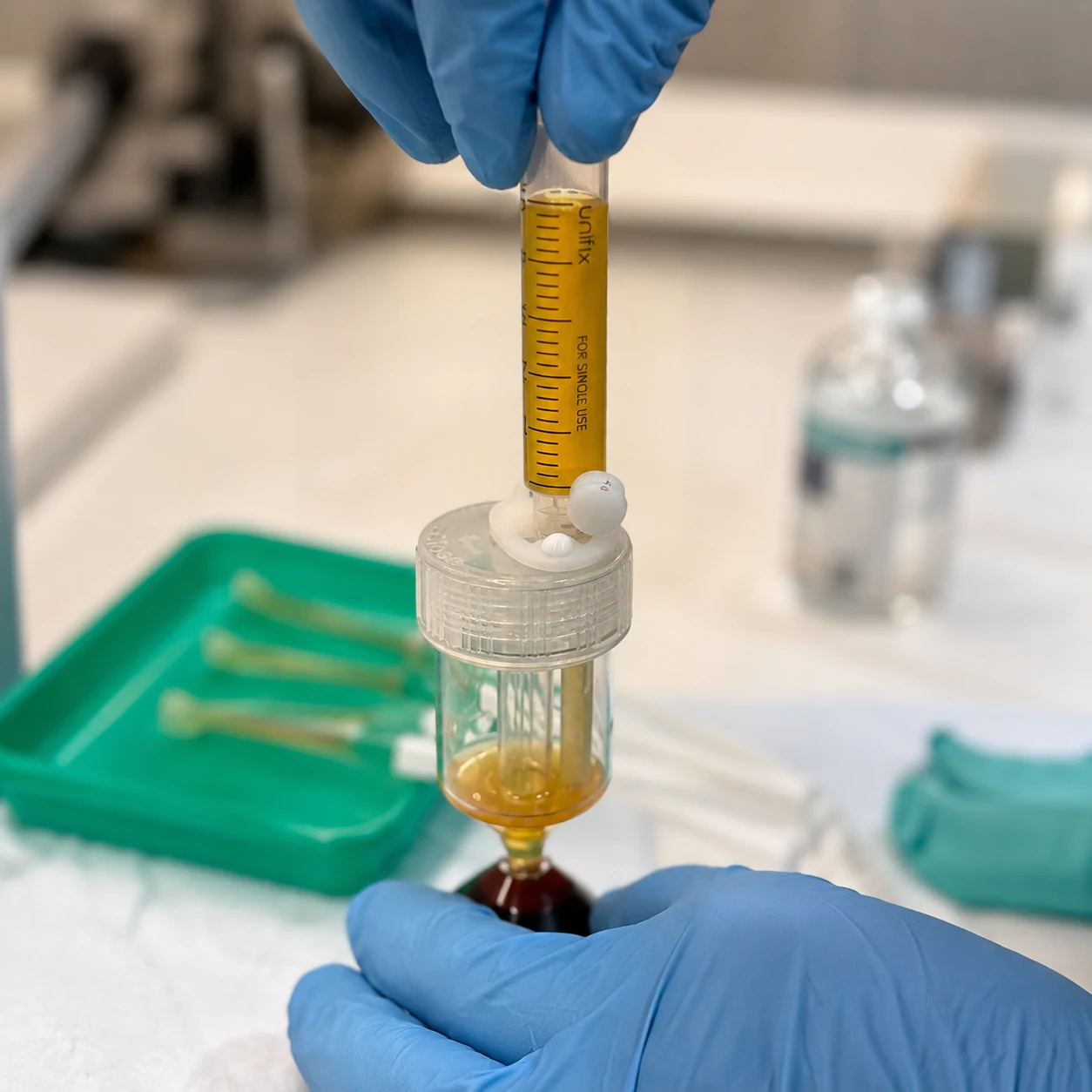
On the PRP side of PRP vs hair transplant, the treatment is a concentrate made from your own blood, injected into thinning areas. It does not create new follicles and it does not switch off the hormonal process behind pattern hair loss.3 Our guide to whether PRP works for hair loss has the detail; in short, pooled trials show an average gain in hair density with low certainty, and the benefit has to be maintained.4
The NHS describes a hair transplant as a procedure to move hair to an area that is thin or bald, usually from the back of the head. There are two main methods. In follicular unit transplantation (FUT, the strip method) a strip of scalp is removed and divided into grafts, leaving a linear scar. In follicular unit extraction (FUE) single hairs are removed one at a time, leaving many tiny marks, and the head is shaved for the harvest.1 The reason it works is that hair from the back and sides of the scalp is typically more resistant to the hormone DHT, so it tends to keep growing after it has been moved.2
Which stage of hair loss suits PRP, and which suits a transplant?
PRP suits early to moderate thinning, where follicles are still alive. A transplant suits established, stable loss with enough healthy donor hair at the back and sides. In between, many people need both a plan for the hair they have and a decision about the areas they have lost.
For PRP, a review of the literature noted that men with milder loss (Norwood grades II to III) had more favourable results than those with advanced loss, and that PRP does not suppress the hormonal component of androgenetic alopecia.3 If an area has been smooth and bald for a long time, the follicles have usually gone, and PRP cannot bring back what is not there.
For a transplant, the NHS says it is generally suited to inherited (family-pattern) baldness, and usually not suitable for other types of hair loss such as alopecia areata.1 An international panel of 38 hair transplant experts stressed correct candidate selection and the need for adequate medical treatment before surgery.6 The ISHRS, the international society for hair restoration surgeons, describes the ideal candidate for FUE as someone whose hair has been stabilised with medical therapy such as finasteride and minoxidil.7
PRP may suit you if
- Thinning is early or moderate, with fine hairs still visible
- Your parting is widening or the temples have started to recede
- You want to support the hair you have rather than have surgery
- You are willing to commit to a course and maintenance
A transplant consultation may be the better first step if
- Areas have been bald for years and the skin is smooth
- Your loss has settled and a surgeon confirms enough donor hair
- You want density restored where follicles have gone
- You accept the cost, recovery and a surgical scar
Is a hair transplant for a receding hairline a good idea?
It can be, for the right person at the right time. A hair transplant for a receding hairline places grafts along the front, but the hair around them keeps ageing, and the NHS lists continued thinning of surrounding hair as a recognised risk.1 That is why very early recession is often a stage to treat and monitor first. Our guide to receding hairline signs, stages and treatment explains how to tell where you are.
Will you still need medical treatment after a transplant?
Yes, in most cases. Pattern hair loss carries on in the hair that was not transplanted, so surgeons advise medical therapy to protect it. A review in a dermatology surgery journal advises patients to use medical therapy to protect their surgical results and prevent ongoing thinning of the surrounding hairs.5
The 2023 expert consensus makes the same point from the other side: patients should have received adequate medical treatment for alopecia before transplant.6 A 2026 Delphi consensus among hair transplant surgeons gave practical guidance on using topical and low-dose oral minoxidil around surgery, including applying topical minoxidil to the grafted area at 7 to 14 days after the transplant.16 That is surgeon-panel opinion, not a trial, and timing is the surgeon’s call. Medicines such as minoxidil and finasteride are prescribed by your GP or specialist, only work for as long as they are used, and finasteride is not suitable for women.20
PRP after hair transplant: what does the evidence show?
PRP used around a transplant has shown benefits in several small studies, but the evidence is early and inconsistent in design. A 2025 systematic review found only three controlled studies (two randomised, one not) with 217 participants in total. Adding PRP was associated with more hair density, better follicle survival and earlier regrowth, but the studies used different preparations and measures, and none used standardised assessment tools or trichoscopy.10
The individual studies, with their limits:
- Garg, 2016. Forty people having FUE were allocated alternately to PRP or saline injected into the recipient area during surgery. At 6 months all PRP patients had more than 75% regrowth versus four people in the control group. The study was single-blind and used alternate allocation.11
- Pathania, 2023. Twenty people had grafts held in PRP or chilled Ringer’s lactate before implantation. The PRP group recovered faster from post-transplant shedding and had higher density at 6 months. It was a pilot study.12
- Dawane, 2026. In 60 men having FUE, all PRP patients reached at least 75% regrowth at 6 months versus 40% of controls, with faster resolution of scalp redness (24 versus 36 days).13
- Saxena, 2026. In 50 participants, density at 6 months improved by 25% more with PRP.14
- Zontos, 2026. A split-area study of 19 men found that PRP injected into FUE donor sites cut wound surface area by about 50% at 24 hours versus 21% in untreated sites. It measured early healing only, not final hair outcomes.15
So is the evidence mixed? Not in direction, since every study we found favoured PRP, but it is thin, mostly small and single-centre, and the effect sizes (for example 100% against 40%) are large enough that we would want to see independent replication before treating them as typical. A single-centre pilot is a reason to ask your surgeon, not a reason to expect a particular result. We found no controlled study in this search that tested PRP started well after surgery, so these results relate to intra-operative use, which is a surgeon’s decision made on the day.
With PRP after hair transplant surgery, the sensible target is the native hair. If you have had a transplant elsewhere and your own surrounding hair is thinning, PRP is one of the options we can discuss for those follicles, alongside medical therapy, once your surgeon is happy with healing. We would not offer it as a way to make grafts grow.
PRP vs hair transplant: how do the options compare?
The clearest difference is the goal: PRP aims to thicken hair that exists, a transplant aims to restore hair where it has gone. The table uses NHS figures and our own price list where they exist, and leaves gaps rather than guessing.
| Option | Best-suited stage | Goal | Downtime | Cost | Durability | Maintenance |
|---|---|---|---|---|---|---|
| PRP | Early to moderate thinning, living follicles | Support and thicken existing hair | Short-lived tenderness, redness or bruising; most people resume normal activity the same day | At Rejuvena: £400 single, £1,125 for 3, £1,750 for 5; not on the NHS | Gains fade without maintenance, because the underlying loss continues | Periodic sessions, usually alongside medical treatment |
| Hair transplant (FUT or FUE) | Established, stable loss with good donor hair | Restore hair to areas where follicles have gone | One to two weeks off work; bandages off after 2 to 5 days; new growth after about 4 months, full result 10 to 18 months1 | £1,000 to £30,000 in the UK, depending on extent, technique and clinic; not on the NHS1 | Grafts come from areas more resistant to DHT, so transplanted hair tends to last2 | Ongoing medical therapy for native hair is advised; a later session may be needed as loss progresses5,17 |
| Medical therapy (minoxidil, finasteride) | Most stages, usually the foundation | Slow loss and help regrowth | None | Minoxidil is not available on NHS prescription; not quoted here2 | Benefit lasts only while used2 | Continuous; 6 to 12 months to judge minoxidil2 |
What are the risks and recovery of a hair transplant?
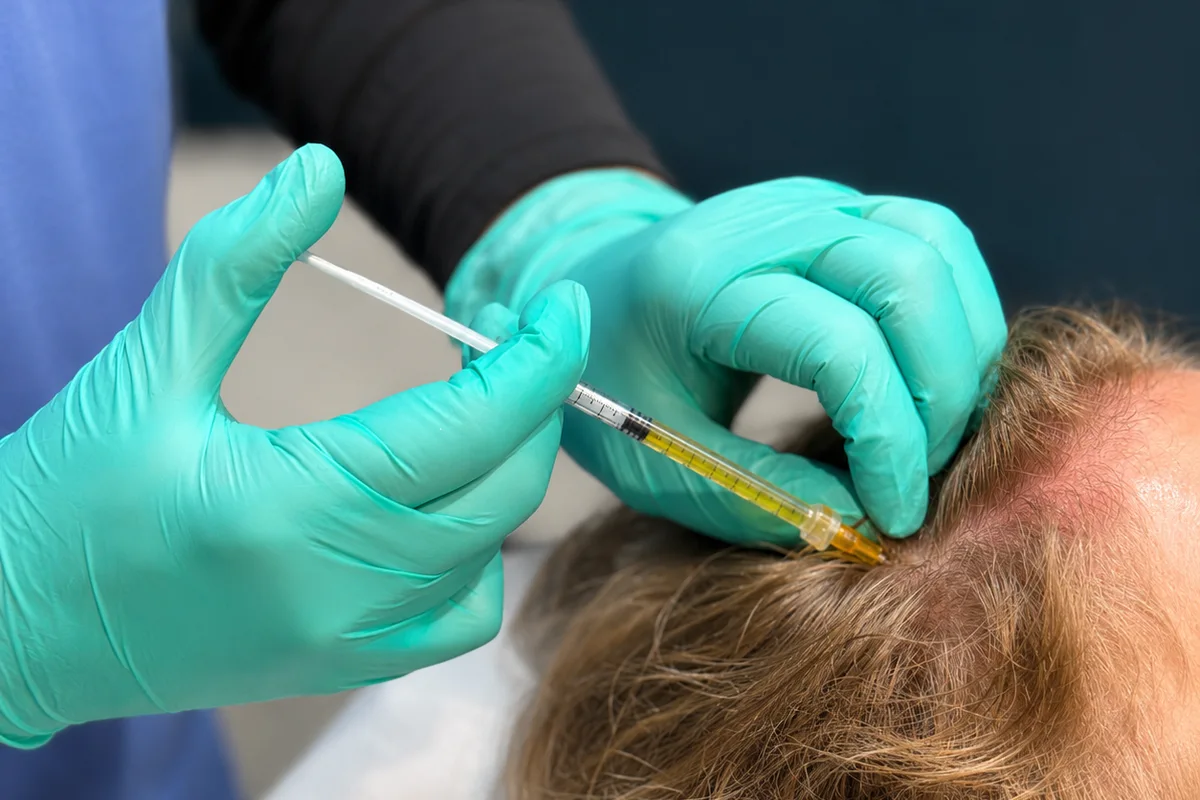
A hair transplant is generally safe, but it is surgery, so it carries risks and a slow recovery. The NHS lists a small risk of bleeding, infection or an allergic reaction to the anaesthetic, plus the possibility that grafts may not take, a noticeable scar, and continuing thinning of surrounding hair. Transplanted hair often falls out after a few weeks before new growth appears, and full results take 10 to 18 months.1
A 2025 systematic review and meta-analysis concluded that hair transplant surgery is generally safe, with pain, swelling and oedema at the donor site the most commonly reported complications, and scarring the most reported at the recipient site.8 A 2026 review of FUE complications lists donor depletion, donor-area scarring and unnatural results among the less common problems, and stresses careful patient selection and technique.9 The ISHRS notes that donor hair, once removed, is gone, which is why it is meant to be used carefully, with reserves kept for later.7
PRP is gentler on the body. Its side effects in the trials are typically mild and short-lived: pain at injection, redness, swelling or bruising.19
How much does a hair transplant cost in the UK?
The NHS says a hair transplant in the UK can cost between £1,000 and £30,000, depending on the extent of hair loss, the type of procedure and the quality of the clinic. That is the only hair transplant cost UK figure we are comfortable quoting, because it comes from the NHS rather than a clinic’s marketing, and it is a wide range.1
Hair transplants are not offered on the NHS because they are classed as cosmetic surgery.1,2 BAHRS standards say fees should be set out in advance, with follow-up care and who pays for it made clear, and that because many forms of hair loss are ongoing, the cost of repeat procedures should be explained.17 When you compare hair transplant cost UK quotes, ask what is included (consultation, medication, follow-up, any PRP) and whether a second session is likely. For PRP, our own prices are on the pricing page; a single session is £400 and a three-session course is £1,125.
How do you choose a hair transplant surgeon in the UK?
Check that the surgeon is registered with the General Medical Council (GMC) and holds a licence to practise, that the clinic is registered with the Care Quality Commission (CQC), and look up the surgeon’s membership of the British Association of Hair Restoration Surgery (BAHRS). These are the NHS’s own three starting checks.1 If you are in Bedford weighing up a hair transplant, the same checks apply wherever you travel for surgery.
- GMC register. Confirm the named surgeon is on the GMC register with a licence to practise. BAHRS notes that “hair transplant surgeon” is the term it endorses even where a doctor is not on the GMC Specialist Register, and that members’ qualifications are listed on the BAHRS website, so read the listing.17
- CQC registration. The NHS says independent clinics providing cosmetic surgery in England must be registered with the CQC.1
- BAHRS and ISHRS. BAHRS requires its surgeons to attend an ISHRS annual meeting at least once every five years, to comply with GMC guidance, and not to delegate the surgical steps.17 BAHRS membership is a professional standard, not a legal requirement, so treat it as one signal among several.
- Who makes the incisions. BAHRS guidance says surgeons should never delegate making skin incisions; technicians may assist with the non-surgical steps.18
- No pressure. BAHRS standards say a procedure should not happen on the day of the first consultation, with a cooling-off period of at least two weeks, no deposit before you have been examined and counselled, and no time-limited offers to hasten your decision.17
- Ask direct questions. The NHS suggests asking about qualifications, experience, complication rates, the recommended technique, follow-up care and patient satisfaction, and being cautious of clinics that pay for search advertising.1
A good surgeon will tell you if you are too early for surgery. The NHS also advises seeing a GP to find out what is causing your hair loss before going to a commercial hair clinic.20
Where does Rejuvena fit in PRP vs hair transplant, and how do you find your stage?
We do not perform hair transplants. We offer doctor-led PRP hair treatment in Bedford, led by Dr Nick, for people whose follicles are still alive, and we will say so if a surgical opinion or a medical review would serve you better. Our hair loss treatment guide compares the options we do offer. Knowing where you sit on the stage scale is the sensible first step before you compare PRP vs hair transplant quotes.
Free 2-minute check
Where do you sit on the hair loss stage scale?
Our Hair Growth Potential check has seven questions, including a picture-based stage picker for men and women. It shows what trial ranges suggest for someone with a similar profile, and sends you to a doctor first if you describe patchy loss, sudden all-over shedding or scarring. It looks at PRP response, not surgical suitability, so it is a starting point for a conversation rather than a verdict.
Check your hair growth potential →Frequently asked questions
Can PRP replace a hair transplant?
Not where follicles have gone, which is the central point of PRP vs hair transplant. PRP works on follicles that still exist, so it cannot refill an area that has been smooth and bald for years. In early thinning it may be a reasonable first step, and some people never need surgery.
Can I have PRP before a hair transplant?
The studies we found tested PRP during surgery, not as preparation beforehand. If you are planning a transplant, ask your surgeon whether they advise anything beforehand. Expert consensus emphasises adequate medical treatment before surgery.6
Do transplanted hairs fall out?
Often, yes, and this is expected. The NHS says transplanted hair often falls out after a few weeks, with new growth usually appearing after about four months.1 The ISHRS adds that existing native hairs can also shed temporarily after surgery.7
Is a transplant suitable for women?
Sometimes. A review in a dermatology surgery journal describes transplantation as an option for male and female pattern hair loss.5 Suitability depends on the pattern of loss and the donor hair, so it needs a surgeon’s assessment. Diffuse thinning and hormonal causes should be looked at by a doctor first.
How do I know which stage of hair loss I am at?
Photographs of the hairline, parting and crown, and a scalp examination, are the starting point. Our quiz offers a plain-English stage picker, and a doctor can confirm the pattern and rule out other causes.
References
- NHS. Hair transplant (cosmetic procedures). Last reviewed 29 September 2023. nhs.uk
- British Association of Dermatologists. Male pattern hair loss (patient information; updated June 2024). skinhealthinfo.org.uk
- Stevens J, Khetarpal S. Platelet-rich plasma for androgenetic alopecia: a review of the literature and proposed treatment protocol. Int J Womens Dermatol. 2019;5(1):46–51. doi:10.1016/j.ijwd.2018.08.004
- Kieling L, Konzen AT, Zanella RK, Valente DS. Is autologous platelet-rich plasma capable of increasing hair density in patients with androgenic alopecia? A systematic review and meta-analysis of randomized clinical trials. An Bras Dermatol. 2024;99(6):847–862. doi:10.1016/j.abd.2024.01.002
- Rogers NE. Hair transplantation update. Semin Cutan Med Surg. 2015;34(2):89–94. doi:10.12788/j.sder.2015.0131
- Vañó-Galván S, Bisanga CN, Bouhanna P, et al; Hair Transplant Surgery Expert Group. An international expert consensus statement focusing on pre and post hair transplantation care. J Dermatolog Treat. 2023;34(1):2232065. doi:10.1080/09546634.2023.2232065
- International Society of Hair Restoration Surgery. FUE hair transplant: benefits, process and recovery. ishrs.org
- Khatib M, Skorochod R, Wolf Y. Complications following hair transplantation: a systematic literature review and meta-analysis. Aesthetic Plast Surg. 2025;49(23):6393–6405. doi:10.1007/s00266-025-05125-y
- Romera de Blas C, Vega Díez D, Ricart Vayá JM, Gómez Zubiaur A. Complications in follicular unit excision hair transplantation: current evidence and practical approaches. Front Med (Lausanne). 2026;13:1750989. doi:10.3389/fmed.2026.1750989
- Sindhusen S, Tawanwongsri W, Eden C. Efficacy of platelet-rich plasma as an adjunct to hair transplantation: a systematic review. Cureus. 2025;17(10):e94116. doi:10.7759/cureus.94116
- Garg S. Outcome of intra-operative injected platelet-rich plasma therapy during follicular unit extraction hair transplant: a prospective randomised study in forty patients. J Cutan Aesthet Surg. 2016;9(3):157–164. doi:10.4103/0974-2077.191657
- Pathania V, Sood A, Beniwal N, Baveja S, Shankar P, Patrikar S. Randomized control trial to study the efficacy and safety of platelet-rich plasma as intraoperative holding solution in hair restoration surgery: a pilot study. Med J Armed Forces India. 2023;79(1):46–53. doi:10.1016/j.mjafi.2021.04.015
- Dawane PV, Rode VN, Bharsakle SM, Kadam AP, Hiware GK. Efficacy of intraoperative platelet-rich plasma in follicular unit extraction hair transplantation: a prospective study. J Maxillofac Oral Surg. 2026;25(4):1166–1172. doi:10.1007/s12663-026-02997-8
- Saxena M, Chaithanya DJ, Sharma P, Chattopadhyay A, Jugade S, Sheikh RA. Assessment of efficacy of platelet-rich plasma augmentation in follicular unit extraction in hair density improvement: a prospective study. J Pharm Bioallied Sci. 2026;18(2):99–101. doi:10.4103/jpbs.jpbs_555_25
- Zontos G. Platelet-rich plasma accelerates donor area healing after follicular unit excision: a prospective study. Dermatol Surg. 2026;52(7):666–671. doi:10.1097/dss.0000000000005029
- Gupta AK, Talukder M, Williams G, et al. Low-dose oral minoxidil (LDOM) and topical minoxidil: consensus recommendations for managing male and female pattern hair loss in hair transplant patients using a modified Delphi process. Expert Opin Pharmacother. 2026;27(3):253–261. doi:10.1080/14656566.2026.2642216
- British Association of Hair Restoration Surgery. Professional standards for hair transplant surgeons (PSFHTS/V4/June19). bahrs.co.uk (PDF)
- D’Souza C, Williams G (BAHRS). BAHRS provides guidance to consumers on hair transplant surgery in the UK. ISHRS “Fight the Fight”. fightthefight.ishrs.org
- Anitua E, Tierno R, Alkhraisat MH. Platelet-rich plasma in the management of alopecia: a systematic review and meta-analysis of clinical evidence. Dermatol Ther (Heidelb). 2025;15(11):3213–3252. doi:10.1007/s13555-025-01542-8
- NHS. Hair loss: treatments. nhs.uk
This article is for general information and does not replace a personal consultation or a surgeon’s assessment. Rejuvena does not perform hair transplant surgery. Results of any hair treatment vary with the type and stage of hair loss and how many viable follicles remain.