
Menopause hair loss is common, real and usually has more than one cause, which is why it is worth getting it properly looked at rather than guessing. The hormonal shift around menopause can change how hair grows and can unmask inherited female pattern hair loss, but thyroid problems, low iron, medicines and a stressful year can all produce the same picture. This guide explains why hair thins around perimenopause and menopause, what else to rule out, what helps, and how strong the evidence is for each option, including PRP.
The short version
- Hair thinning is a recognised menopause symptom. The NHS lists it among the other effects of perimenopause and menopause.3
- The usual driver is female pattern hair loss. It is inherited and hormone-sensitive, and it tends to become more noticeable after menopause.1,2
- Check for other causes first. Thyroid, iron, medicines and recent illness or stress can all cause shedding on top of, or instead of, pattern loss.8,11,12
- A receding frontal hairline with eyebrow loss needs a doctor. Frontal fibrosing alopecia scars the follicle, and PRP is not the answer to it.13,14
- Treatment evidence is modest. Topical minoxidil has the strongest evidence; PRP in women has mixed trial results and is not offered on the NHS.4,7
Why does menopause hair loss happen?
Hair follicles are sensitive to hormones, and the years around menopause change the balance. A 2025 review in Maturitas describes how the transition, which can begin up to ten years before the final period, brings a relative rise in androgens as ovarian oestrogen production stops. Because the follicle is an oestrogen-sensitive tissue, the result can be lower hair density, finer hairs and a change in texture.1
The same review notes that the follicle’s blood supply and metabolism may also work less well once oestrogen falls, and that female pattern hair loss, telogen effluvium and frontal fibrosing alopecia are all seen more often in postmenopausal women.1 A 2026 systematic review of 40 studies reached a similar conclusion: of the common skin and hair conditions it examined, alopecia, particularly frontal fibrosing alopecia and female pattern hair loss, showed the strongest postmenopausal associations, with earlier or surgical menopause carrying greater risk.2
It is worth saying plainly what this does not tell us. These reviews describe associations and mechanisms. They do not mean every woman will lose hair at menopause, and they do not predict how much you personally will lose. Many women notice that their hair is simply different, a little finer, drier or harder to style, without any visible thinning.
Is it female pattern hair loss? What female pattern baldness looks like
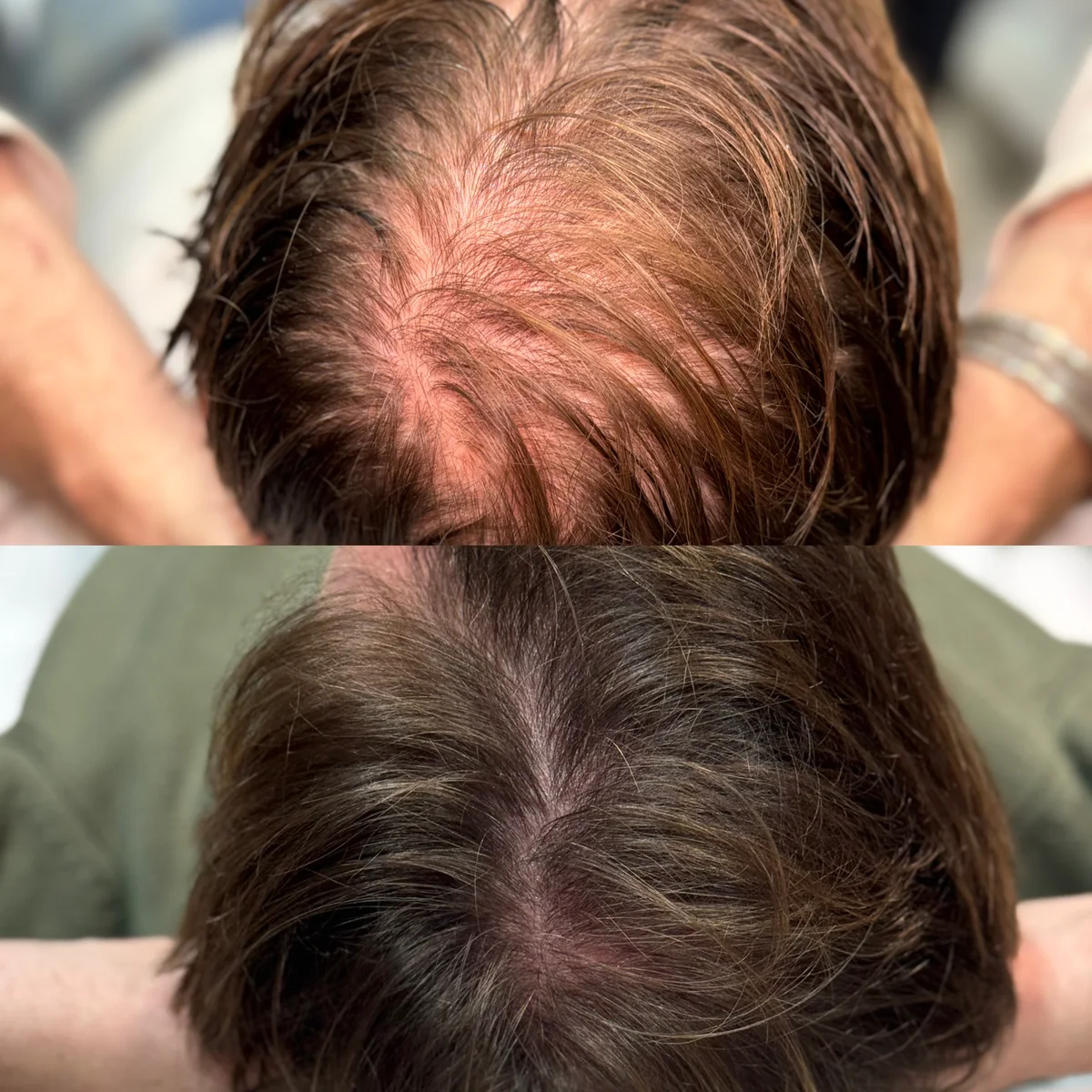
Female pattern hair loss, sometimes called female pattern baldness, is the most common cause of thinning hair in women, and it behaves differently from the male version. It is a non-scarring, gradual thinning in which follicles shrink (miniaturise). It usually shows over the top and crown of the scalp, while the frontal hairline is often spared, and the thinning is generally less severe than in men.5 Doctors grade the pattern using scales named after Ludwig and Sinclair, which is why you may hear “stage one or two” in a consultation.
The British Association of Dermatologists (BAD) says it usually begins in the 50s or 60s, though it can start in the 30s or 40s, and that it arises from a combination of genetic and hormonal factors.4 One review puts it at about 40% of women by the age of 50.18 The honest summary is that the role of androgens in women is less clear than in men, so the hormonal explanation is plausible but not complete.6
What women usually describe is not a bald patch. It is a parting that looks wider, a ponytail that feels thinner, more scalp visible under bright light, and hair that does not recover its volume.
What else can cause thinning hair in women at this age?
Several other causes are common at the same time of life and are worth checking before you assume it is hormonal. The NHS lists illness, stress, cancer treatment, weight loss and iron deficiency as causes of temporary hair loss, and advises seeing your GP to understand the cause before going to a commercial hair clinic.8 We agree with that advice, and it is the same logic behind our own consultation.
- Telogen effluvium. A sudden increase in diffuse shedding, usually two to three months after a trigger such as illness, surgery, a crash diet or a very stressful period. It is one of the most common forms of diffuse non-scarring hair loss and is generally self-limited, although finding the cause can be difficult.12 It often overlaps with pattern loss.
- Thyroid disease. An underactive thyroid can cause dry hair or hair loss, and the NHS notes that Hashimoto’s disease, its main UK cause, is most common in women and usually starts between 30 and 50.11 Its other symptoms (tiredness, feeling cold, weight gain) can be mistaken for menopause.
- Iron. Low iron is a recognised cause of temporary hair loss,8 and a serum ferritin test is a common first check, particularly with diffuse shedding.10 The picture is less clear-cut than supplement marketing suggests. In a specialist-clinic study of 194 women with chronic diffuse hair loss, only 12 had a ferritin of 20 micrograms per litre or less, seven of those 12 turned out to have pattern loss on biopsy, and in the five who did not, correcting the iron alone did not stop the loss.9 A normal result is useful information; a low one is worth treating on its own merits.
- Medicines. Some prescribed medicines can trigger shedding. If a new tablet coincided with your hair changes, tell your GP or prescriber, and do not stop it yourself.
- Androgen excess. Female pattern hair loss can accompany conditions with raised androgens such as PCOS,4 so new facial hair growth or irregular cycles in your history are worth mentioning.
What is frontal fibrosing alopecia, and why is it different?
Frontal fibrosing alopecia (FFA) is a scarring hair loss that mostly affects postmenopausal women, and it needs a doctor’s diagnosis rather than a hair-growth treatment. The BAD describes a frontal hairline that progressively recedes, sometimes with redness or flaking around individual hairs and loss of eyebrow hair. Because the follicles are destroyed, it says no treatment can bring hair back in areas where the follicles have gone; treatment aims to slow or halt further loss.14
FFA has become more common since it was first described in 1994, and its cause is still being worked out. A 2025 review identifies an inherited predisposition and ongoing research into environmental factors, with treatment based largely on case series and trials of newer agents still under way. It stresses that the aim of treatment is to prevent progression, so early diagnosis matters.13
If your hairline is moving backwards in a line (as opposed to a widening parting), your eyebrows are thinning, or the skin along the hairline looks red, scaly or smooth and shiny, please see your GP or a dermatologist first. PRP is not a treatment for this condition, and delaying a diagnosis costs follicles that cannot be replaced. Our quiz is built to send these patterns to a doctor rather than to treatment.
What helps menopause hair loss, and how strong is the evidence?
Topical minoxidil has the strongest evidence for female pattern hair loss, and most other options are supported by smaller or weaker studies. A 2023 therapeutic update describes topical minoxidil as the only medication with a high level of evidence and the usual first choice, while noting that about 40% of patients do not improve on it and that many other options have limited evidence.7 The table summarises where things stand. All medicines are discussed in general terms: any prescription decision belongs with your GP or prescriber.
| Option | What it is | Strength of evidence | What to know |
|---|---|---|---|
| Topical minoxidil | A solution or foam applied to the scalp | Strongest; first choice in reviews7 | Use for at least 6 months before judging; only the 2% strength is licensed for women in the UK4 |
| Low-dose oral minoxidil | A prescription tablet used off-label | Emerging; BAD says it may be at least as effective as topical in some cases4 | Prescriber-led; has side effects of its own |
| Anti-androgen tablets (e.g. spironolactone) | Medicines that block androgen effects | Moderate to low; one pooled analysis found improvement in about 57% of patients, with high variability15 | Not licensed for this use; need specialist or GP oversight and contraception advice4,6 |
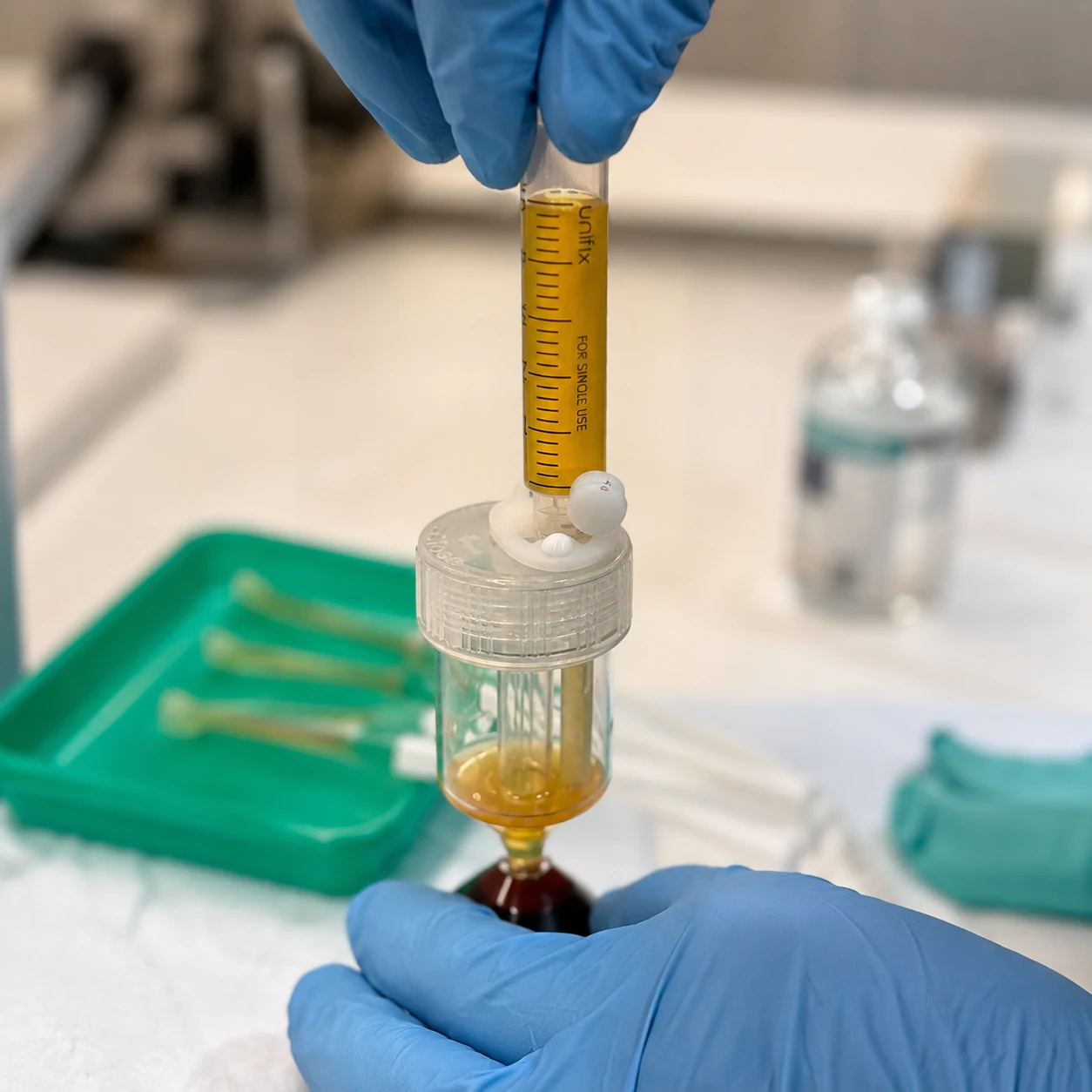
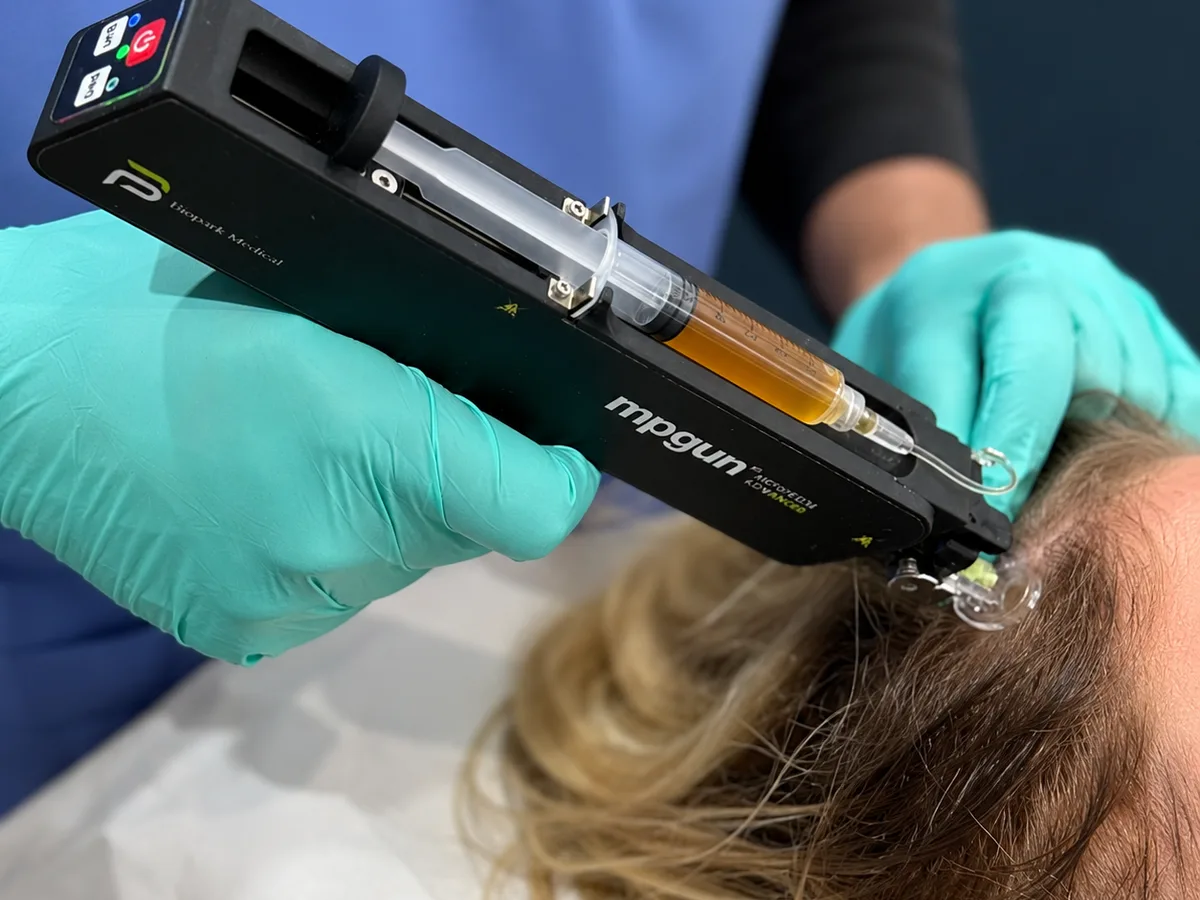
| PRP | Platelet concentrate from your own blood, injected into the scalp | Small, mixed trials in women16,17,18 | Private only; BAD calls the research too limited4 |
| Camouflage, wigs, hair transplant | Cosmetic and surgical options | Listed by the BAD4 | Transplant is private only and depends on donor hair |
Expect patience. Hair follows a slow cycle, minoxidil can cause extra shedding in the first four to six weeks, and the BAD advises at least six months before judging benefit.4 Most treatments for pattern loss slow or reverse thinning only while you keep using them.
Does HRT help hair thinning in menopause?
The evidence that hormone replacement therapy helps hair thinning in menopause is limited and mixed, so it is a conversation to have with your GP rather than a hair treatment to request. The 2026 systematic review found that menopausal hormone therapy was linked to an increased risk of frontal fibrosing alopecia, although most of the studies involved formulations that are less commonly used today.2 That is an association, not proof of cause, and HRT has well-established benefits for other menopausal symptoms. Whether HRT is right for you depends on your overall health, symptoms and risks, and that decision should be made with your GP, not for the sake of your hair. If you take HRT and are worried about your hairline or eyebrows, tell your GP.
Does PRP work for menopause hair loss and thinning hair in women?
PRP in women has shown benefit in some trials and none in others, so it is best seen as an option for early to moderate thinning rather than a reliable fix. We cover the wider evidence in our guide on whether PRP works for hair loss. For women, the picture is this:
- A 2020 randomised trial in 30 women found hair density rose by about 106 hairs per cm² at 24 weeks with PRP, while the saline group fell by about 52. The trial was supported by the manufacturer of the system it tested, and the size of the placebo-group decline suggests some measurement noise.16
- A 2016 double-blind pilot study in women found no significant difference in hair count or hair mass index between PRP and placebo.17
- A review of eight studies in 197 women found PRP well tolerated and said it “may be proposed” for women who have not responded to, or cannot use, minoxidil.18
- A 2024 meta-analysis of PRP trials could use only two female-only studies for its density analysis, and rated the overall certainty of the evidence as low.19
The BAD’s patient leaflet says PRP is not offered on the NHS and that research is too limited to show when and how it might work.4 We think that is a fair summary. PRP supports follicles that are still alive; it does not change the hormonal and genetic tendency behind the thinning, so any gain is likely to need maintenance, and it does not replace a medical treatment that has better evidence. For some women it is a sensible addition, particularly where minoxidil has not helped or is not tolerated.
PRP is also not a treatment for the other causes in this article. One small pilot trial of PRP in chronic telogen effluvium (30 women, three months of follow-up) reported promising results, but it is too small to change practice,20 and sudden shedding needs assessment first. At Rejuvena a plan can combine PRP, PRF and microneedling, and Dr Nick will tell you if medical treatment, bloods or a dermatology referral should come first. Our doctor-led PRP hair treatment in Bedford page explains the method.
PRP may suit you if
- Your parting is widening or the crown is thinning gradually
- You still have fine hairs in the thinning area
- Thyroid, iron and other causes have been checked
- Minoxidil has not helped, or you cannot use it
- You are happy to commit to a course and maintenance
See a doctor first if
- Your frontal hairline is receding or your eyebrows are thinning
- Shedding started suddenly and is heavy and all over
- You have round bald patches
- The scalp is red, scaly, itchy or smooth and shiny
- You have tiredness, weight change or feel cold all the time
- You take anticoagulants or have a platelet disorder
A realistic plan for menopause hair loss
A sensible plan finds the cause first, starts with the best-evidenced treatment, and adds options in stages while you judge results over months, not weeks. This is how we would approach it, and how we would advise a friend:
- Get the cause checked. See your GP about thyroid, iron and any medicines, and mention your menopause symptoms and cycle history.
- Rule out scarring. Any receding hairline, eyebrow loss or red, flaky or shiny scalp skin needs a clinician to look at it.
- Discuss a proven first step. Talk to your GP or prescriber about minoxidil and, where appropriate, other medicines. Give any treatment at least six months.
- Consider adding PRP. If thinning is early to moderate and you want to build on medical treatment, a doctor-led assessment will tell you whether PRP is reasonable. Most protocols use a course of sessions about a month apart, then maintenance; our current prices are on the pricing page.
- Look after the basics and the camouflage. Gentle handling, a haircut that suits finer hair and, if useful, scalp-concealing products are legitimate parts of the plan.
- Review at six to twelve months. Photograph the parting in the same light every month. If nothing has changed, change the plan rather than pay for more of the same.
Hair loss at this stage of life can hit confidence hard, and the 2025 Maturitas review explicitly notes the emotional impact on mood and self-esteem.1
Free 2-minute check
Could PRP help your hair loss?
Answer seven quick questions about your hair loss pattern, how long it has been happening, your age and anything you are taking or have been diagnosed with. Our Hair Growth Potential check shows what clinical trials suggest for someone with a similar profile, and tells you plainly if your pattern needs a doctor’s assessment first, including sudden shedding, patchy loss or signs of scarring.
Check your hair growth potential →If you would rather talk it through, our hair loss treatment guide sets out the options, and you can read about Dr Nick before booking.
Frequently asked questions
Will my hair grow back after menopause?
It depends on the cause. Shedding from a temporary trigger such as illness or low iron usually recovers once the cause is corrected. Pattern hair loss is progressive and tends to need ongoing treatment to hold or improve it, and scarring loss does not regrow.
When should I see my GP about thinning hair?
The NHS advises seeing a GP if you are worried about hair loss, particularly to understand the cause before going to a commercial hair clinic. Go sooner if shedding is sudden, you have bald patches, or your hairline or eyebrows are receding.
Can supplements fix menopause hair loss?
Not on their own. If a blood test shows a genuine deficiency, correcting it is sensible, but in a specialist-clinic study correcting low iron did not stop loss in women whose ferritin was low and whose scalp biopsy was otherwise normal.9 Be cautious about products promising to reverse menopausal thinning.
Is PRP safe if I am taking HRT?
PRP uses your own blood, and HRT is not one of the things our assessment screens out (those are blood thinners, bleeding or platelet disorders, scalp infection, pregnancy or breastfeeding, and current cancer treatment). Tell us about every medicine you take at consultation all the same. Dr Nick will check your history, including anything affecting clotting or platelets, before recommending treatment.
How long before I see any change?
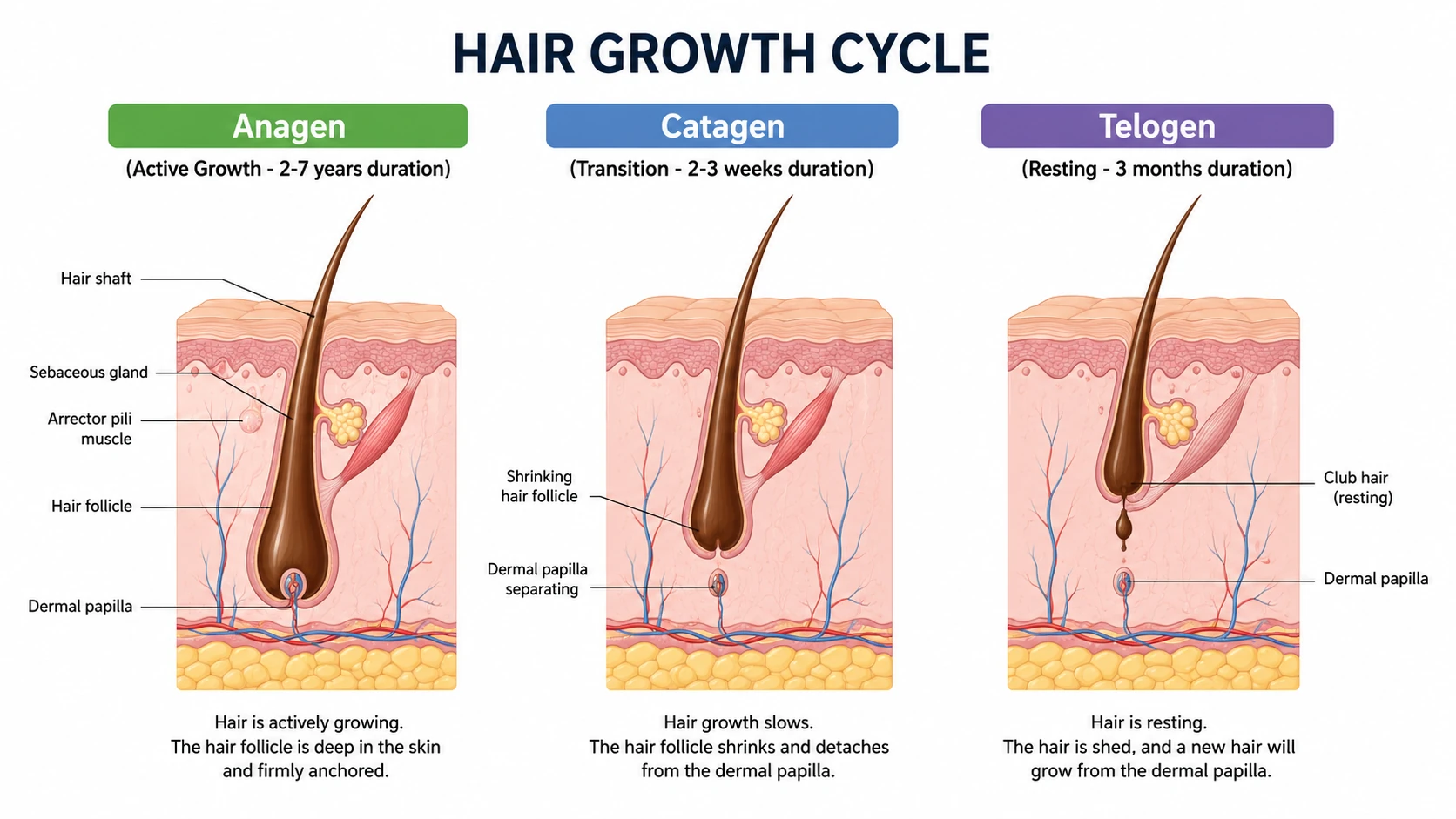
Because follicles rest for around three months before a new hair emerges, early change tends to appear as less shedding. The BAD advises at least six months on minoxidil, and most PRP trials measure results at around six months.4,16
References
- Gupta AK, Economopoulos V, Mann A, Wang T, Mirmirani P. Menopause and hair loss in women: exploring the hormonal transition. Maturitas. 2025;198:108378. doi:10.1016/j.maturitas.2025.108378
- Roster K, Fleshner L, Karatas TB, Ecanow A, Sayegh A, Farabi B, Marmon S. Menopause and common dermatoses: a systematic review. Am J Clin Dermatol. 2026;27(1):67–84. doi:10.1007/s40257-025-00994-0
- NHS. Menopause: symptoms. nhs.uk/conditions/menopause/symptoms
- British Association of Dermatologists. Female pattern hair loss (patient information). skinhealthinfo.org.uk
- Bhat YJ, Saqib NU, Latif I, Hassan I. Female pattern hair loss: an update. Indian Dermatol Online J. 2020;11(4):493–501. doi:10.4103/idoj.idoj_334_19
- Ong MM, Avram M, McMichael A, Tosti A, Lipner SR. Antiandrogen therapy for the treatment of female pattern hair loss: a clinical review of current and emerging therapies. J Am Acad Dermatol. 2025;93(3):749–760. doi:10.1016/j.jaad.2025.04.074
- Müller Ramos P, Melo DF, Radwanski H, de Almeida RFC, Miot HA. Female-pattern hair loss: therapeutic update. An Bras Dermatol. 2023;98(4):506–519. doi:10.1016/j.abd.2022.09.006
- NHS. Hair loss. nhs.uk/conditions/hair-loss
- Sinclair R. There is no clear association between low serum ferritin and chronic diffuse telogen hair loss. Br J Dermatol. 2002;147(5):982–984. doi:10.1046/j.1365-2133.2002.04997.x
- Zhang D, LaSenna C, Shields BE. Serum ferritin levels: a clinical guide in patients with hair loss. Cutis. 2023;112(2):62–67. doi:10.12788/cutis.0837
- NHS. Underactive thyroid (hypothyroidism): symptoms. nhs.uk
- Jimeno Ortega I, Stefanato CM. Telogen effluvium: a 360 degree review. Ital J Dermatol Venerol. 2023;158(6):457–466. doi:10.23736/s2784-8671.23.07579-5
- Messenger AG, Asfour L, Harries M. Frontal fibrosing alopecia: an update. Am J Clin Dermatol. 2025;26(2):155–174. doi:10.1007/s40257-024-00912-w
- British Association of Dermatologists. Frontal fibrosing alopecia (patient information). skinhealthinfo.org.uk
- Aleissa M. The efficacy and safety of oral spironolactone in the treatment of female pattern hair loss: a systematic review and meta-analysis. Cureus. 2023;15(8):e43559. doi:10.7759/cureus.43559
- Dubin DP, Lin MJ, Leight HM, et al. The effect of platelet-rich plasma on female androgenetic alopecia: a randomized controlled trial. J Am Acad Dermatol. 2020;83(5):1294–1297. doi:10.1016/j.jaad.2020.06.1021
- Puig CJ, Reese R, Peters M. Double-blind, placebo-controlled pilot study on the use of platelet-rich plasma in women with female androgenetic alopecia. Dermatol Surg. 2016;42(11):1243–1247. doi:10.1097/DSS.0000000000000883
- Mercuri SR, Paolino G, Di Nicola MR, Vollono L. Investigating the safety and efficacy of platelet-rich plasma (PRP) treatment for female androgenetic alopecia: review of the literature. Medicina (Kaunas). 2021;57(4):311. doi:10.3390/medicina57040311
- Kieling L, Konzen AT, Zanella RK, Valente DS. Is autologous platelet-rich plasma capable of increasing hair density in patients with androgenic alopecia? A systematic review and meta-analysis of randomized clinical trials. An Bras Dermatol. 2024;99(6):847–862. doi:10.1016/j.abd.2024.01.002
- El-Dawla RE, Abdelhaleem M, Abdelhamed A. Evaluation of the safety and efficacy of platelet-rich plasma in the treatment of female patients with chronic telogen effluvium: a randomised, controlled, double-blind, pilot clinical trial. Indian J Dermatol Venereol Leprol. 2023;89(2):195–203. doi:10.25259/ijdvl_1011_20
This article is for general information and does not replace a personal consultation or your GP’s advice. Do not start, stop or change any prescribed medicine, including HRT, because of this article. PRP results vary with the type and stage of hair loss, general health and how many viable follicles remain.