Thread Veins: Face vs Leg, and When It’s Circulation
Why facial thread veins and leg thread veins are genuinely different problems, the venous-disease warning signs to know on the legs, the honest sclerotherapy matting risk, and treatment in Bedford.
Thread veins on the face and thread veins on the legs look similar but are usually different problems with different causes. Facial thread veins are most often sun damage, ageing or rosacea: a cosmetic and dermatological issue. Leg thread veins can be an early sign of the same circulation problem behind varicose veins, and sometimes need medical rather than purely cosmetic attention.
What are thread veins?
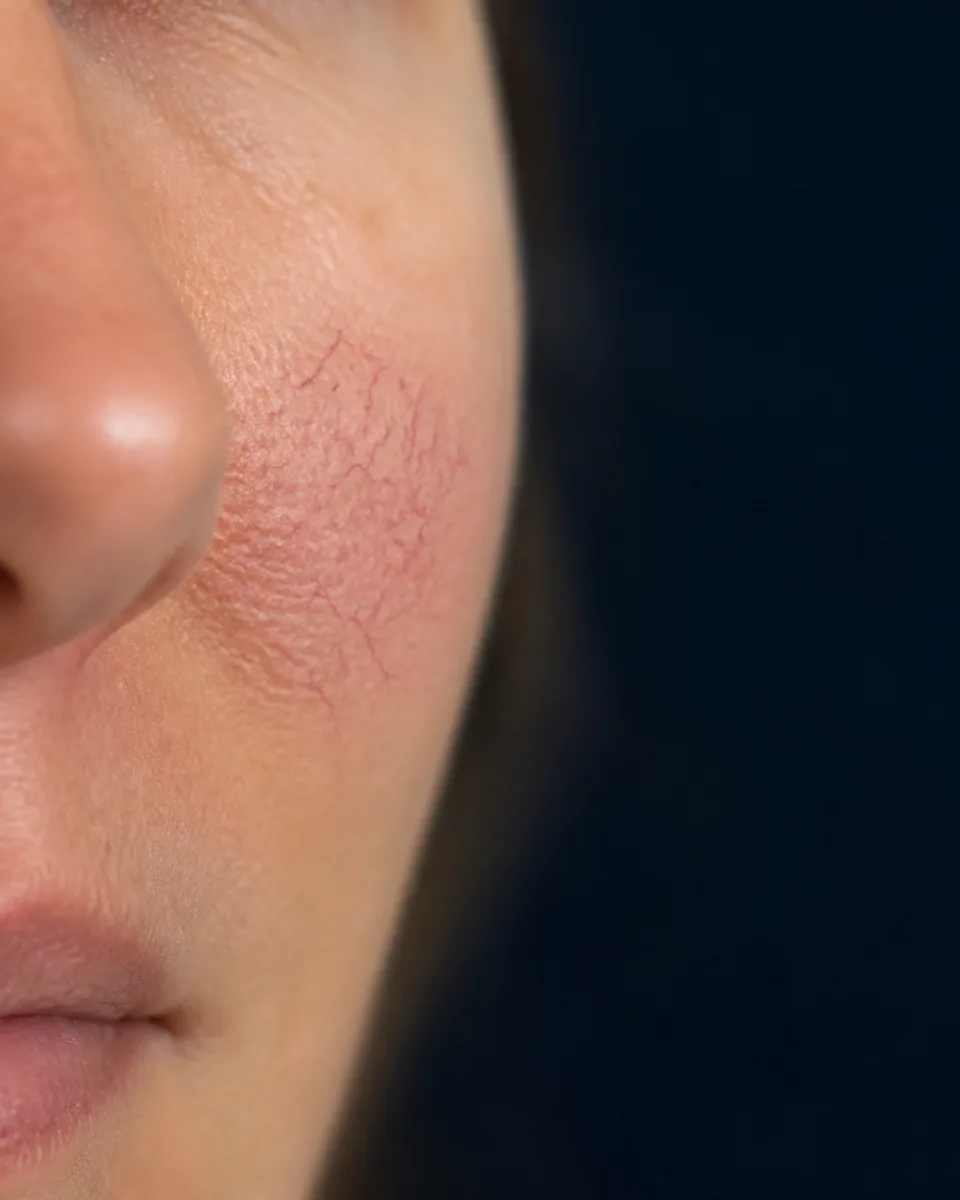
Thread veins, medically called telangiectasia, are small, dilated blood vessels visible near the surface of the skin: fine red, blue or purple lines. They are different from varicose veins, which are larger, widened veins that bulge and twist under the skin.
On the face, thread veins commonly appear on the cheeks and around the nose, and are driven mainly by sun damage, ageing, alcohol, hormonal change, genetics and certain skin conditions: most notably rosacea.
On the legs, thread veins sit on the same spectrum as varicose veins. Both are caused by faulty valves in the leg veins that let blood pool and put pressure on the vessel walls: a mechanical, pressure-related process rather than simple cosmetic ageing. This is why leg thread veins need a different way of thinking about them than facial ones.
What causes thread veins?
Facial causes include sun-damaged and ageing skin (particularly in smokers), alcohol use, pregnancy-related changes, certain medications, and a genetic tendency that runs in some families. Rosacea deserves particular mention: persistent facial redness with visible vessels is a recognised subtype of rosacea, not simply sun-damaged “broken capillaries,” and treating it correctly means recognising rosacea when it’s present. See our separate page on rosacea in Bedford for the full picture on that condition.
Leg causes centre on venous valve failure: being female, getting older, being overweight, pregnancy, spending long periods standing or sitting, a family history of varicose veins, and a previous deep vein thrombosis all increase risk. None of these apply to facial thread veins, which is the practical reason the two are managed so differently.
When leg thread veins need a doctor, not just a clinic
This is the safety point with no equivalent on the face. Leg thread veins can be an early, purely cosmetic marker of ordinary varicose veins, but they can also signal the same underlying vein pressure problem in a more advanced stage. See a GP rather than booking cosmetic treatment first if you notice any of the following alongside your thread veins:
- Pain, aching or a feeling of heaviness in the leg
- Swollen ankles or legs
- Itching, colour changes, or dry, scaly skin over the veins
- Symptoms that are worse after standing for a long time
- A sore on your leg that hasn’t healed after two weeks
- Bleeding from a vein
Left unmanaged, this underlying process can progress to varicose eczema (itchy, flaky, discoloured skin) and, in more advanced cases, to hardened skin (lipodermatosclerosis) or leg ulcers. If any of the above applies to you, that route is a GP referral for assessment (often with a duplex ultrasound scan), not a straight-to-cosmetic booking.
Sclerotherapy (the standard treatment for leg thread veins) carries a real, quantified risk of “matting”: new, fine vessels appearing after treatment, roughly four times more likely than with no treatment, and higher still with the foam form of the treatment than the liquid form. This should be discussed honestly before treatment, not discovered afterward.
Are thread veins treated on the NHS?
Purely cosmetic thread vein treatment is not NHS-funded, on the face or the legs, improving how veins look is not usually available on the NHS if they aren’t causing other problems.
Where leg thread veins come with genuine symptoms (pain, heaviness, swelling, itching, skin changes, or complications such as ulcers) NHS assessment and treatment can be available, typically starting with a GP referral and a duplex ultrasound scan to check blood flow before any treatment is planned.
So the honest summary is this. If your leg veins are symptomatic, start with your GP. If your thread veins (facial or leg) are the ordinary, symptom-free cosmetic kind, that is a private consultation.
Because treatment and the number of sessions needed depend on whether your thread veins are facial or on the legs, and how extensive they are, we don’t quote a single fixed fee. After Dr Nick has assessed your veins, you’ll receive a clear, honest plan and its price.
If your leg veins suggest a symptomatic circulation problem rather than a cosmetic one, we will say so and point you to your GP rather than treat it cosmetically.
How thread veins are treated at Rejuvena
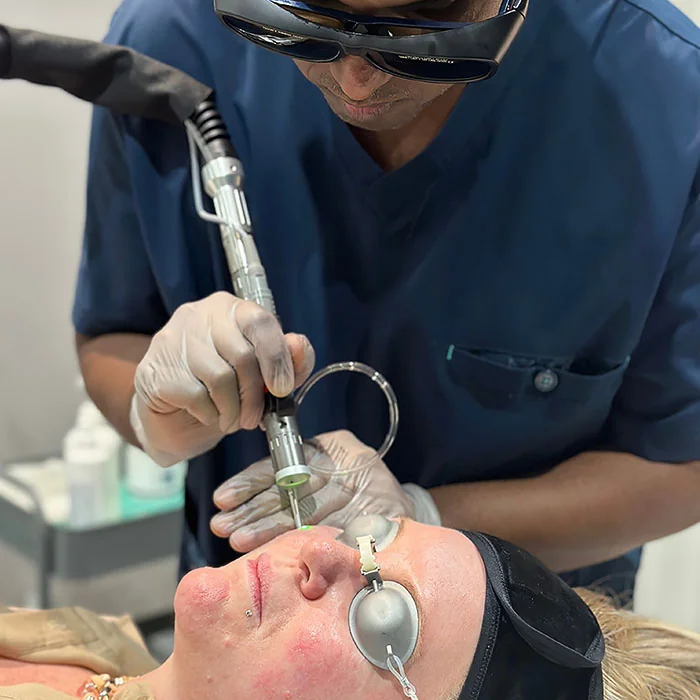
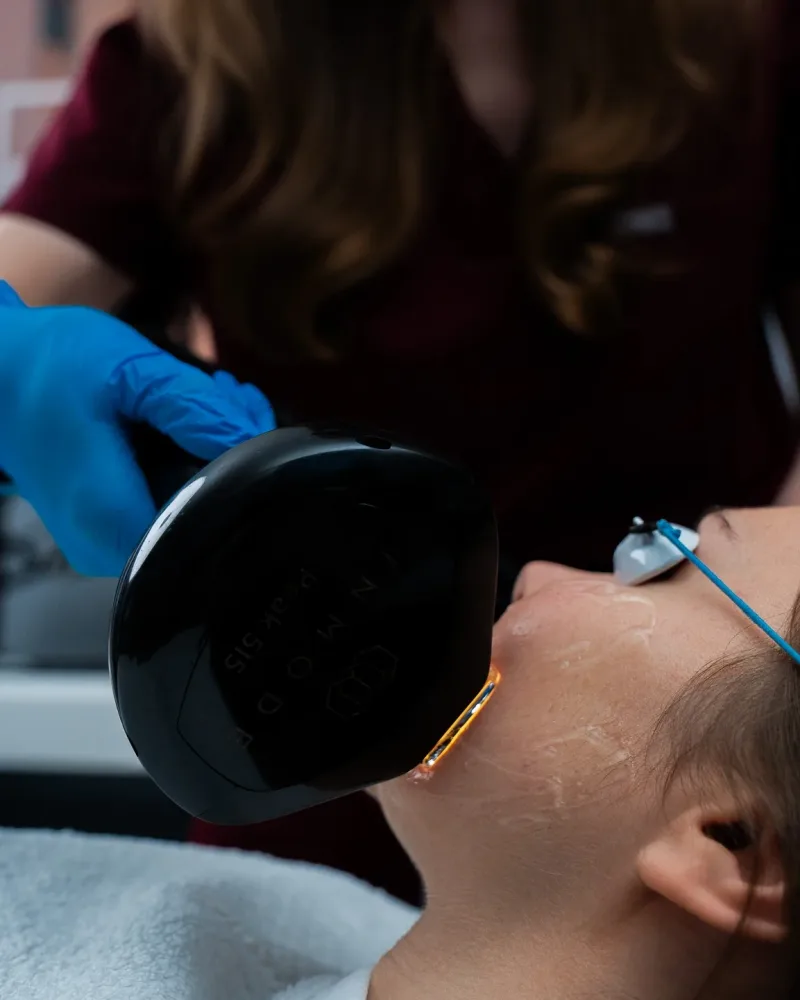
Dr Nick assesses your thread veins first, checking for the leg symptom red flags above and, on the face, distinguishing straightforward sun-damage vessels from rosacea. Suitable facial and leg thread veins are then treated with vascular laser or sclerotherapy as appropriate, with the honest matting risk of sclerotherapy explained clearly before treatment.
Why choose Rejuvena for thread veins in Bedford?
We check face and leg differently
Facial and leg thread veins have different causes and different safety flags; we assess each properly rather than treating both the same.
Diploma in Dermatology
Assessed by Dr Nick, a GMC-registered doctor, not a beauty therapist or nurse.
Honest about matting risk
We tell you about the real, quantified matting risk of sclerotherapy before treatment, not after.
Local & welcoming
Based at 52 Thor Drive, Bedford, we care for patients from Kempston, Biddenham, Bromham and across Bedfordshire.
Verified Google reviews
What our patients say
5.0from 161 Google reviews
Lana and Dr Nick are both friendly and professional. I had treatment for thread vein removal and starting to see good results already! Thank you :)
Rejuvena repliedThank you very much for your kind words Alison. Your thread veins are improving great! Kind regards 🤗
Read this review on Google (opens in a new tab)Where to begin? Easy online booking, friendly team and professional pre-treatment consultations. Dr Nick’s medical background offers the expertise and reassurance that’s often missed in beauty salons. Lots of valuable advice as I explored thread vein treatments, options, budget, and desired results. In addition to the treatment itself, I’ve welcomed the superb after-care and support. I’ll absolutely be returning and already have my eye on their cool later facial. Thank you team Rejuvena!
Rejuvena repliedThank you very much Gemma, for your kind review. We are so glad to hear you liked our services. We are very grateful. ☺️🙏
Read this review on Google (opens in a new tab)So happy to visit Svetlana and have it an amazing make up for my photoshoot. Thank you so much,highly recommended ☺️
Rejuvena repliedThank you very much for your kind words ☺️🤗🥰
Read this review on Google (opens in a new tab)I have already been a customer for almost a year and I’m impressed with every visit of how professional the clinic is and how professional Lana is. She is very friendly as well and very knowledgeable in her domain, and knows the answer to every possible question I always have. I highly recommend the clinic for its services and for its professionalism! Thank you so much for everything, and I’m always looking forward for my appointments! ❤️
Rejuvena repliedThank you very much for your feedback Andreea. We appreciate you taking time to leave this review and glad to know you and your sister liked our service. ☺️🙏
Read this review on Google (opens in a new tab)Lana and Dr Nick are absolutely fabulous. They provide an exceptional service and genuinely go above and beyond to achieve the best possible outcome — particularly for those of us whose only request is to look “10 years younger”! Having experienced and attended numerous aesthetic clinics around the world over many years, I feel particularly well placed to recognise exceptional standards of care and expertise. I can categorically say that this is my clinic of choice. That is not simply because of the clinic’s extensive and impressive range of treatments, but because of Lana and Dr Nick, their professionalism and genuine commitment to their clients are what truly set this clinic apart. The atmosphere is wonderfully warm, welcoming and friendly, while remaining highly professional throughout. Their expertise, care and attention to detail inspire complete confidence, and I have always felt that I am in exceptionally capable hands. I recommend Lana, Dr Nick and the clinic with the utmost confidence. For me, it is not simply the treatments available or the results they achieve — it is the people behind them that make this clinic so special and keep me coming back.
Rejuvena repliedThank you very much for your kind review Monika. Your words and trust mean a lot to us, and we will continue to strive hard the exceptional service that our patients deserve. We ho
Read this review on Google (opens in a new tab)Great friendly and professional service . Explained everything and not at all pushy regarding any of the procedures . Would highly recommend them
Rejuvena repliedThank you very much for your kind comments Shaun. ☺️🙏
Read this review on Google (opens in a new tab)Every review above is published on Google. Tap any card to read it there.
Thread Vein FAQs in Bedford
Are facial and leg thread veins the same thing?
When should I see a doctor about leg thread veins?
Could my facial redness actually be rosacea?
Does sclerotherapy cause more veins to appear?
How much does thread vein treatment cost in Bedford?
Book your thread vein assessment in Bedford
Speak with Dr Nick’s team at Rejuvena Bedford for an honest assessment of your thread veins. Book online or call us.