
Does creatine cause hair loss? On the best evidence available, no. The worry traces back to a single 2009 study of 20 rugby players that measured a rise in the hormone DHT but never looked at their hair. The first randomised trial to measure both DHT and hair directly, published in 2025, found no difference between creatine and placebo on either. That does not make hair loss in young men imaginary, because it is extremely common and mostly inherited. This guide explains where the myth came from, what the newer research shows, what really drives male pattern hair loss, and what to do if you are noticing thinning.
The short version
- The myth rests on one small study. A 2009 trial reported higher DHT in rugby players taking creatine. It did not measure hair.1
- A 2025 randomised trial tested hair directly. After 12 weeks of 5 g a day, DHT, the DHT-to-testosterone ratio and every hair measure were no different from placebo.2
- Genetics decides who goes bald. Pattern hair loss is driven by inherited sensitivity of follicles to DHT, not by how much DHT you make.7,8
- The risk is unproven, not disproven forever. The trial was 12 weeks long and did not record family history, so we cannot say the question is closed for everyone.2
- Thinning is worth acting on early, whatever supplements you take.
Does creatine cause hair loss? Where the claim came from
The belief that creatine causes hair loss comes almost entirely from one 2009 paper. Researchers in South Africa gave 20 college-aged rugby players creatine or placebo in a crossover design and measured their hormones. The speculation about creatine and hair loss that followed on gym forums and social media grew from that single result.1,3
It is worth looking at what that study actually did. Players took a loading dose of 25 g a day for seven days, then 5 g a day for 14 days, with glucose in both arms. The authors measured serum testosterone and DHT (dihydrotestosterone) at baseline, day 7 and day 21. Testosterone did not change. DHT rose by 56% after the loading week and was still 40% above baseline after the maintenance phase, and the DHT-to-testosterone ratio rose by 36% and then 22%.1
Two things matter here. First, the outcomes were blood hormones and body composition. Nobody examined a scalp, counted a hair or asked about thinning, so the study cannot show that creatine affects hair. The authors themselves framed it as a reason for further investigation rather than a finding about baldness.1
Second, a later review of the same data pointed out that the creatine group started with lower DHT than the placebo group (0.98 against 1.26 nmol/L), that the post-creatine values stayed within the normal range for men, and that the result had not been replicated.3,2 That does not make the 2009 finding wrong, but it is a thin foundation for a long-repeated belief.
Creatine and DHT: what do the other studies show?
Most studies that measured testosterone after creatine found no change, and the 2009 DHT result has not been repeated in a hair-focused trial. The International Society of Sports Nutrition (ISSN) authors reviewed the area in 2021. Beyond the rugby study they found 12 other studies of creatine (3 to 25 g a day for 6 days up to 12 weeks) that measured testosterone. Two reported small increases and ten reported none; free testosterone, the fraction the body converts to DHT, did not rise in the five that measured it.3
The same review makes a point that rarely reaches the forums: hard resistance training itself can raise androgen hormones, so a lifter’s DHT can move for reasons unrelated to the supplement. It concluded that the evidence at that point did not show creatine raising testosterone or DHT, and that no study had reported hair loss in humans.3
Is there a creatine and hair loss study that measured hair directly?
Yes. A 2025 randomised, placebo-controlled trial in the Journal of the International Society of Sports Nutrition is, to our knowledge, the first to measure hair directly. Its authors state that before their study there was no direct evidence on creatine and hair follicle health.2
The design was straightforward. Forty-five resistance-trained men aged 18 to 40 were randomly assigned to 5 g of creatine monohydrate a day or 5 g of maltodextrin placebo for 12 weeks, keeping their usual diet and training. Thirty-eight finished. Blood samples measured total testosterone, free testosterone and DHT. Hair was assessed by dermatologists using a trichogram and the FotoFinder imaging system, looking at hair density, follicular units and cumulative hair thickness at the vertex, the crown area where pattern loss commonly shows.2
The result was null. There were no differences between creatine and placebo in DHT, in the DHT-to-testosterone ratio, or in any hair measure. Testosterone and free testosterone did change over the 12 weeks, but equally in both groups, so the supplement was not responsible.2 The authors read this as strong evidence against the claim, noting that their DHT results contradicted the 2009 finding.
| 2009 rugby study | 2025 randomised trial | |
|---|---|---|
| Participants | 20 college rugby players, crossover | 45 recruited, 38 completed, resistance-trained men aged 18 to 40 |
| Creatine dose | 25 g/day for 7 days, then 5 g/day for 14 days | 5 g/day for 12 weeks, no loading |
| DHT result | Up 56% after loading, 40% above baseline at day 21 | No difference from placebo |
| Hair measured? | No | Yes: trichogram and FotoFinder at the crown |
| Hair result | Not applicable | No difference from placebo |
What the 2025 creatine and hair loss study cannot tell us
“No evidence of harm” is not the same as “proven impossible”, and the authors list their own caveats. The trial lasted 12 weeks, so a longer course or a higher dose could in theory behave differently. It included only men. Androgens were measured in blood rather than in the scalp. Crucially, family history of hair loss was not recorded, so the trial cannot say whether men who are genetically prone responded differently.2
It is also fair to note that the authors include researchers with ties to the sports-nutrition world, including the ISSN itself, and one disclosed receiving donated creatine for research. The trial reports no specific funding.2 An independent replication in men with early pattern thinning would be welcome; one 38-person trial is not the last word.
What do the safety reviews say about creatine?
The larger body of safety research on creatine is reassuring, though it does not single out hair. The ISSN position stand on creatine safety (2017) concluded that supplementation of up to 30 g a day for up to five years was safe and well tolerated in healthy people.5 Its text does not discuss hair loss. The hair question was handled separately in the 2021 “common questions and misconceptions” review, which also addressed water retention, kidneys and dehydration, and was followed by a second part in 2025.3,4
A 2025 analysis pooled side-effect reports from 685 human trials of creatine. Side effects were reported in 13.2% of placebo studies and 13.7% of creatine studies, which is not a significant difference, and across 49 individual side effects the authors found no significant multivariate difference between groups. Gastrointestinal upset and muscle cramps were the signals that edged higher in creatine arms.6 Hair loss is not one of the outcomes the abstract highlights, so we cite this as general safety context, not as hair evidence.
One practical point for gym-goers: some sports supplements have been found to be adulterated with anabolic steroids or prohormones.13 If you are using anything beyond plain creatine monohydrate from a reputable source, or any hormonal product, tell your doctor, because that is a different conversation from creatine.
What does DHT actually do in male pattern hair loss?
In androgenetic alopecia, DHT acts on hair follicles that are genetically sensitive to it, gradually shrinking them. Testosterone is converted to DHT by an enzyme called 5-alpha-reductase. In susceptible follicles on the scalp, DHT shortens the growth phase and the follicle becomes “miniaturised”, producing shorter, finer, paler hairs until little visible hair is left.7
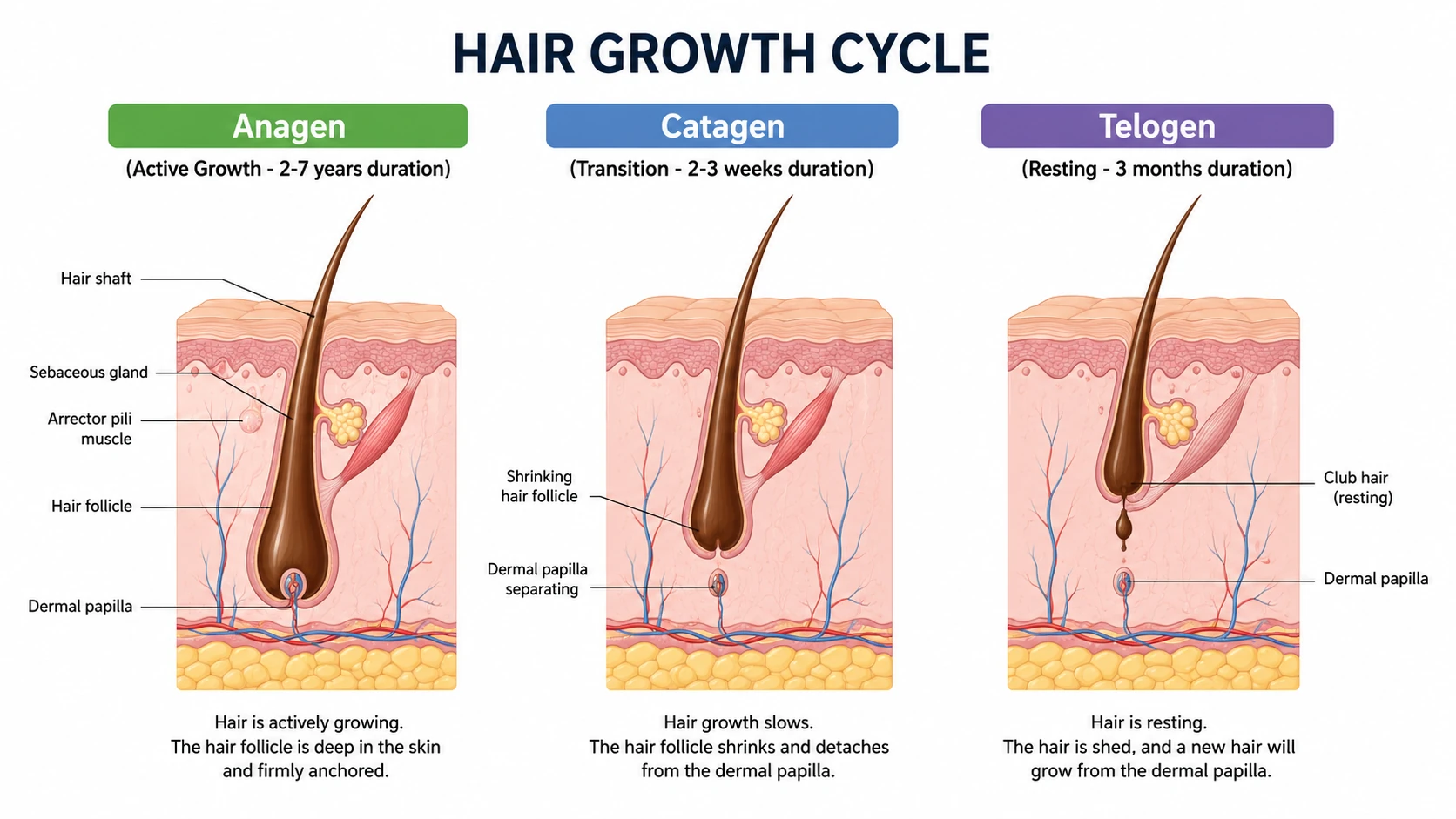
Evidence that androgens are central comes from people who lack them or cannot respond to them: those castrated before puberty, or with complete androgen insensitivity or 5-alpha-reductase deficiency, have a lower prevalence of this type of hair loss. Medicines that block 5-alpha-reductase, such as finasteride, reduce DHT and slow miniaturisation.7
But the key detail is that DHT levels are only half the story. A review in Drugs notes that testosterone levels are similar in people with and without pattern hair loss, and that the characteristic pattern follows the distribution of androgen receptors in the scalp.7 In other words, sensitivity is inherited. That is why a small, within-normal-range change in blood DHT would not be expected to decide who loses hair.
Why genetics matter far more than supplements
Male pattern hair loss is common, heritable and polygenic, and your inherited profile outweighs any single lifestyle factor. It affects at least 80% of men by the age of 70, and the NHS describes male pattern baldness as a type of hair loss that usually runs in the family.7,9
A UK Biobank study of over 52,000 men identified more than 250 independent genetic loci linked to severe hair loss, and a prediction model built on common genetic variants alone could discriminate men with no hair loss from men with severe hair loss reasonably well (AUC 0.78).8 The 2025 trial itself cites the finding that men whose biological fathers have hair loss are about twice as likely to have it themselves.2
Pattern thinning often starts in the twenties, just when many men take up serious training, so a supplement can get the blame for what the genes were already doing.
Does creatine cause hair loss if you are genetically prone?
If hair loss runs in your family, the creatine risk is unproven rather than established, and the choice is yours to make with your doctor. The only randomised hair data are reassuring but did not check family history, so we cannot promise that a man with a strong family pattern would be unaffected.2
Reasonable approach
- Treat creatine as low-concern on current evidence
- If you choose to take it, the usual dose is 3 to 5 g a day; a loading phase is not needed3
- Photograph your hairline and crown every month in the same light
See a doctor first if
- You have round bald patches or sudden clumps of hair coming out
- The scalp is red, itchy, scaly or sore
- You use steroids, prohormones or other hormonal products
- You have lost hair rapidly after illness, weight loss or a new medicine
So does creatine cause hair loss in men with a family history? Nobody has shown that it does, and nobody has ruled it out in that group. If you stop creatine for a few months and your hair does not change, you have learned something useful and lost little. If you stop and the thinning continues, you have learned something more useful still: the cause was probably your genes, and it is better to deal with that directly than to keep guessing.
What are the early signs of male pattern hair loss?
Early male pattern hair loss usually shows as a receding hairline at the temples, a thinning crown, or both, developing gradually over months and years. Pattern loss typically affects the crown and frontal scalp, with the hairline receding, and individual hairs become shorter and finer as follicles miniaturise.7
- Temples: the corners of the hairline move back, creating an “M” shape. Our guide to receding hairline signs, stages and treatment shows what each stage looks like.
- Crown: a small, thinning round area at the back of the head that you often notice first in photos or when someone else points it out. See crown thinning in hair for what to look for.
- Finer hair: strands that look shorter and wispier than they used to, with more scalp showing under bright light.
Sudden shedding, round bald patches or a sore scalp are different problems with different causes. They need a diagnosis, not a supplement change. For what counts as ordinary daily shedding, see how much hair shedding is normal.
What should you do if you are noticing thinning?
Get it looked at early, because the treatments that exist work best on follicles that are still producing hair. The NHS advises seeing a GP if you are worried about hair loss, and to do so before turning to a commercial hair clinic. It names finasteride and minoxidil as the main treatments for male pattern baldness, notes that they do not work for everyone and only work for as long as they are used, and adds that no treatment is 100% effective.9 Both are prescriber decisions, so speak to your GP or a doctor about whether either is suitable for you.
Where PRP fits is as an option for early-stage thinning, usually alongside medical treatment rather than instead of it. In a review of the literature, patients with milder pattern loss (Norwood grades II to III) did better than those with advanced loss, and the reviewers recommended PRP as a co-adjuvant because it does not suppress the hormonal component of androgenetic alopecia.10 Pooled results from randomised trials show a modest average gain in hair density of about 27 hairs per cm², with low certainty because the studies were small and varied widely.11 In a network comparison, PRP alone ranked below minoxidil alone.12 Our full evidence review, does PRP work for hair loss?, goes through these trials and what they mean in practice.
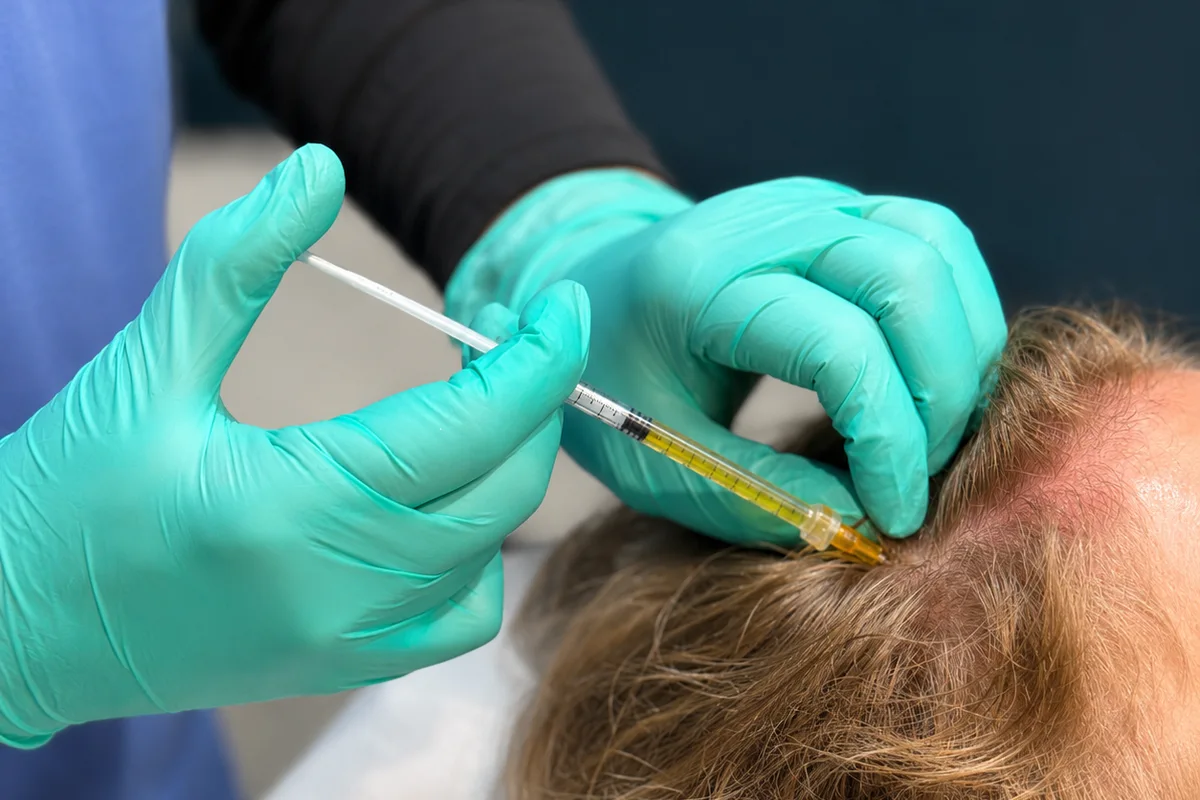
At Rejuvena, Dr Nick leads every hair consultation, starting with working out what type of hair loss you have. If it is early pattern thinning, he may suggest PRP hair treatment in Bedford, sometimes combined with microneedling. If your picture points to something else, such as patchy loss, sudden diffuse shedding or a scalp condition, he will say so and refer you appropriately. Prices are on our pricing page, and our hair loss treatment guide compares the options side by side.
Free 2-minute check
Noticing thinning? See what the evidence suggests for your pattern
Answer seven quick questions about your hair loss pattern, how long it has been happening and what you have tried. Our Hair Growth Potential check shows what clinical trials reported for people with a similar profile, and flags if your hair loss needs a doctor’s assessment first.
Check your hair growth potential →Frequently asked questions
Does creatine make you go bald?
There is no good evidence that it does. A 2025 randomised trial measured DHT and hair density, hair count and thickness over 12 weeks and found no difference from placebo. Baldness is primarily driven by inherited follicle sensitivity to DHT, which is why it often starts at the same age that many men begin training.
Does creatine increase DHT?
One 2009 study found a rise in DHT in rugby players. The 2025 randomised trial did not reproduce it, finding no difference in DHT or the DHT-to-testosterone ratio between creatine and placebo.
Does a creatine loading phase affect hair differently?
The 2009 study used a loading phase and reported the DHT rise; the 2025 trial used a steady 5 g a day with no loading and found no change. No trial has directly compared loading against not loading for hair outcomes, so we cannot say. Loading is not necessary for creatine to work, and the standard 3 to 5 g a day approach avoids the question.3
Will my hair grow back if I stop creatine?
If creatine is not the cause, stopping it will not change much. Male pattern baldness is a permanent type of hair loss that usually runs in families, so it does not reverse simply because a supplement is stopped.9 If you have noticed shedding or thinning, it is worth finding out which type it is.
Is creatine safe to take if I am already losing hair?
Current evidence suggests it does not worsen hair loss, but the studies did not specifically recruit men with established pattern thinning. Discuss it with your GP or doctor, and focus on identifying and treating the hair loss itself rather than assuming creatine is the cause.
References
- van der Merwe J, Brooks NE, Myburgh KH. Three weeks of creatine monohydrate supplementation affects dihydrotestosterone to testosterone ratio in college-aged rugby players. Clin J Sport Med. 2009;19(5):399–404. doi:10.1097/jsm.0b013e3181b8b52f
- Lak M, Forbes SC, Ashtary-Larky D, et al. Does creatine cause hair loss? A 12-week randomized controlled trial. J Int Soc Sports Nutr. 2025;22(sup1):2495229. doi:10.1080/15502783.2025.2495229
- Antonio J, Candow DG, Forbes SC, et al. Common questions and misconceptions about creatine supplementation: what does the scientific evidence really show? J Int Soc Sports Nutr. 2021;18(1):13. doi:10.1186/s12970-021-00412-w
- Antonio J, Brown AF, Candow DG, et al. Part II. Common questions and misconceptions about creatine supplementation: what does the scientific evidence really show? J Int Soc Sports Nutr. 2025;22(1):2441760. doi:10.1080/15502783.2024.2441760
- Kreider RB, Kalman DS, Antonio J, et al. International Society of Sports Nutrition position stand: safety and efficacy of creatine supplementation in exercise, sport, and medicine. J Int Soc Sports Nutr. 2017;14:18. doi:10.1186/s12970-017-0173-z
- Kreider RB, Gonzalez DE, Hines K, Gil A, Bonilla DA. Safety of creatine supplementation: analysis of the prevalence of reported side effects in clinical trials and adverse event reports. J Int Soc Sports Nutr. 2025;22(sup1):2488937. doi:10.1080/15502783.2025.2488937
- Devjani S, Ezemma O, Kelley KJ, Stratton E, Senna M. Androgenetic alopecia: therapy update. Drugs. 2023;83(8):701–715. doi:10.1007/s40265-023-01880-x
- Hagenaars SP, Hill WD, Harris SE, et al. Genetic prediction of male pattern baldness. PLoS Genet. 2017;13(2):e1006594. doi:10.1371/journal.pgen.1006594
- NHS. Hair loss. nhs.uk/conditions/hair-loss
- Stevens J, Khetarpal S. Platelet-rich plasma for androgenetic alopecia: a review of the literature and proposed treatment protocol. Int J Womens Dermatol. 2019;5(1):46–51. doi:10.1016/j.ijwd.2018.08.004
- Kieling L, Konzen AT, Zanella RK, Valente DS. Is autologous platelet-rich plasma capable of increasing hair density in patients with androgenic alopecia? A systematic review and meta-analysis of randomized clinical trials. An Bras Dermatol. 2024;99(6):847–862. doi:10.1016/j.abd.2024.01.002
- Gupta AK, Wang T, Bamimore MA, Polla Ravi S, Talukder M. Relative effects of minoxidil 5%, platelet-rich plasma, and microneedling in pattern hair loss: a systematic review and network meta-analysis. Skin Appendage Disord. 2023;9(6):397–406. doi:10.1159/000534196
- Puscasiu D, Flangea C, Vlad D, et al. Adulteration of sports supplements with anabolic steroids: from innocent athlete to vicious cheater. Nutrients. 2025;17(19):3146. doi:10.3390/nu17193146
This article is for general information and does not replace a personal consultation. It is not advice to start or stop any supplement or medicine; speak to your GP or prescriber. PRP results vary with the type and stage of hair loss, general health and how many viable follicles remain.