
Crown thinning is real hair loss only if the density at the crown is falling over time, and that is harder to judge than it sounds. Every crown has a whorl, a swirl where the hair radiates outwards, and it often shows scalp. Overhead lighting, wet hair and a phone held at the wrong angle can make a healthy crown look like thinning hair on the crown. This guide explains how to tell a normal whorl from genuine vertex thinning, how male and female patterns differ, when a bald spot on the crown needs a doctor rather than a treatment, and what each option can realistically do.
The short version
- A whorl is normal. Hair radiates from a point at the crown in a swirl, and some scalp is usually visible there. It is a developmental feature, not a sign of hair loss.1
- Trend matters more than any single photo. Take the same photos, in the same light, every month or two, and compare.
- Men and women lose hair differently. Men usually thin at the vertex and temples; women usually thin diffusely over the top, with a widening parting and a preserved front hairline.2,3
- A round, smooth bald patch is a different problem. It points towards alopecia areata and needs a doctor, not a pattern hair loss treatment.4
- Medicines have the strongest evidence. PRP and microneedling are supporting options with lower-certainty evidence, and none of these treatments is a one-off fix.5,6
Is it crown thinning or just my hair whorl?
A normal whorl is a small, central swirl where the hair grows outwards in a spiral, with consistent density all around it. Crown thinning is a widening area where hairs are finer, shorter and further apart, so that the scalp shows through across a larger patch. The swirl itself is anatomy. A 2024 study of twins and children concluded that whorl formation is a genetically determined developmental process, which fits with almost everyone having one.1
The trouble is that a whorl shows the scalp more readily than the rest of the head, so it is the first place people notice something. Three things commonly make a healthy crown look worse than it is:
- Harsh overhead light. Bathroom spotlights and flash photography shine straight down between the hairs and light up the scalp.
- Wet, product-laden or freshly cut hair. Hair clumps into strands, and short hair has less cover.
- Odd angles. A phone held high, or a mirror held behind you, changes how much scalp you see from one day to the next.

How can I check my crown properly at home?
The aim is to take away every variable except your hair. A simple routine works for most people:
- Same light, same place. Use soft, even daylight from a window, or the same lamp each time. Avoid spotlights directly overhead.
- Same state of hair. Dry, clean, styled the same way, ideally on the same day of the week.
- Same angles. Ask someone to photograph the crown from directly above, and also the parting if you have one. Keep the phone at the same distance and height.
- Same interval. Every four to eight weeks, saved in one album. Judge the set, not the latest picture.
- Compare across months, not days. Hair density changes slowly, so a bad week of shedding or a haircut tells you nothing.
Researchers use the same principle. In the large finasteride trials of men with vertex hair loss, results were judged from standardised clinical photographs reviewed against baseline.7 If three or four sets taken months apart show the area of visible scalp growing, or the hairs in it getting finer, that is a trend worth acting on.
What does thinning hair on the crown look like in men?
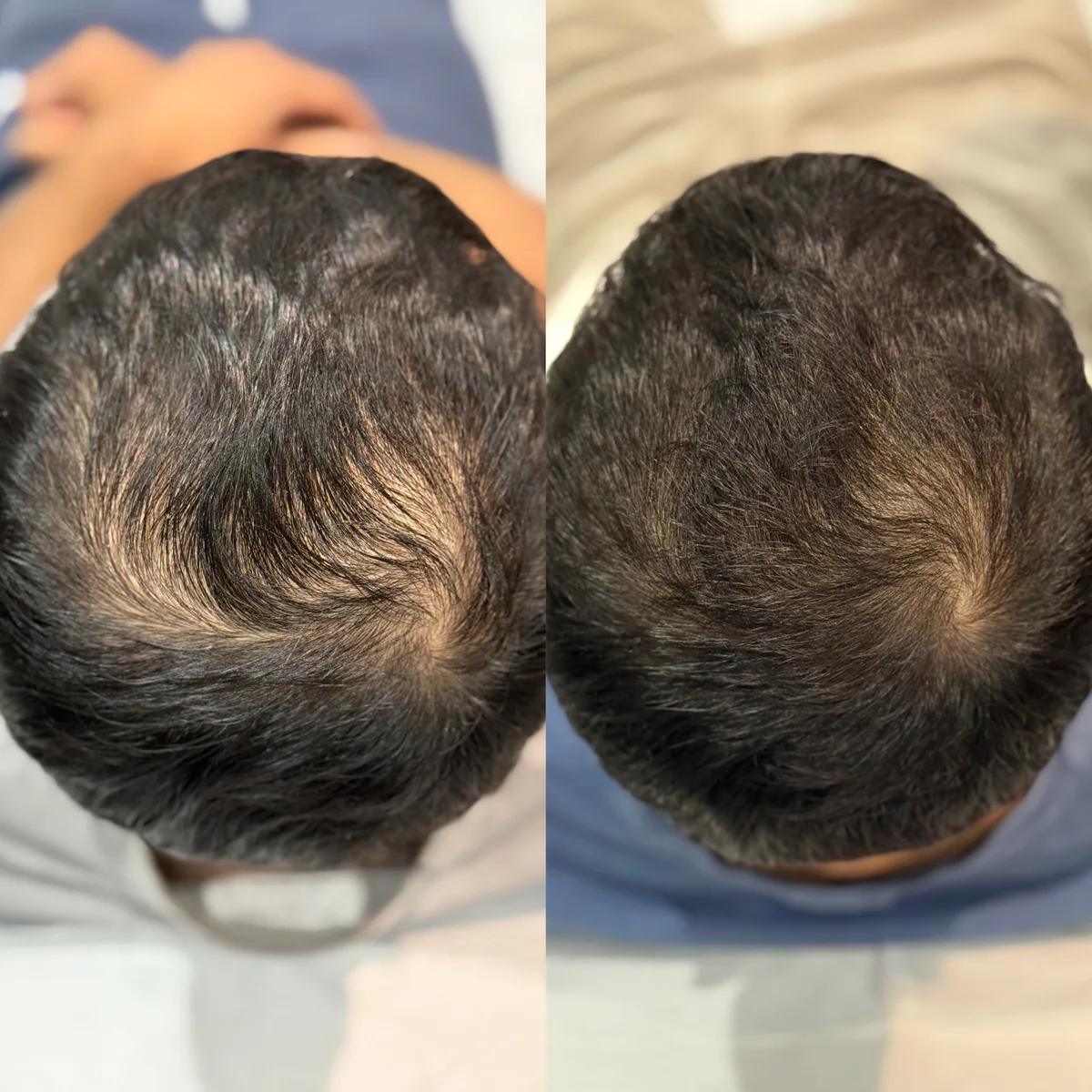
In men, crown thinning usually appears as a round or oval area at the vertex where hair becomes progressively sparser, often alongside receding temples. It is the most recognisable form of male pattern hair loss, and clinicians grade it on the Hamilton-Norwood scale, which describes thinning starting at the temples as well as the crown or vertex and gradually spreading across the top of the scalp.8
Norwood’s scale includes a specific “vertex” variant. In Type III vertex, the hair loss is primarily at the vertex, with limited recession at the front that does not go beyond a Type III hairline.8 Higher types describe progressively larger bald areas at the front and vertex, separated at first by a band of denser hair across the top. The British Association of Dermatologists notes that in male pattern hair loss the hair at the sides and back of the head is spared.3
That pattern is useful for self-checking. If the thinning is at the very top of the back of the head, getting wider over a year or two, with healthy hair on the sides and lower back of the scalp, it fits vertex pattern loss. For more on the front of the scalp, see our guide to receding hairline signs, stages and treatment.
What does crown thinning in women look like?
Crown thinning in women is usually diffuse rather than a defined bald spot: the parting widens, hair over the top becomes less dense and the hairline at the front stays in place. The British Association of Dermatologists describes female pattern hair loss as thinning spread across the top of the scalp, with the central parting becoming more visible and wider, while the hairline at the front often remains normal.2
The Ludwig scale grades it by the crown. Grade I is perceptible thinning on the crown, limited at the front by a line one to three centimetres behind the frontal hairline; grade II is pronounced thinning within that area; grade III is full baldness within it. Ludwig emphasised that the frontal fringe is preserved.8 A related description is a “Christmas tree” distribution, where density falls progressively from the vertex towards the front.8
Several things can mimic female crown thinning, and a doctor will usually look for them first: iron deficiency, thyroid disease, recent illness, childbirth, a crash diet or some medications. If your shedding started suddenly, or all over, a different process may be involved. Our posts on menopause hair loss and postpartum hair loss cover two of the commonest triggers.
| Pattern | Typical look | Who | Next step |
|---|---|---|---|
| Normal whorl | Small central swirl, consistent density around it, unchanged in photos over months | Everyone | Keep a photo record; no treatment needed |
| Male vertex pattern | Widening round or oval thinning at the vertex, often with receding temples; sides and back spared | Mostly men | Seek advice early; medicines have the best evidence |
| Female diffuse crown / parting | Wider parting, less density over the top, front hairline preserved | Mostly women | Doctor assessment for other causes, then options |
| Round, smooth patch | Coin-sized, smooth, clearly edged bald patch, not scaly or inflamed | Anyone | See a doctor; probably not pattern hair loss |
When is a bald spot on the crown something else?
A bald spot on the crown that is round or oval, smooth and suddenly obvious is more likely to be alopecia areata than pattern hair loss, so it should be looked at by a doctor. The British Association of Dermatologists describes alopecia areata as typically starting with one or more small, coin-sized, round, smooth patches of baldness that are not inflamed or scaly.4 It is an immune condition, can affect anyone, and may also involve the beard, eyebrows or eyelashes.4
The same applies to a bald patch on the back of the head that is shiny, red, scaly, itchy or sore, which can point to scarring or inflammatory conditions where follicles are permanently damaged. Platelet-rich plasma is not the right starting point for either alopecia areata or scarring loss. Our PRP hair check flags a round-patch answer as “needs a doctor’s assessment” for exactly this reason. The NHS advises seeing a GP if you are worried about your hair loss.9
More likely gradual pattern thinning
- Slow change over many months or years
- Hairs in the area are finer and shorter, not absent
- Widening parting or enlarging crown area
- Family history of hair loss
- Sides and back of the scalp look healthy
See a doctor first if
- A round or oval bald patch appeared quickly
- The skin is smooth, shiny, red, scaly or sore
- Hair is coming out in handfuls, all over
- You are losing eyebrow, beard or eyelash hair
- Loss followed illness, childbirth or major stress
What treatments work for crown thinning, and how strong is the evidence?
For hair thinning from the crown, the strongest evidence is for minoxidil in men and women and finasteride in men, followed by microneedling and PRP as add-ons with lower-certainty evidence. All of these treatments only work for as long as they are used, and none works for everyone.5 Medicines are mentioned here for information only; your GP or prescriber decides what is suitable for you.
| Option | What the evidence says | Strength | Worth knowing |
|---|---|---|---|
| Minoxidil (topical) | In a 24-week trial in 70 men, 5% foam gave similar responses at the vertex and the front; users rated vertex coverage as improved10 | Strong; licensed | Needs 6 to 12 months to judge; benefit lasts only while used |
| Finasteride (men only) | In trials of men with vertex loss, more hair growth than placebo across scalp regions at 24 months7 | Strong; licensed for men | Prescription-only; not for women; slightly more sexual side effects than placebo in that trial |
| Microneedling | In 100 men with vertex or more advanced loss, weekly microneedling plus minoxidil gave far greater hair-count gains than minoxidil alone at 12 weeks11 | Promising add-on; pilot-sized | Ranked best in a network analysis when combined with minoxidil12 |
| PRP | Pooled gain of roughly 20 to 28 hairs per cm² in meta-analyses13,14 | Low certainty | Ranked below minoxidil alone in one network analysis; best as part of a plan12 |
Do minoxidil and finasteride work on the crown?
Yes, the crown is where they have been studied most. Both tend to work best at preserving and thickening hair at the vertex when started early, and both only work while you keep using them. In one 24-week randomised trial in men, 5% minoxidil foam produced similar responses in the frontotemporal and vertex regions, and users rated their vertex scalp coverage as improved.10 In a follow-up of that trial the authors concluded the foam was effective in stabilising hair density and scalp coverage in both areas over 104 weeks, in other words it held the line rather than reversing loss.15
For finasteride, double-blind studies randomised men with vertex hair loss to the drug or placebo. At 24 months there was significantly more hair growth than with placebo in all scalp regions, judged from standardised photographs, with a slightly higher rate of drug-related sexual side effects in the finasteride group.7 Finasteride is not suitable for women.5 For female pattern loss, the British Association of Dermatologists says daily minoxidil may help slow progression, that only the 2% strength is licensed for women, and that it should be used for at least six months before any benefit is expected.2
Does PRP work for crown thinning?
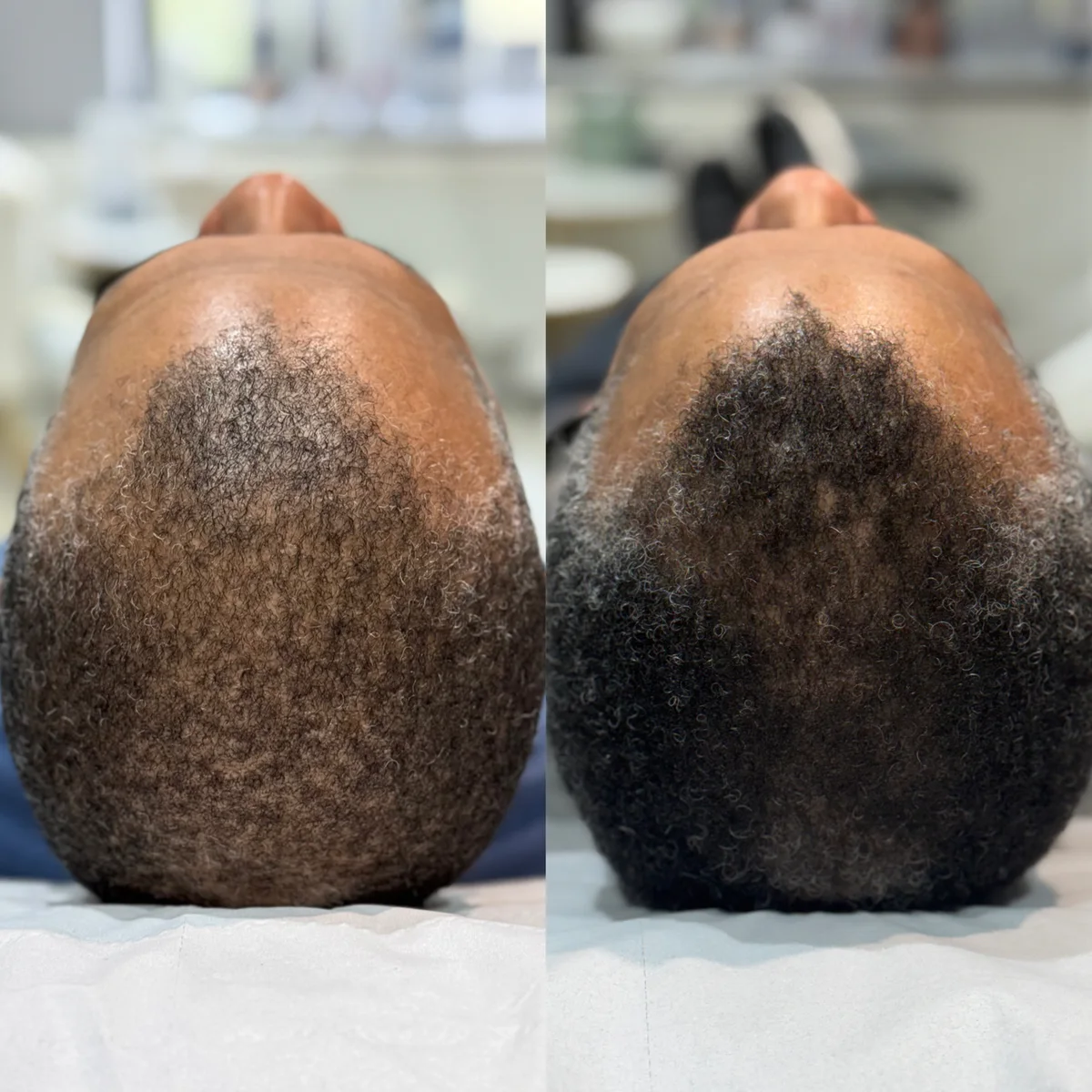
PRP can modestly increase hair density in pattern hair loss, but the evidence is low-certainty and it has not been shown to work better than minoxidil. A 2024 meta-analysis of 13 randomised trials found an average gain of about 27.6 hairs per cm², rated low certainty, with no significant change in hair thickness.13 A 2025 review of 43 trials found about 19.6 per cm² overall.14 We explain these figures in detail in Does PRP work for hair loss?
Hair trials usually count hairs in one marked target area, and where that area sits varies between studies, so a pooled figure is not a crown-specific one. What the reviews do suggest is that men with milder loss respond better than those with advanced loss.16 PRP acts on follicles that are still alive, so a crown that is thin but still producing fine hairs is a far better candidate than one that has been smooth and bald for years. In the best-known small trial, four of 20 men saw their loss progressing again by around 16 months, which is why maintenance is part of any realistic plan.17
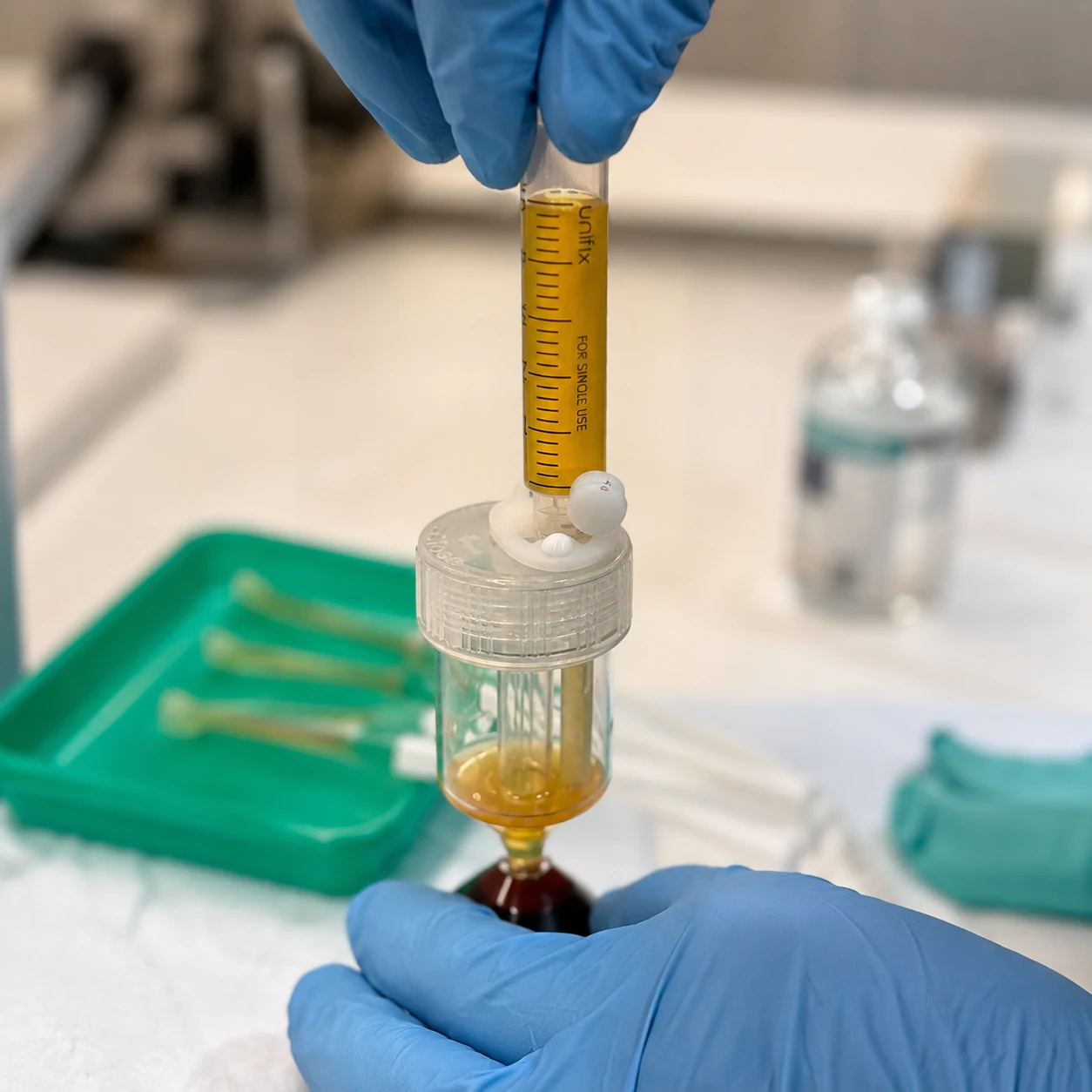
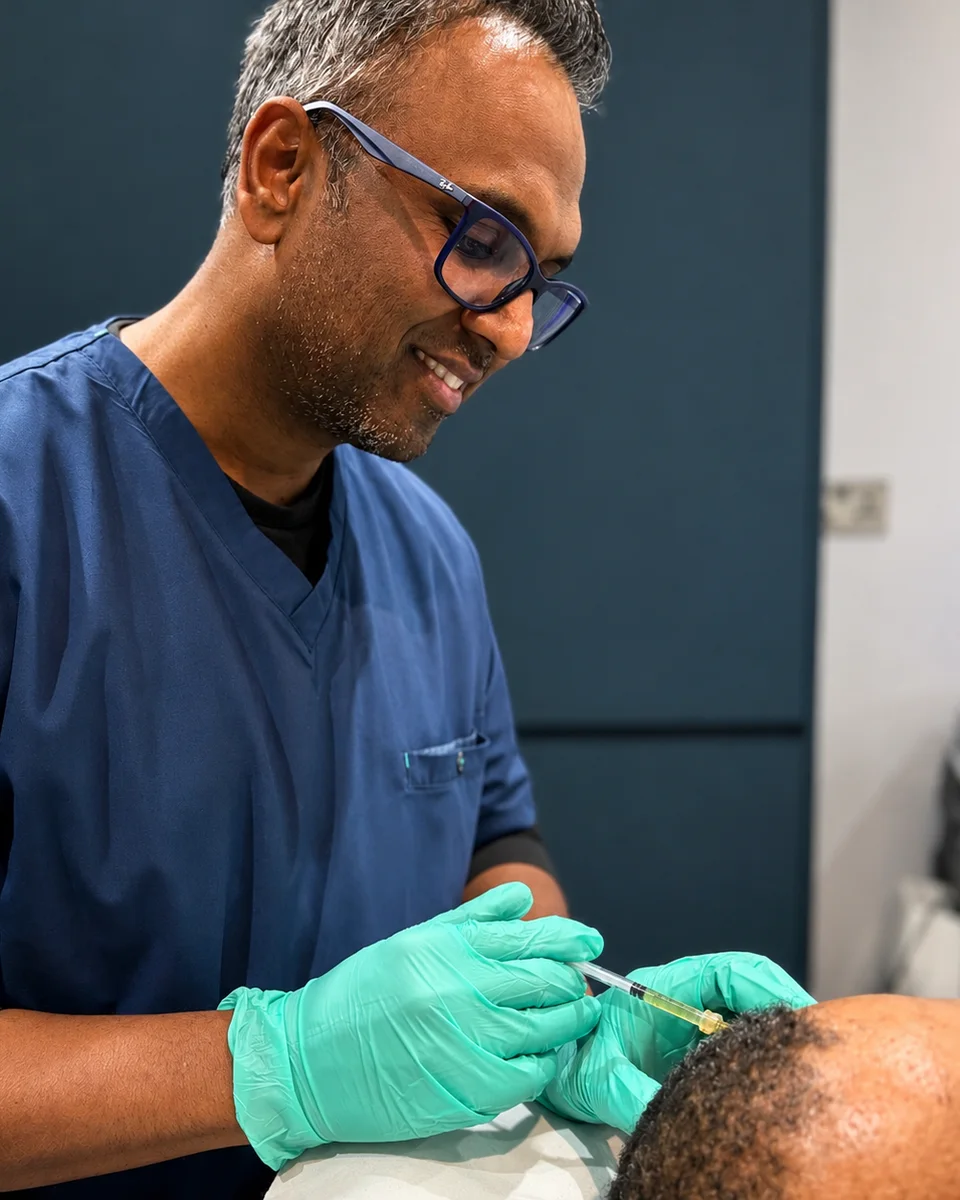
At Rejuvena, Dr Nick often combines PRP with microneedling, and sometimes PRF, in a plan tailored after a consultation. For crown thinning that has progressed, we may also encourage a conversation with your GP about minoxidil or finasteride, because the evidence suggests combinations beat PRP alone.12 Read more about our approach to doctor-led PRP hair treatment in Bedford.
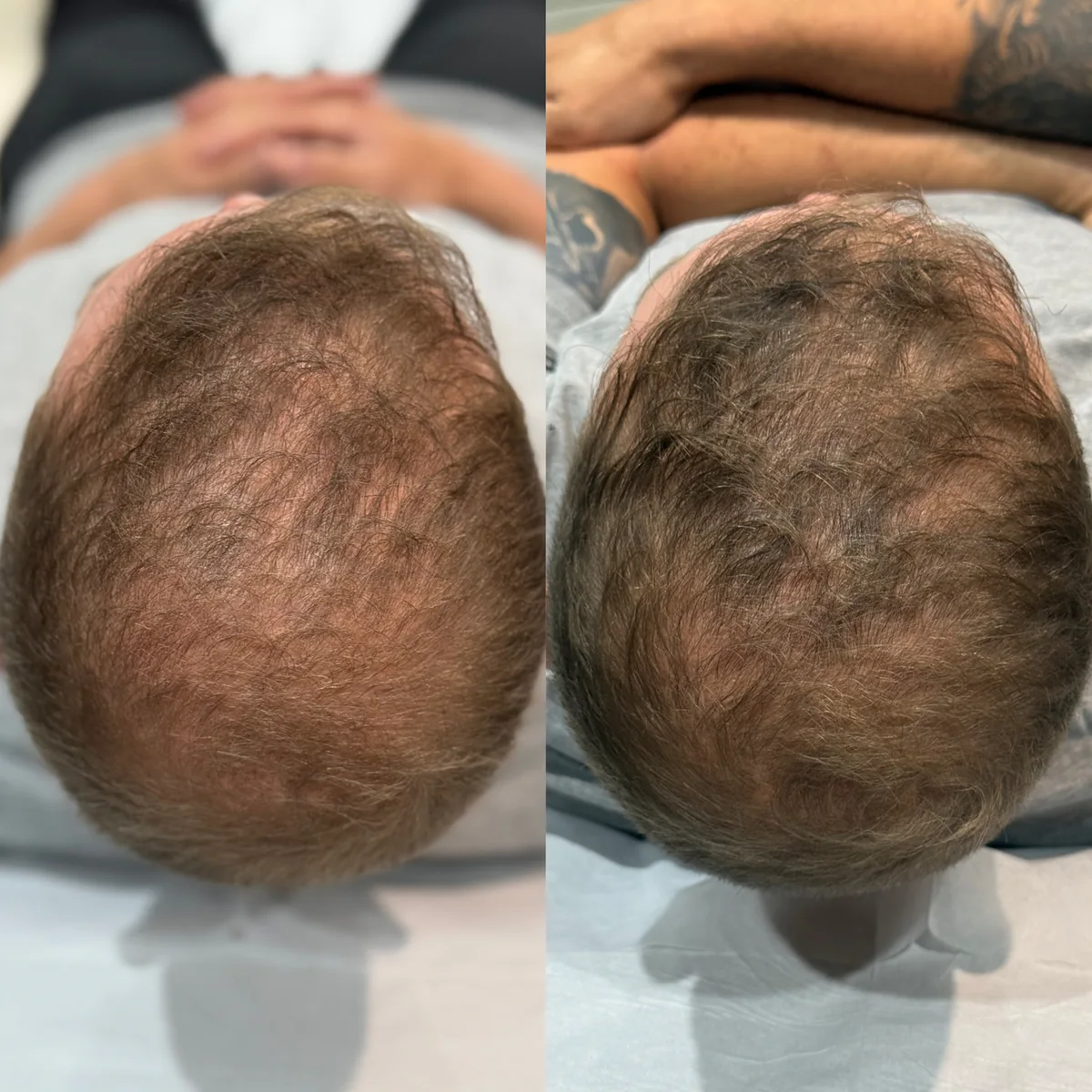
How long does it take to see a difference at the crown?
Plan on six to twelve months to judge any treatment for crown thinning, because hair responds on its own cycle. The British Association of Dermatologists says minoxidil needs at least six months and possibly up to twelve in men, while finasteride may take up to 14 months of continuous use before a benefit is usually seen.3 For women, it says all the treatments only work for as long as they are continued.2 PRP follows the same hair cycle, so this is the timeline we describe for it in clinic:
- Weeks 1 to 4. Nothing to see. Some people notice a little extra shedding at first.
- Months 2 to 3. Shedding settles; fine new hairs may begin to appear.
- Months 4 to 6. Density changes become visible on a consistent photo set.
- 6 to 12 months. The realistic judgement point for medicines; periodic maintenance is usually needed with PRP to hold gains.17,18
This is why the photo routine above matters: at month four your mirror will look much like it did at month one, but a consistent set of pictures will show the difference.
Free 2-minute check
Is your crown thinning suitable for PRP?
Our Hair Growth Potential check asks seven questions, including a picture-based hair loss stage picker for men and women, and shows what the evidence suggests for someone with a similar profile. If your answers point to round patches, sudden shedding or scarring, it will tell you to see a doctor first.
Check your hair growth potential →Frequently asked questions
Can a crown whorl look like thinning?
Yes. A whorl always shows more scalp than the surrounding hair, and light from above makes it more obvious. If it looks the same in consistent photos over several months, it is very likely just your whorl, though a doctor can confirm.
Is hair thinning from the crown always genetic?
Pattern hair loss is the commonest cause and usually runs in families,9 but not the only one. Iron deficiency, thyroid problems, illness, medicines and stress can all contribute, particularly in women.
Can women get a bald patch on the back of the head?
Women more often develop diffuse thinning than a defined bald spot. A distinct round patch should be assessed by a doctor, because alopecia areata and scarring conditions look different from pattern hair loss and are managed differently.
Will cutting my hair shorter hide crown thinning?
Often it helps, because longer hair separates and shows the scalp. It does not change the underlying density, so keep tracking with photos taken at the same hair length.
Should I see my GP or a clinic first?
If the change is sudden, patchy or accompanied by symptoms, start with your GP. For gradual thinning, a doctor-led assessment of the pattern and likely causes is the sensible first step before any treatment.
Is PRP available on the NHS for crown thinning?
No. The British Association of Dermatologists states PRP is not offered on the NHS and can be sought privately.3 At Rejuvena a single session is £400, a three-session course is £1,125 and a five-session course is £1,750; see pricing.
References
- Willems M, Hennocq Q, de Lara ST, Kogane N, Fleury V, Rayssiguier R, Santander JJC, Requena R, Stirnemann J, Khonsari RH. Genetic determinism and hemispheric influence in hair whorl formation. J Stomatol Oral Maxillofac Surg. 2024;125:101664. doi:10.1016/j.jormas.2023.101664
- British Association of Dermatologists. Female pattern hair loss (patient information). skinhealthinfo.org.uk
- British Association of Dermatologists. Male pattern hair loss (patient information). skinhealthinfo.org.uk
- British Association of Dermatologists. Alopecia areata (patient information). skinhealthinfo.org.uk
- NHS. Hair loss: treatments. nhs.uk/conditions/hair-loss/treatments
- Devjani S, Ezemma O, Kelley KJ, Stratton E, Senna M. Androgenetic alopecia: therapy update. Drugs. 2023;83(8):701–715. doi:10.1007/s40265-023-01880-x
- Olsen EA, Whiting DA, Savin R, Rodgers A, Johnson-Levonas AO, Round E, Rotonda J, Kaufman KD; Male Pattern Hair Loss Study Group. Global photographic assessment of men aged 18 to 60 years with male pattern hair loss receiving finasteride 1 mg or placebo. J Am Acad Dermatol. 2012;67(3):379–386. doi:10.1016/j.jaad.2011.10.027
- Gupta M, Mysore V. Classifications of patterned hair loss: a review. J Cutan Aesthet Surg. 2016;9(1):3–12. doi:10.4103/0974-2077.178536
- NHS. Hair loss. nhs.uk/conditions/hair-loss
- Hillmann K, Garcia Bartels N, Kottner J, Stroux A, Canfield D, Blume-Peytavi U. A single-centre, randomized, double-blind, placebo-controlled clinical trial to investigate the efficacy and safety of minoxidil topical foam in frontotemporal and vertex androgenetic alopecia in men. Skin Pharmacol Physiol. 2015;28(5):236–244. doi:10.1159/000375320
- Dhurat R, Sukesh M, Avhad G, Dandale A, Pal A, Pund P. A randomized evaluator blinded study of effect of microneedling in androgenetic alopecia: a pilot study. Int J Trichology. 2013;5(1):6–11. doi:10.4103/0974-7753.114700
- Gupta AK, Wang T, Bamimore MA, Polla Ravi S, Talukder M. Relative effects of minoxidil 5%, platelet-rich plasma, and microneedling in pattern hair loss: a systematic review and network meta-analysis. Skin Appendage Disord. 2023;9(6):397–406. doi:10.1159/000534196
- Kieling L, Konzen AT, Zanella RK, Valente DS. Is autologous platelet-rich plasma capable of increasing hair density in patients with androgenic alopecia? A systematic review and meta-analysis of randomized clinical trials. An Bras Dermatol. 2024;99(6):847–862. doi:10.1016/j.abd.2024.01.002
- Anitua E, Tierno R, Alkhraisat MH. Platelet-rich plasma in the management of alopecia: a systematic review and meta-analysis of clinical evidence. Dermatol Ther (Heidelb). 2025;15(11):3213–3252. doi:10.1007/s13555-025-01542-8
- Kanti V, Hillmann K, Kottner J, Stroux A, Canfield D, Blume-Peytavi U. Effect of minoxidil topical foam on frontotemporal and vertex androgenetic alopecia in men: a 104-week open-label clinical trial. J Eur Acad Dermatol Venereol. 2016;30(7):1183–1189. doi:10.1111/jdv.13324
- Stevens J, Khetarpal S. Platelet-rich plasma for androgenetic alopecia: a review of the literature and proposed treatment protocol. Int J Womens Dermatol. 2019;5(1):46–51. doi:10.1016/j.ijwd.2018.08.004
- Gentile P, Garcovich S, Bielli A, Scioli MG, Orlandi A, Cervelli V. The effect of platelet-rich plasma in hair regrowth: a randomized placebo-controlled trial. Stem Cells Transl Med. 2015;4(11):1317–1323. doi:10.5966/sctm.2015-0107
- Natarelli N, Gahoonia N, Sivamani RK. Integrative and mechanistic approach to the hair growth cycle and hair loss. J Clin Med. 2023;12(3):893. doi:10.3390/jcm12030893
This article is for general information and does not replace a personal consultation. Hair loss has many causes, and a diagnosis needs a doctor. PRP and other treatment results vary with the type and stage of hair loss, general health and how many viable follicles remain.