
Postpartum hair loss is very common, usually temporary, and almost never a sign that something is wrong with you. Around three months after a baby arrives, many women notice far more hair in the brush, the shower drain and on the pillow. It is alarming, particularly when you are already tired and adjusting to life with a newborn. This guide explains what is happening, how long it normally lasts, which checks are worth asking your GP or health visitor about, how to look after your hair in the meantime, and the point at which thinning deserves a proper assessment.
The short version
- It is a shift in the hair cycle, not hair “dying”. More follicles than usual move into the resting phase after birth and the hairs shed together.1,2
- Timing is fairly predictable. Shedding typically shows up around 3 to 4 months after the trigger, and the shedding phase lasts about 3 to 6 months.1,4
- Most hair recovers without treatment. The British Association of Dermatologists says this type of shedding usually gets completely better, though thickness can take many months to return.1
- Some checks are worth asking about: iron, thyroid function and general nutrition.1,5,6
- This is usually not a PRP situation. We do not treat during pregnancy, and breastfeeding is something Dr Nick assesses individually. If thinning persists after recovery, an assessment is the right next step.
What causes postpartum hair loss?
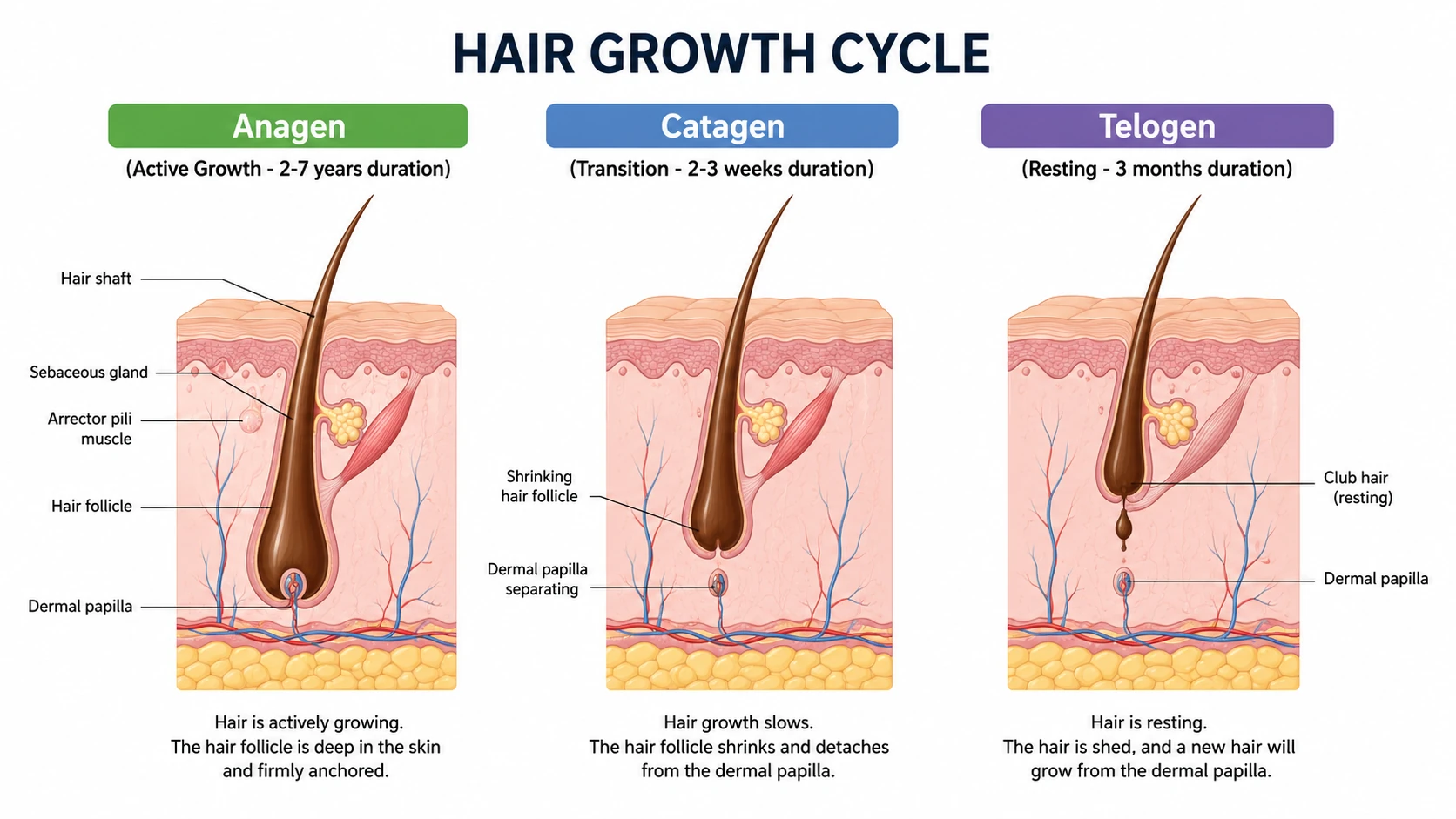
Postpartum hair loss happens because pregnancy temporarily changes the hair cycle and birth changes it back. During pregnancy, more follicles than usual stay in the growth phase because of hormonal changes. After delivery, hormone levels drop and those follicles move into the resting phase together, so a larger than usual number of hairs shed within a few weeks of each other.2 Doctors call this telogen effluvium, and the pregnancy-related version is sometimes called telogen gravidarum.
It helps to know how the cycle works. Each hair grows for years (anagen), then regresses (catagen), then rests (telogen) before it falls and a new hair begins. At any moment around 9% of scalp follicles are in the resting phase.11 Losing 50 to 100 hairs a day is normal.10 Postpartum shedding is what you see when that resting group suddenly becomes much larger.

One thing worth saying openly: the research on how much of this is truly extra is mixed. In a study of 116 women using a computerised hair analysis, the proportion of resting hairs was significantly higher at four months after birth than in late pregnancy, but the authors concluded that in most women the change was not exaggerated.2 A 2016 literature review went further and argued that the postpartum shedding “entity” is poorly defined and its true frequency unknown.3 That does not mean your experience is imaginary. Hair often looks fuller in pregnancy, so the contrast afterwards can feel dramatic, and sleep loss, stress and low iron can add to it. It does mean that the usual explanation is a normal, self-limiting process rather than a disease.
When does postpartum hair loss start, and how long does it last?
Postpartum hair loss typically starts about three months after the baby is born and the shedding phase lasts around three to six months. The British Association of Dermatologists says telogen effluvium can occur around 3 months after a trigger, that the shedding lasts between 3 and 6 months, and that it usually gets completely better without treatment.1 Other reviews give a similar window of 3 to 4 months between trigger and shedding.4
That is the shedding. Regrowth runs behind it, because new hairs start from nothing and grow slowly. Many mothers first notice short new hairs along the hairline and temples, which is a good sign that the cycle is resetting. The BAD notes that it can take many months for hair to return to its usual thickness.1
| Stage | What you may notice | What helps |
|---|---|---|
| Birth to about 2 months | Hair often still feels thick | Rest, food and iron-rich meals where you can manage them |
| About 3 to 4 months | Shedding picks up; more hair on brush and in the shower | Gentle handling; ask about iron and thyroid checks if you feel exhausted or unwell |
| About 4 to 9 months | Shedding settles; short new hairs appear around the hairline | Be patient; avoid tight styles on the fragile new hair |
| Around 9 to 12 months | Hair gradually regains its usual thickness for most women | If it clearly has not, book a review with your GP |
| Beyond 12 months | Parting still wider, or thinning has not recovered | Ask for an assessment; other causes may be involved |
The stages are a guide, not a promise: everyone’s timeline differs, and a second pregnancy or a long period of broken sleep can shift it. The 12-month mark is the point at which we would encourage a proper look rather than more waiting. It is a clinical rule of thumb rather than a figure taken from a single trial. The BAD itself describes shedding as chronic once it lasts more than 6 months, and says to see a doctor if it does not improve.1
Hair loss after pregnancy: what should I ask my GP or health visitor to check?
If your hair loss is heavy, lasts beyond a few months, or comes with exhaustion, ask about iron levels and thyroid function. Both are standard first-line checks for diffuse shedding, and both are common after pregnancy. Treating a genuine deficiency or thyroid problem helps your general health as well as your hair, and the BAD notes that shedding can return if an underlying cause such as iron deficiency is left untreated.1
- Iron and ferritin. Blood loss at delivery, a pregnancy that drew heavily on your reserves, and a broken diet in the early weeks can all leave iron stores low. The NHS lists iron deficiency among the causes of temporary hair loss,9 and a review of micronutrients in non-scarring hair loss describes iron as one of the nutrients with a role in the hair cycle, although the evidence on supplementing is not settled.6 Take iron only if a blood test shows you need it, and on your GP’s advice.
- Thyroid function. Postpartum thyroiditis is an autoimmune inflammation of the thyroid in the first year after birth. A review puts its incidence at around 5.4% of women, with symptoms such as fatigue and dry skin more common in the underactive phase.5 Because tiredness is expected with a newborn, it is easily missed, which is exactly why it is worth raising if you feel unusually flat, cold or low as well as noticing the hair.
- Nutrition. The BAD advises a balanced diet with enough iron and protein, and crash dieting to lose baby weight is itself a recognised trigger for shedding.1
A blood test is usually enough to rule these in or out. Reviews of telogen effluvium make the same point: finding the cause needs a proper history and appropriate tests to exclude endocrine, nutritional and autoimmune disorders.4 We are not a substitute for that conversation with your GP or health visitor; if you are worried about your mood as well as your hair, mention that too.
How do I look after my hair while it recovers?
The best thing for postpartum shedding is gentle handling and patience, and the most important thing to avoid is tension on the hair. You cannot speed up the resting phase, but you can avoid adding breakage on top of it and protect the fragile new hairs coming through at the hairline.
- Avoid traction. The commonest cause of traction alopecia is tight hairstyles; tight ponytails and buns, tight braids and attached extensions, hair clips and tight headscarves are all linked to it. The BAD says that if it is caught early the hair can completely regrow once the tension stops, but long-standing damage can destroy follicles permanently.7 A newborn who grabs hair and a quick bun at 3 am are a risky combination, so choose soft scrunchies and looser styles.
- Be gentle when it is wet. Detangle with a wide-tooth comb, starting at the ends. Avoid rough brushing.1
- Go easy on heat and chemicals. Limit hot tools, and put off bleaching or relaxing until the hair has recovered.1,7
- Eat as regularly as you can. Iron and protein matter; if your diet is restricted, speak to your GP before taking supplements.1
- Use a volumising shampoo or camouflage fibres if they help you feel better. They change how thin hair looks, not how it grows.1
- Check medicines before you buy. Minoxidil, a common hair-loss lotion, should be avoided if you are planning a pregnancy or breastfeeding.8 Speak to your GP or pharmacist before using anything on your scalp.
Is it more than postpartum hair loss? Signs to get checked
Postpartum hair loss should be diffuse, settle within months and then regrow, so thinning that does not follow that pattern is worth a proper look. Most mothers never need more than reassurance. The signs below are the ones that suggest another cause, or a second one alongside it.
Usually just postpartum shedding
- Hair coming out evenly all over, starting a few months after birth
- Shedding that eases within a few months
- Short new hairs along the hairline and temples
- A normal-looking scalp with no soreness or scaling
See a doctor if
- You have round or patchy bald areas
- The scalp is red, itchy, scaly, sore or scarred
- Shedding is still heavy after 6 months
- Thinning has not recovered by about 12 months
- You feel very tired, cold, anxious or low alongside the hair loss
Patchy loss is a different condition (alopecia areata is an immune problem, not shedding) and needs diagnosis rather than waiting. Gradual thinning that persists is the other possibility. Shedding can bring forward hair thinning that was already developing, which dermatologists describe as female pattern hair loss “unmasked” by telogen effluvium.12 Female pattern hair loss usually begins in the 50s or 60s, but can start earlier, in the 30s or 40s,8 which is why a wider parting that never quite fills back in is worth discussing. It is diagnosed from the history of gradual thinning and an examination, and your GP can refer you to a dermatologist if needed.8
Postpartum hair loss treatment: is PRP an option?
For ordinary postpartum shedding, no: the hair will usually recover by itself, and PRP is not the right first step. PRP aims to support follicles that are struggling, not to hurry a normal cycle. We do not treat during pregnancy, and breastfeeding is something Dr Nick assesses individually before any treatment, which is why our online check asks about both and points anyone affected to a conversation with him rather than a result.
So the honest plan is: wait, support your general health, rule out iron and thyroid causes, and be gentle with your hair. There is no proven postpartum hair loss treatment that outperforms time for the typical case. We would be doing you a disservice by suggesting otherwise.
Where PRP can become relevant is later. If, once you are well past the first year (and, if relevant, no longer breastfeeding, or after Dr Nick has assessed your situation), your hair has not recovered and the pattern looks like early female thinning, it is a conversation worth having. Evidence for PRP in women is smaller and more mixed than for men, and the research is still too limited for the BAD to say when and how it works,8 so we would assess the cause first, consider medical options alongside it, and never promise a result. Our evidence review of PRP for hair loss sets out what the trials do and do not show, and our hair loss treatment guide compares the options. If thinning is related to the menopause rather than pregnancy, see our guide to menopause hair loss, and for general questions about what counts as heavy shedding, our guide to how much hair shedding is normal.
Free 2-minute check
Still thinning after your hair should have recovered?
Answer seven quick questions about your pattern, how long it has been happening and your health. Our Hair Growth Potential check shows what the clinical evidence suggests for someone with a similar profile. It asks about pregnancy, breastfeeding and recent childbirth, and if you are pregnant or breastfeeding, or your shedding is sudden and all over, it points you to a conversation with Dr Nick rather than a PRP result.
Check your hair growth potential →How we approach hair loss after pregnancy at Rejuvena
Dr Nick leads every hair consultation. For a new parent, that usually means listening to the timeline, looking at the scalp, asking which blood tests have been done, and telling you plainly if the answer is to wait and monitor. If thinning persists, he can explain whether it looks like female pattern hair loss and whether PRP hair treatment in Bedford is worth considering or whether you would be better served by your GP, a dermatologist or a medical option. Prices are on our pricing page, and you can read more about Dr Nick before you decide to book.
Frequently asked questions
Will my hair grow back after having a baby?
For most women, yes. This type of shedding is temporary and usually gets completely better without treatment, though the BAD notes it can take many months for hair to regain its usual thickness.1 If it has not recovered by about a year, ask for an assessment.
Does breastfeeding make postpartum hair loss worse?
Not on the evidence we found. In one study of 116 women, hair measured at four months after birth had a higher proportion of growing hairs in breastfeeding mothers than in those who were not, and the groups did not differ over the first postpartum year.2 It is a single study, so treat it as reassuring rather than definitive.
Can stress or lack of sleep make it worse?
Physical and emotional stress, illness and rapid weight loss are all recognised triggers for telogen effluvium,1,11 so a hard first year can plausibly add to the shedding. Sleep and food are worth protecting where you can. Note this is a general link, not something we can measure in an individual.
Which vitamins should I take for postpartum hair loss?
None are proven to speed recovery. Micronutrient research in hair loss is conflicting and large placebo-controlled trials are still needed.6 If you are breastfeeding, taking a supplement is a decision for your GP or pharmacist, ideally guided by a blood test.
Is losing hair in clumps normal after pregnancy?
Losing noticeably more hair than usual is common, and it can feel like clumps in the shower. A normal day is 50 to 100 hairs.10 Round bald patches, a sore or scaly scalp, or shedding that is still heavy after 6 months are not typical, and are reasons to see your GP.
Can I use hair loss lotions while breastfeeding?
Check first. The BAD advises that minoxidil should be avoided if you are planning on getting pregnant or breastfeeding.8 Ask your GP or pharmacist what is suitable for you.
References
- British Association of Dermatologists. Telogen effluvium (patient information). skinhealthinfo.org.uk/condition/telogen-effluvium
- Gizlenti S, Ekmekci TR. The changes in the hair cycle during gestation and the post-partum period. J Eur Acad Dermatol Venereol. 2014;28(7):878–881. doi:10.1111/jdv.12188
- Mirallas O, Grimalt R. The postpartum telogen effluvium fallacy. Skin Appendage Disord. 2016;1(4):198–201. doi:10.1159/000445385
- Malkud S. Telogen effluvium: a review. J Clin Diagn Res. 2015;9(9):WE01–3. doi:10.7860/jcdr/2015/15219.6492
- Stagnaro-Green A. Approach to the patient with postpartum thyroiditis. J Clin Endocrinol Metab. 2012;97(2):334–342. doi:10.1210/jc.2011-2576
- Almohanna HM, Ahmed AA, Tsatalis JP, Tosti A. The role of vitamins and minerals in hair loss: a review. Dermatol Ther (Heidelb). 2019;9(1):51–70. doi:10.1007/s13555-018-0278-6
- British Association of Dermatologists. Traction alopecia (patient information). skinhealthinfo.org.uk/condition/traction-alopecia
- British Association of Dermatologists. Female pattern hair loss (patient information). skinhealthinfo.org.uk/condition/female-pattern-hair-loss
- NHS. Hair loss. nhs.uk/conditions/hair-loss
- American Academy of Dermatology. Do you have hair loss or hair shedding? aad.org
- Natarelli N, Gahoonia N, Sivamani RK. Integrative and mechanistic approach to the hair growth cycle and hair loss. J Clin Med. 2023;12(3):893. doi:10.3390/jcm12030893
- Desai DD, Nohria A, Sikora M, Anyanwu N, Shapiro J, Lo Sicco KI. Assessing low-dose oral minoxidil efficacy in androgenetic alopecia: a comparative study of AGA and AGA unmasked by telogen effluvium. Arch Dermatol Res. 2024;316(8):514. doi:10.1007/s00403-024-03257-w
This article is for general information and does not replace a personal consultation or advice from your GP, midwife or health visitor. Postpartum hair loss usually settles by itself; if you are worried about your hair, your health or your mood, please speak to a doctor.