
Mounjaro hair loss is real enough to appear in the UK product information, but it is usually temporary and usually a shedding problem rather than a permanent one. In the weight-management trials, hair loss was reported by 4.9% of people taking tirzepatide against 1.0% on placebo. The most likely explanation is telogen effluvium, a delayed shedding that follows rapid weight loss or a drop in calories and protein, the same pattern seen after bariatric surgery. This guide sets out what the trials and the product information actually say, what tends to help, and when thinning is something else.
The short version
- It is listed, and it is not common. UK product information reports hair loss in 4.9% of tirzepatide patients and 2.5% to 5.3% of semaglutide patients (depending on dose), against 1.0% on placebo.1,2
- The cause is probably the weight loss, not the molecule. Rapid loss and low protein or calorie intake can tip hairs into the resting phase. Causality has not been proven.4,5
- Timing fits. Shedding typically begins about three months after the trigger and the shedding phase lasts around three to six months.6
- Most people recover. The product information says most patients recovered while continuing treatment.1,2
- PRP is not the first answer. Sudden, all-over shedding needs a doctor’s assessment first. PRP only becomes relevant later if pattern thinning persists.
- Never stop a prescribed medicine on your own. Speak to your prescriber or GP.
Does Mounjaro cause hair loss? What the UK product information says about Mounjaro hair loss
Yes, hair loss is a recognised reported side effect, but it affects a minority of people. The UK prescribing information (SmPC) for tirzepatide, sold as Mounjaro, lists “hair loss” in its table of adverse reactions. It states that in the pooled SURMOUNT-1, -2 and -3 weight-management trials, hair loss was reported by 4.9% of patients on tirzepatide and 1.0% on placebo.1
Two further details about Mounjaro hair loss in that text matter. The events were “mainly of mild severity”, and “most patients recovered while on continued treatment”. No tirzepatide patient stopped the drug or the study because of hair loss.1 A rate of 4.9% falls inside the SmPC’s own “common” band, which runs from 1 in 100 to fewer than 1 in 10 people.
We should say plainly what we have not done. We have read the product information and the published reviews, but we have not re-analysed the SURMOUNT trial data ourselves, and the abstract of the main SURMOUNT-1 paper does not mention hair loss.7 The numbers above are the manufacturer’s pooled figures as recorded in the UK SmPC.
Does Ozempic cause hair loss, and what about Wegovy?
Semaglutide, the active drug in Ozempic and Wegovy, also lists hair loss, and the rate appears to rise with dose. The UK product information for the weight-management product reports hair loss in 2.5% of patients on semaglutide 2.4 mg and 1.0% on placebo. At the higher 7.2 mg dose studied in the STEP UP trials, it was 5.3% against 1.0%.2 The same text says hair loss was reported more often in people who lost 20% or more of their body weight.
A 2026 systematic review of 24 studies found the same shape. Semaglutide and tirzepatide had the highest hair-loss rates in this drug class, semaglutide-associated hair loss looked dose-dependent (doses under 2 mg weekly rarely implicated), and tirzepatide, which produces the largest weight loss, was most often linked to telogen effluvium.4 Ozempic is the lower-dose semaglutide used for type 2 diabetes, which is one reason rates differ between products.
Do weight loss injections cause hair loss across the whole drug class?
Weight loss injections as a group are associated with more hair loss than placebo, but the evidence is still developing. A 2026 meta-analysis pooled nine interventional studies (seven randomised trials) covering 4,114 people using GLP-1 receptor agonists. Hair loss was more likely than with placebo (risk ratio 3.25, 95% CI 1.44 to 7.36). In randomised trials in people with overweight or obesity the ratio was 3.59 (2.10 to 6.12), and the single-arm event rate was 3.9%.3
Read those numbers carefully. A risk ratio of 3 to 4 sounds dramatic, but it is applied to a small baseline: an absolute rate of roughly 3% to 5% means most people did not report hair loss at all. Much of the remaining evidence comes from pharmacovigilance reports and retrospective records. A 2026 clinical commentary concluded that causality “has not been established” and that no prospective controlled study has yet looked at the question specifically.5 Reports in these databases are also not all confirmed by a dermatologist, so the type of hair loss is often unrecorded.
Why would weight loss injections cause hair loss? The telogen effluvium explanation
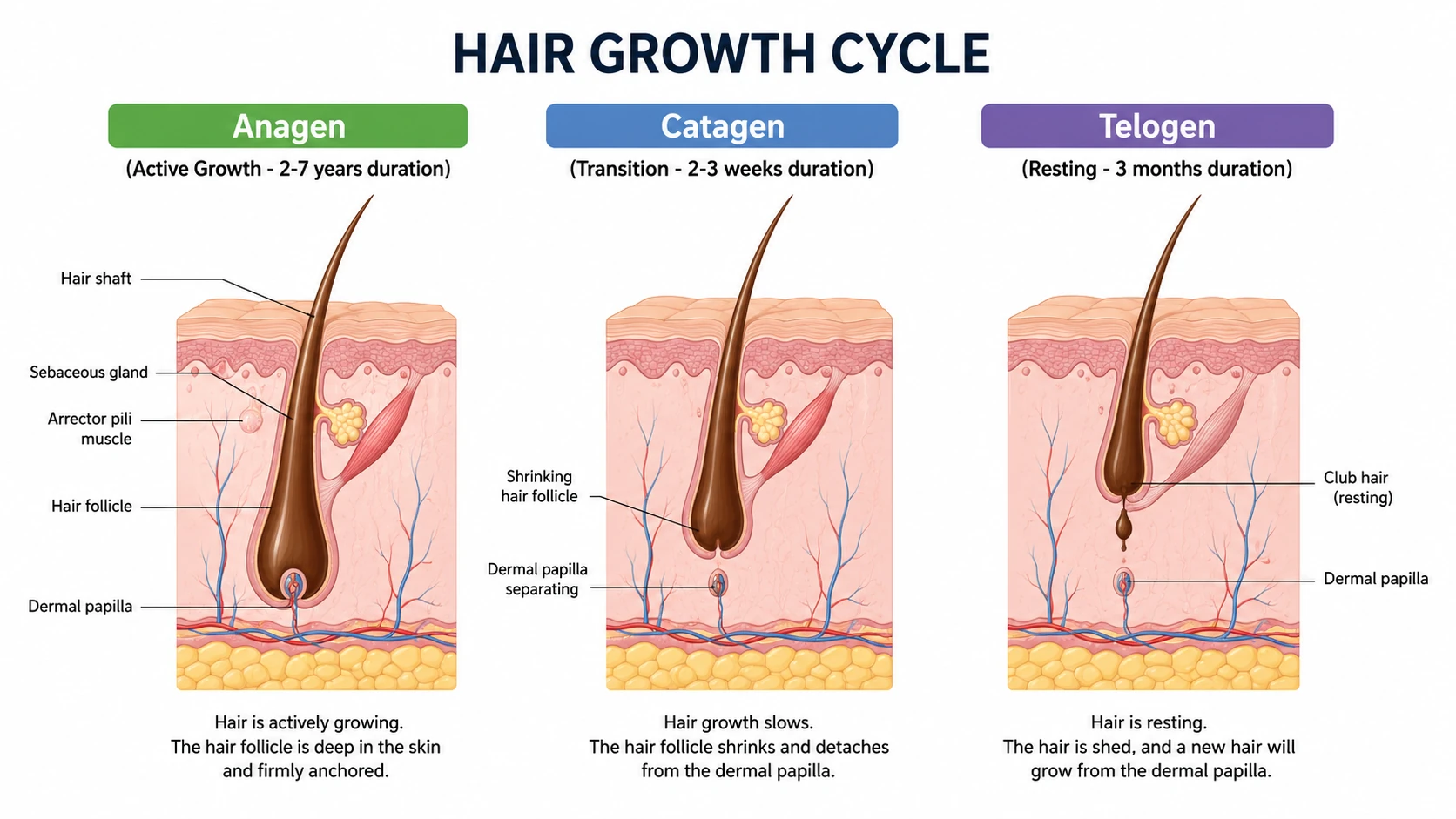
The leading explanation is telogen effluvium: a stressor pushes more hairs than usual into the resting phase, and they shed a few months later. The hair follicle cycles through growth (anagen), a brief transition (catagen) and rest (telogen), after which the hair falls and a new one starts. About 9% of scalp hairs are normally resting at any time.8 A trigger can move many more follicles into rest at once, and the loss shows up weeks later when those hairs fall.

The British Association of Dermatologists lists marked weight loss and extreme dieting among the common triggers, alongside childbirth, severe illness, surgery, major stress and starting new medicines.6 Weight loss injections combine several of these at once: fast weight loss, a sharply reduced appetite and, for some people, too little protein or iron.
A 2026 review concluded that the predominant mechanism is telogen effluvium secondary to rapid weight loss and caloric restriction. It also noted that direct effects on the follicle, hormonal shifts and nutritional gaps may contribute.9 Another 2026 review proposes that these drugs may change the fat tissue around follicles, but that remains a hypothesis awaiting validation.12 We would not describe any of this as settled. The evidence supports a plausible, mainstream mechanism that fits the timing, not a proven one.
The same pattern after bariatric surgery
Bariatric surgery gives the clearest picture of weight-loss shedding, because the weight loss is rapid and hair can be tracked from a known date. A 2025 meta-analysis of 41 articles and 7,044 patients put the incidence of hair loss after metabolic and bariatric surgery at 47%.10 In a 2026 prospective cohort of 261 patients, hair loss scores peaked at three months and improved by six. Falling iron levels were strongly associated with more hair loss, and the authors described telogen effluvium as a temporary and reversible complication with appropriate supplementation.11
Surgery is a bigger and faster change than injections, and the 47% figure is far higher than the 3% to 5% seen with the drugs, so the two should not be equated. What carries over is the shape: a trigger, a delay of about three months, then recovery, with iron status mattering along the way.
How long does weight-loss hair shedding last, and does it grow back?
Shedding usually begins around three months after the trigger and settles within about three to six months, and the hair usually grows back. The British Association of Dermatologists says telogen effluvium “can occur around 3 months after a trigger”, that the shedding phase lasts around three to six months, and that it usually resolves fully without treatment, although volume and thickness may take many months to return to normal.6
- Trigger (months 0 to 3). Rapid weight loss, a calorie or protein shortfall, or a dose increase with heavy weight loss. Nothing visible yet.
- Shedding (about months 3 to 6). More hair in the shower, brush and plughole. The scalp does not usually look bald, but the ponytail or parting may feel thinner.
- Recovery (from about month 6). Shedding settles and short new hairs appear, often around the hairline. Full density can take many more months.
- Review at six months. If shedding is still going, or a pattern is emerging, see your GP. The BAD describes telogen effluvium lasting more than six months as chronic.6
One caution about Mounjaro hair loss and the “recovered while on continued treatment” wording in the product information: it describes what trial participants experienced, not a promise for any individual. Some people recover more slowly, particularly if weight is still falling fast or nutrition stays poor.
What helps with hair loss on weight loss injections?
The sensible steps are to protect protein and iron intake, rule out other causes with your GP, and talk to your prescriber about the pace of weight loss. None of these is a quick fix, because the hairs that are going to shed have already moved into the resting phase. They are about removing what keeps the cycle disturbed and giving regrowth the best chance.
- Protein. A 2026 dermatology review suggests clinicians aim for 1.2 to 2.0 g of protein per kg per day, based on adjusted body weight.9 That is one review’s suggestion, not a UK guideline, and the right amount depends on your health and kidney function, so ask your prescriber, GP or a dietitian what suits you. Reduced appetite on these medicines makes it easy to under-eat protein without noticing.
- Iron and other blood tests. Iron deficiency is a recognised cause of shedding and can make telogen effluvium recur if left untreated.6 In the bariatric cohort, lower iron went hand in hand with more hair loss.11 Ask your GP about blood tests, usually iron status (often measured as ferritin) and thyroid function. Do not start high-dose iron supplements without a result.
- Rate of loss. If weight is falling very quickly, or you are eating far too little, speak to the prescriber who manages your dose. They can review the pace, your intake and whether the dose suits you. Please do not stop or change a prescribed medicine on your own.
- Gentle hair care. The BAD advises avoiding harsh brushing, heat tools, bleaching and tight hairstyles, and notes that smoking can worsen hair loss.6
- Be wary of quick fixes. The BAD recommends a balanced diet with iron and protein, suggests supplements only if your diet is restricted, and says medication does not speed regrowth in telogen effluvium.6
Is it telogen effluvium or something else? When weight loss unmasks pattern hair loss
Not all thinning after weight loss is simple shedding. Sometimes the event brings forward pattern hair loss that was already developing. Androgenetic alopecia is extremely common, affecting at least 80% of men and about 50% of women by age 70, and early thinning can go unnoticed until a shedding episode makes it obvious.13 The 2026 systematic review noted that both androgenetic alopecia and telogen effluvium were reported among people using these drugs.4
| Pattern | What you notice | Typical timing | Sensible next step |
|---|---|---|---|
| Telogen effluvium | Sudden, all-over shedding; hair looks thinner overall | Starts about 3 months after a trigger; settles in about 3 to 6 months | GP review, blood tests, nutrition, time |
| Pattern hair loss (unmasked) | Widening parting, crown thinning or receding temples that persist | Gradual; does not settle after 6 months | Doctor’s assessment; established medical treatments first |
| Both together | A shedding wave on top of an existing pattern | Shedding settles, but thinning in the pattern area remains | Wait for the shedding to settle, then reassess the pattern |
| Patchy or scarring loss | Round bald patches, or smooth, shiny, sore or scaly skin | Any time | See a GP or dermatologist promptly; this is not shedding |
Likely just shedding if
- It began a few months after rapid weight loss
- Hair is falling evenly across the whole scalp
- Your parting and hairline look the same shape, only thinner
- There are short new hairs growing back
See a doctor first if
- Shedding continues beyond six months
- You see round patches, redness, scaling, soreness or smooth bald skin
- Thinning is concentrated at the temples, crown or parting
- You have other symptoms such as fatigue, heavy periods or feeling cold
Is PRP the answer for weight loss injection hair loss?
No, PRP is not the first answer for Mounjaro hair loss or other drug-related or weight-related shedding. Telogen effluvium is a temporary disturbance of the hair cycle, and it generally recovers once the trigger settles. Injecting a scalp in the middle of a shedding wave does not address the cause, and we would not recommend starting PRP for it. We are not aware of robust trial evidence that PRP helps weight-loss-related shedding, and the first step is always to establish what type of hair loss you have.
PRP can be relevant later, and only in one situation: the shedding has settled and pattern thinning is still there. That is a different condition with a different evidence base. Across large analyses, PRP gives a modest average gain in hair density in androgenetic alopecia, on low-certainty evidence, and it is not a replacement for established medical treatment.14 Our guide to whether PRP works for hair loss covers that in detail, and our PRP hair treatment in Bedford page explains how Dr Nick assesses and plans treatment.
If you are unsure which situation you are in, our guide to how much hair shedding is normal is a good place to calibrate, and our hair loss treatment guide compares the options. We do not prescribe or supply weight loss injections; decisions about those medicines belong with your prescriber.
Free 2-minute check
Is it shedding, or is it pattern thinning?
Our Hair Growth Potential check asks seven quick questions. If you describe sudden, all-over shedding, it does not give you a score. It tells you the shedding needs a doctor’s assessment first. If your answers point to gradual pattern thinning, it shows what the clinical evidence suggests for someone with a similar profile, and it asks about recent crash diets, major illness or other events that can cause shedding.
Check your hair growth potential →Frequently asked questions
How much weight do I have to lose before hair loss starts?
There is no threshold we can quote from verified data. The semaglutide product information says hair loss was reported more often in people who lost 20% or more of their body weight, and trial rates rose with dose.2 Speed of loss and nutrition probably matter as well as the total.
Will my hair grow back if I stay on the injection?
Often, yes. The UK product information for both drugs says most affected patients recovered while continuing treatment.1,2 If you are worried about the shedding, talk to your prescriber rather than stopping the medicine.
Is Mounjaro hair loss from the drug itself or from losing weight?
That is not yet known. Weight loss alone can cause telogen effluvium, so it is the favoured explanation, but a direct effect of the drugs on the follicle has been proposed and not excluded.5,9,12
Should I take biotin or hair vitamins?
Supplements are not a substitute for finding the cause. The BAD suggests considering them if your diet is restricted, and iron treatment should be guided by a blood test.6 Your GP or a dietitian can advise on what is worth taking.
Can I use minoxidil for weight-loss shedding?
Minoxidil is an established treatment for pattern hair loss, not for telogen effluvium, and the BAD notes that medication does not speed regrowth in telogen effluvium.6 Whether it suits you is a question for your GP or a doctor, especially if you have other health conditions.
When should I see a doctor about hair loss on these injections?
See your GP if shedding is heavy, lasts beyond about six months, comes with patchy or sore areas, or is accompanied by tiredness or other symptoms. The NHS advises seeing a GP if you are worried about your hair loss.15
References
- Eli Lilly and Company Limited. Mounjaro KwikPen (tirzepatide) solution for injection in pre-filled pen: Summary of Product Characteristics, section 4.8 (hair loss, weight management). Electronic Medicines Compendium; text revised 29 August 2026. medicines.org.uk/emc/product/15484/smpc
- Novo Nordisk Limited. Wegovy (semaglutide) solution for injection in pre-filled pen: Summary of Product Characteristics, section 4.8 (hair loss). Electronic Medicines Compendium; text revised 09/2026. medicines.org.uk/emc/product/102093/smpc
- Cheng PL, Chang HC. Glucagon-like peptide-1 receptor agonists and hair loss: a systematic review and meta-analysis. Diabetes Res Clin Pract. 2026;237:113333. doi:10.1016/j.diabres.2026.113333
- Gupta AK, Teasell EM, Economopoulos V, Mirmirani P. GLP-1 therapies and hair loss: a systematic review of current evidence and implications for counseling. Sci Prog. 2026;109(2):368504261444578. doi:10.1177/00368504261444578
- Piraccini BM, Vañó-Galván S, Blume-Peytavi U, Ribet V, Mengeaud V. Hair loss in patients on glucagon-like peptide 1 receptor agonists: understanding risks and managing outcomes. Dermatol Ther (Heidelb). 2026;16(7):3345–3360. doi:10.1007/s13555-026-01792-0
- British Association of Dermatologists. Telogen effluvium (patient information; updated October 2025). skinhealthinfo.org.uk/condition/telogen-effluvium
- Jastreboff AM, Aronne LJ, Ahmad NN, et al. Tirzepatide once weekly for the treatment of obesity (SURMOUNT-1). N Engl J Med. 2022;387(3):205–216. doi:10.1056/NEJMoa2206038
- Natarelli N, Gahoonia N, Sivamani RK. Integrative and mechanistic approach to the hair growth cycle and hair loss. J Clin Med. 2023;12(3):893. doi:10.3390/jcm12030893
- Bridges AG, Jackson T. Hair and scalp effects of GLP-1 receptor agonists in practice. Clin Dermatol. 2026 (online ahead of print). doi:10.1016/j.clindermatol.2026.09.017
- Taghizadeh N, Salhab H, Alirezaei A, et al. Hair loss and metabolic and bariatric surgery: an updated systematic review and meta-analysis. Obes Surg. 2025;35(6):2370–2380. doi:10.1007/s11695-025-07903-8
- Chinisaz F, Maleki T, Najjari K, Miratashi Yazdi SA. Comparative analysis of postoperative hair loss and micronutrient deficiencies after one-anastomosis gastric bypass versus sleeve gastrectomy. Obes Surg. 2026;36(4):1804–1813. doi:10.1007/s11695-026-08597-2
- Gupta AK, Kaur J, Piguet V, Mirmirani P. Adipocytes as a mechanistic link between incretin-based therapies and hair loss. Biology (Basel). 2026;15(18):1642. doi:10.3390/biology15181642
- Devjani S, Ezemma O, Kelley KJ, Stratton E, Senna M. Androgenetic alopecia: therapy update. Drugs. 2023;83(8):701–715. doi:10.1007/s40265-023-01880-x
- Kieling L, Konzen AT, Zanella RK, Valente DS. Is autologous platelet-rich plasma capable of increasing hair density in patients with androgenic alopecia? A systematic review and meta-analysis of randomized clinical trials. An Bras Dermatol. 2024;99(6):847–862. doi:10.1016/j.abd.2024.01.002
- NHS. Hair loss. nhs.uk/conditions/hair-loss
This article is for general information and does not replace a personal consultation or advice from your prescriber or GP. Do not stop, start or change any prescribed medicine without speaking to the clinician who prescribes it. Rejuvena does not supply weight loss injections. Hair loss has many causes, and an accurate diagnosis comes first.