Actinic Keratosis Treatment in Bedford
A rough, scaly patch of sun-damaged skin that is genuinely pre-malignant: a small proportion can, left untreated, progress to skin cancer. Dr Nick examines every lesion, treats suitable ones, and refers appropriately when a patch looks suspicious. Honest, medical care, not a cosmetic quick-fix.
Actinic keratosis is a rough, scaly patch of sun-damaged skin, and unlike most skin growths, it is genuinely pre-malignant: a small proportion of patches can, left untreated, progress to a skin cancer called squamous cell carcinoma. That risk is real but small, and estimates of exactly how small vary considerably in the medical literature.
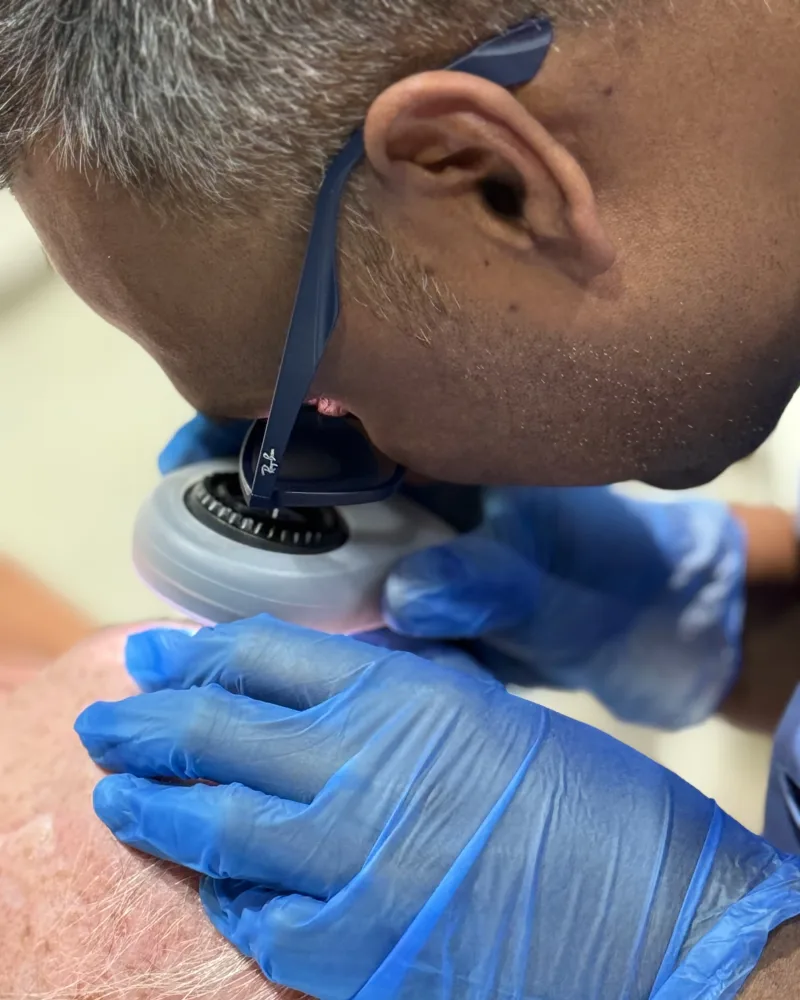
What is actinic keratosis?
Actinic keratosis (AK) (also called solar keratosis, the two names are interchangeable) is a common, rough, dry, scaly patch of skin caused by years of cumulative ultraviolet (UV) exposure from the sun and sunbeds. It is regarded as pre-cancerous: the surface skin cells (keratinocytes) have become abnormal, and DermNetNZ describes it as “an early form of cutaneous squamous cell carcinoma.” It appears on the sites that catch the most sun over a lifetime: the balding scalp, forehead and face, ears, lower lip, and the backs of the hands and forearms.
Prevalence estimates vary meaningfully by population and study. DermNetNZ puts UK-relevant prevalence at around 25% of people over 60 in temperate regions such as southern Ireland and northwest England; a UK clinician reference (Patient.info) cites 19–24% of the UK population over 60. Because AK marks widespread “field” sun damage, people often have several and develop new ones over time.
Actinic keratosis vs seborrhoeic keratosis vs age/sun spots
These names are easy to muddle, and the difference matters because one is pre-cancerous and the others are not. Actinic (solar) keratosis is the UV-driven, pre-cancerous, rough patch described above. Seborrhoeic keratosis is a completely different, benign, waxy “stuck-on” growth, not caused by sun damage and not pre-cancerous, though it can be confused with an AK on sight (see our seborrhoeic keratosis page). Age and sun spots (solar lentigines) are flat, smooth, benign brown pigmentation from the same UV-damage family, but they are cosmetic, not pre-cancerous. Telling these apart reliably is a clinical judgement, not a job for a photo or a home kit.
What causes actinic keratosis?
The dominant cause is cumulative UV radiation over many years: lifetime sun exposure, sunbathing, sunbed use, and outdoor work or recreation. UV damages the DNA of skin cells, producing the abnormal keratinocytes that create the scaly surface. Because the surrounding skin has also been UV-damaged (“field change”), AKs tend to be multiple and recurrent. Fair skin, a history of sunburn, older age, and immunosuppression (organ transplant, chemotherapy, HIV) all raise the risk.
What an actinic keratosis can look like
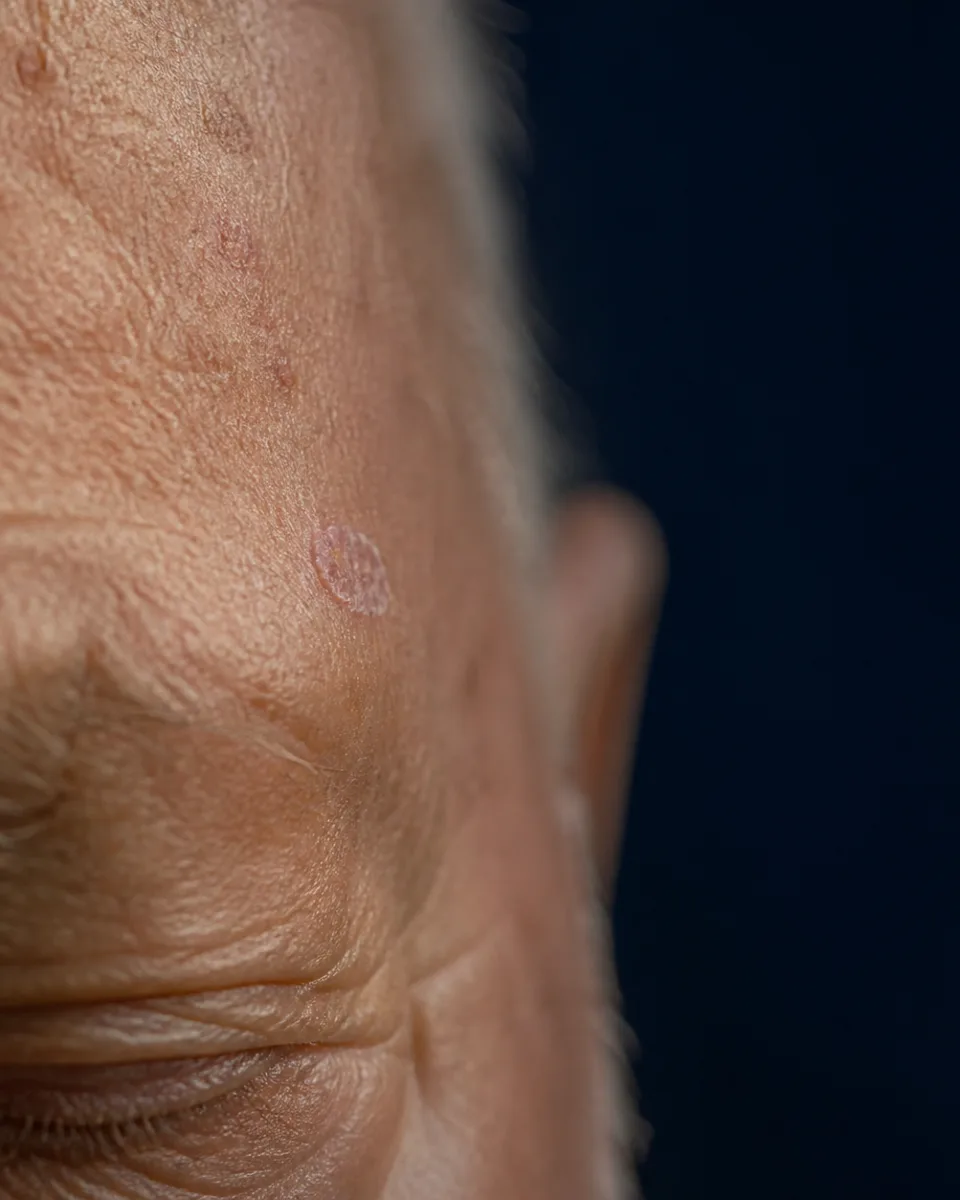
Actinic keratosis often feels rough or scaly on sun-exposed skin. Persistent or changing patches need assessment because photographs alone cannot confirm what a lesion is.

- Surface view
A persistent dry, rough or scaly patch on sun-exposed skin.
- Skin-layer view
Scale and abnormal keratinocyte growth are shown within the epidermal layer.
Is actinic keratosis dangerous? When to get it checked
Actinic keratosis is not cancer. It is confirmed pre-malignant, meaning a small proportion of patches can, left untreated, progress into a squamous cell carcinoma (SCC), a form of skin cancer. This is the single most important fact on this page, so it’s worth being precise about what “small” actually means.
The published progression-risk figures genuinely vary, and we’re not going to pretend otherwise by quoting one convenient number. The per-lesion annual transformation rate reported in the medical literature spans roughly 0.025% to 16% per lesion per year across different studies (Reinehr & Bakos, 2019; Patient.info professional reference).
Clinicians more often communicate cumulative risk instead: roughly 10% over 10 years for an average patient, rising toward 10–20% at 10 years for immunosuppressed or higher-risk patients, or 10–15% at some point for a patient with more than 10 AKs (DermNetNZ). The British Association of Dermatologists’ own patient leaflet deliberately avoids quoting a number at all, describing only “a very small risk that the patches could progress”, and NHS.uk uses the same careful language: “there’s a small chance the patches could become skin cancer.”
At Rejuvena, every lesion is examined by Dr Nick (MBBS, MRCGP, Diploma in Dermatology, GMC 6072251) before anything is treated. A clearly benign-looking AK may be suitable for in-clinic treatment; a suspicious one is referred appropriately, including via the two-week-wait pathway where indicated, rather than frozen or lasered on the day.
Lump, tender or bleeding
Develops into a lump, becomes tender, or starts to bleed.
Grows fast or thickens
Grows quickly, or thickens into a hard “horn”.
Ulcerates or won’t heal
Breaks down or fails to heal over time.
On the lip
Appears on the lip: a higher-risk site.
The BAD is explicit that any of these “could indicate the early onset of skin cancer.” NICE guideline NG12 (“Suspected cancer: recognition and referral”) recommends clinicians consider a two-week-wait urgent cancer pathway referral for a skin lesion that raises suspicion of squamous cell carcinoma. If a patch is behaving like that, the right next step is that pathway, not a cosmetic appointment.
Can I get actinic keratosis treated on the NHS?
Yes, and this is worth being clear about, because it’s genuinely different from how the NHS treats purely cosmetic skin lesions. Because AK is pre-malignant, NHS.uk publishes it as a standard medical condition with a normal GP/dermatology treatment pathway: topical creams and gels, cryotherapy, surgical removal, and photodynamic therapy in some hospitals, escalating to dermatology referral where needed. It is not treated as an elective, cosmetic option.
That’s a different category from the NHS’s general position on benign, purely cosmetic lesions, which is restrictive: local NHS commissioning policies typically state that clinically benign lesions “should not be removed on purely cosmetic grounds,” reserving funding for lesions with features such as suspected dysplasia or malignancy. AK’s pre-malignant status is precisely the kind of feature that qualifies it for NHS-funded care, rather than excluding it.
In practice: if you have a patch that’s genuinely pre-malignant and needs treating, your GP is a reasonable, free first step. A private assessment such as ours is most useful when you want a fast, doctor-led opinion on a patch you’re worried about, or lesion-directed treatment for a small number of discrete, confirmed-benign-looking AKs: always after the same doctor-led assessment, and with the same readiness to refer if anything looks more serious.
Every case starts with a cosmetic skin lesion assessment with Dr Nick: £50, where each lesion is examined, and anything suspicious is identified before any treatment decision is made. Lesion-directed treatment for suitable, confirmed-benign-looking AKs starts from £150, priced by lesion size and number. Field-directed treatment (creams, photodynamic therapy) for widespread sun damage sits on the NHS medical pathway described above, not this private fee list.
How we assess and manage actinic keratosis at Rejuvena
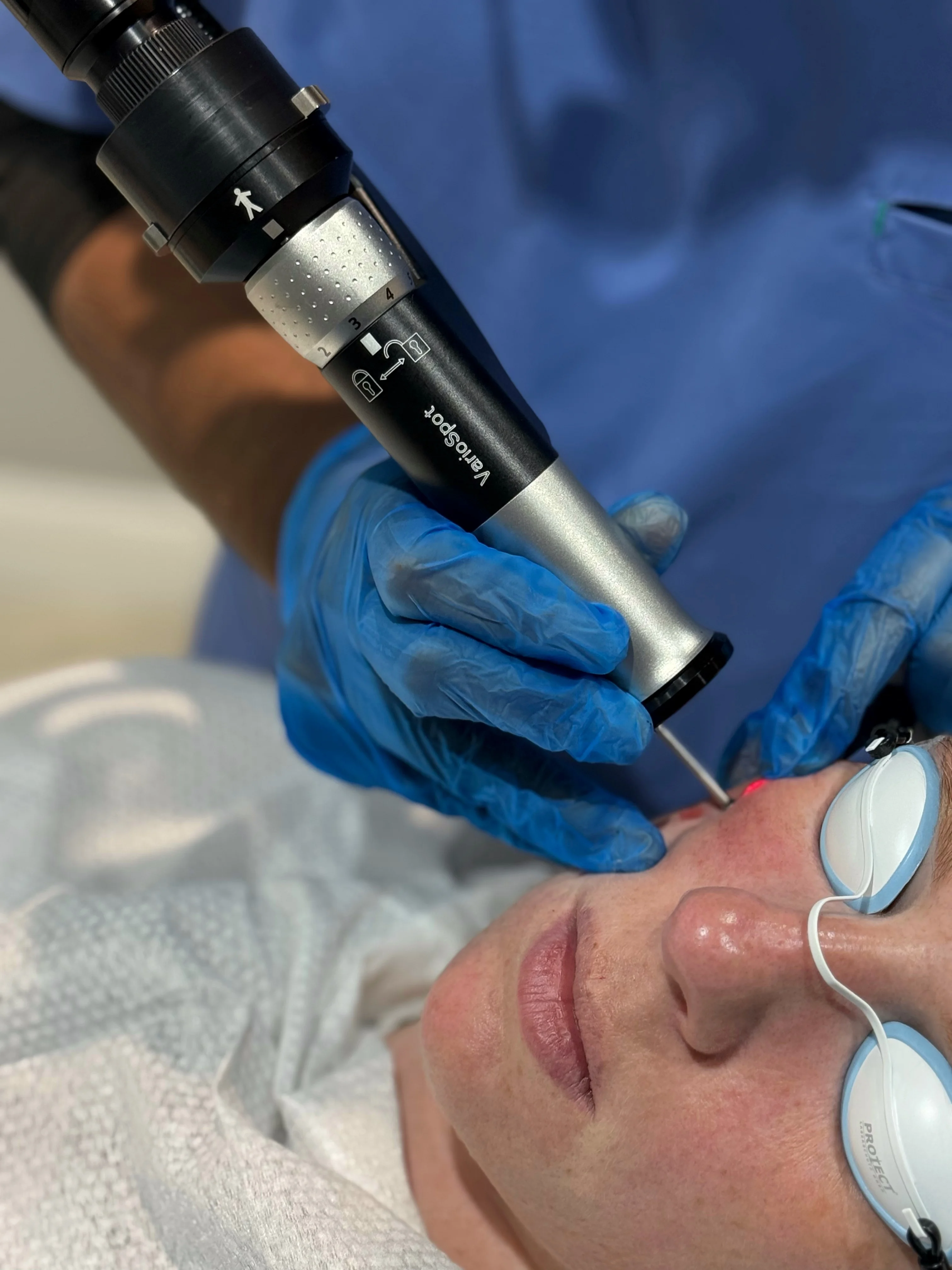
Assessment always comes first. Dr Nick examines the lesion and the surrounding sun-damaged “field”, often with a dermatoscope, to judge whether it looks like a straightforward AK or needs further investigation. For a small number of discrete, clearly benign-looking lesions in accessible sites, lesion-directed cryotherapy (freezing) or laser removal may then be appropriate. Neither is offered for suspicious or undiagnosed lesions, and no treatment “cures” the underlying sun damage: new AKs can appear over time, so ongoing monitoring and sun protection remain part of the plan.
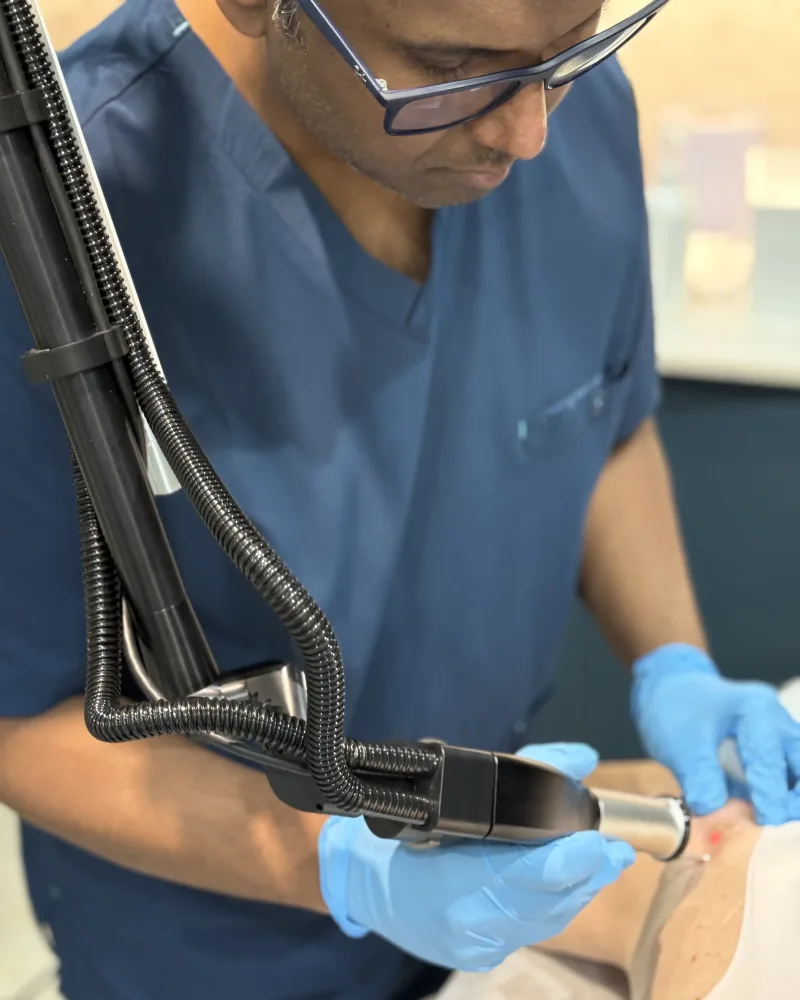
Cryotherapy
Lesion-directed freezing with liquid nitrogen for discrete, confirmed-benign AKs. Full procedure detail and healing timeline.
Learn more →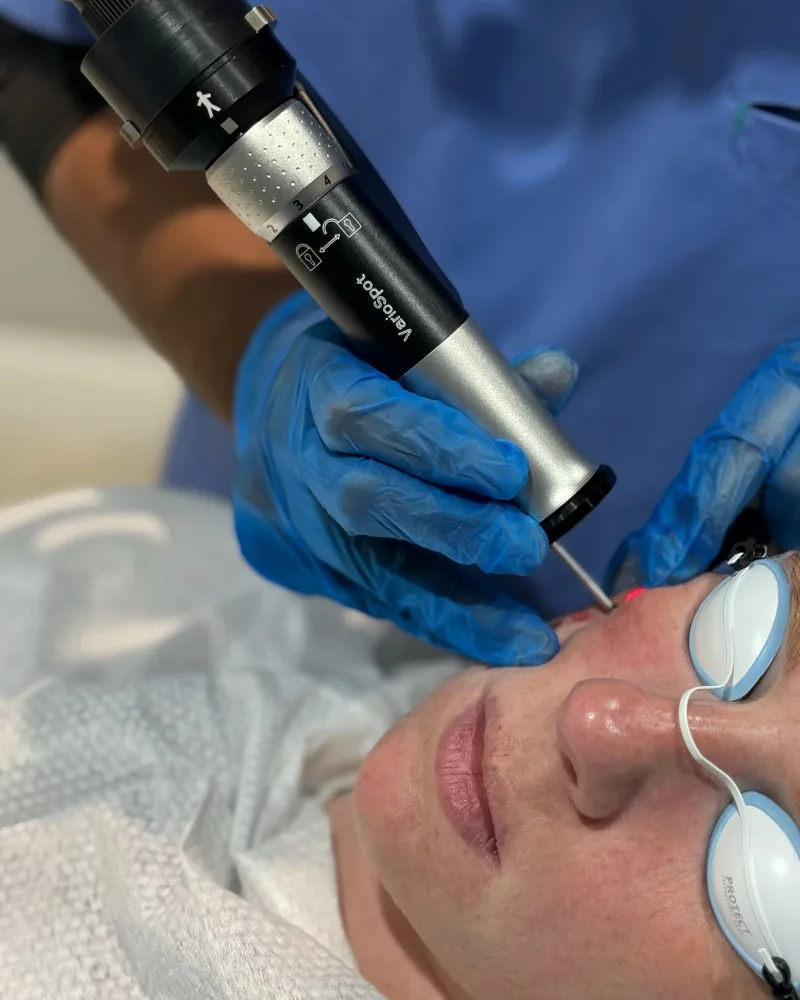
Laser Skin Lesion Removal
An alternative lesion-directed option for selected, confirmed-benign sun-damage lesions. Full procedure detail and healing timeline.
Learn more →See all doctor-led dermatology in Bedford → · Age & sun spots · Mole assessment & removal
Why choose Rejuvena for actinic keratosis in Bedford?
Doctor-led, never blind treatment
Dr Nick (MBBS, MRCGP, Dip Dermatology, GMC 6072251) assesses every lesion, treats suitable ones, and refers appropriately when a patch looks suspicious.
Honest about a pre-cancerous lesion
We explain the small but real risk of progression to squamous cell carcinoma plainly, and that sun damage is managed and monitored, not “cured”.
NHS-aware, not NHS-avoidant
Because AK is pre-malignant, we are upfront that a free NHS route often applies: private care here is for a fast opinion or discrete lesion-directed treatment.
Bedford clinic, peace of mind
At 52 Thor Drive, MK41 0WP. Come in for an honest assessment of a worrying patch: reassurance if it’s benign, the right referral if it isn’t.
Verified Google reviews
What our patients say
5.0from 161 Google reviews
I recently had a lesion removed from my cheek. The pigmented lesion had bothered me for years. I’m glad I finally decided to do something about it. I was quite nervous on the day, but Dr. Nick and Lana were so careful and reassuring — they really put me at ease. The procedure was quick and comfortable, and I feel so much better for having it done. I did a lot of research before I chose this clinic for my treatment. The clinic’s medical dermatology focus made me feel confident I would be in the right hands. I’m really grateful for the care I received and I would definitely recommend this clinic.
Rejuvena repliedThank you so much for your skin review Dupinder 🙏
Read this review on Google (opens in a new tab)I had lots of skin lesions on both hands and Dr Nick and Lana have been great treating me.I will definitely be returning for any future treatments and highly recommend seeing Dr Nick.Great service and facilities thanks again.
Rejuvena repliedAww! Thank you Gavin for your kind review. It was a great pleasure having you in our clinic and we look forward to seeing you in the future too. 😊🙏
Read this review on Google (opens in a new tab)A Friendly, warm welcome as usual. Clinic is spotlessly clean. Great to know you're in the hands of a true professional.
Rejuvena repliedThank you very much Pete 🤗🙏
Read this review on Google (opens in a new tab)Dr Nick and Lana made me feel welcomed and comfortable in their care. I would highly recommend for their wealth of knowledge, kindness, skill and gentle hands.
Rejuvena repliedThank you Silvana for your kind review, glad to hear, you felt well taken care of. ☺️🙏🤗
Read this review on Google (opens in a new tab)I’ve been seeing Dr Nick and Lana for almost a year now. They have provided me with such a comforting experience and given exceptional results. Their Salon isn’t local for me, but I chose to keep seeing Dr Nick because of his professionalism and extra care he takes to my individual needs. I’m always provided with a detailed, realistic outcome before and after any treatment, by being explained any possible risks or benefits, which helped me a lot in making decisions. Seeing Dr Nick has helped changed my skin and I’m grateful for how attentive and skilled he was during my treatment. After any treatment i’ve always been followed up with the recovery, aftercare advice or any worries I had, which helped me feel at ease. I was understandably nervous for my treatment before seeing Dr Nick and Lana, but it was a great joy seeing them as they are always the most genuine and welcoming towards me, anytime I visit I feel very safe in the hands of Dr Nick.
Rejuvena repliedAww Ruby, thank you very much for your kind review. It made us emotional reading it. We are glad to hear you feel you have received good service from us. It’s always a pleasure see
Read this review on Google (opens in a new tab)I have been visiting Lana’s clinic for approximately one year, and each experience has been exceptional. I always leave feeling happy, confident, and fully satisfied with the quality of her work. Lana is highly skilled, attentive, and genuinely cares about her clients, ensuring that every detail is addressed with great care. I wholeheartedly recommend her services. If you are considering booking an appointment, do not hesitate—you will be in excellent hands!
Rejuvena repliedThank you very much for your sweetest review Roxana. It means a lot to me that you like our services ☺️🙏🤗🥺
Read this review on Google (opens in a new tab)Every review above is published on Google. Tap any card to read it there.
Actinic keratosis FAQs in Bedford
Is actinic keratosis a form of skin cancer?
What does actinic keratosis look like and where does it appear?
Can actinic keratosis go away on its own, or does it always need treatment?
How is actinic keratosis treated, and what is cryotherapy?
Will actinic keratosis come back after treatment?
When should I worry, and when does Dr Nick refer instead of treat?
What’s the difference between actinic keratosis and a seborrhoeic keratosis or age spot?
How much does actinic keratosis assessment and treatment cost in Bedford?
Book an actinic keratosis assessment in Bedford
Worried about a rough, scaly or non-healing patch? Speak with Dr Nick’s team at Rejuvena Bedford for an honest, doctor-led assessment: reassurance if it’s benign, the right treatment if it’s suitable, and the right referral if it isn’t.